Microbiome & Metabolites
Thirty Trillion Microbial Partners
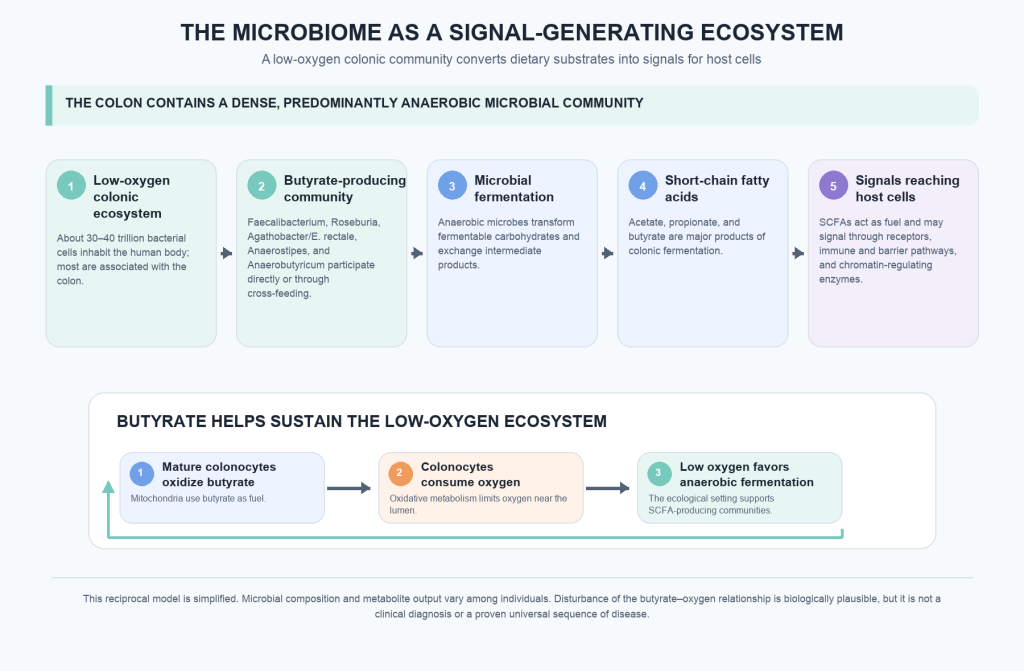
The human body contains approximately 30–40 trillion bacterial cells, with the greatest concentration located in the colon. These microorganisms form a complex ecosystem that transforms dietary material into compounds capable of communicating with human cells.
The colon is a predominantly low-oxygen environment. This favors anaerobic microorganisms—microbes adapted to grow and ferment dietary substrates where very little oxygen is present.
This low-oxygen setting is important because it helps support the microbial production of short-chain fatty acids and connects the microbiome directly with colon-cell metabolism.
The Butyrate-Producing Community
Several groups of anaerobic bacteria contribute to butyrate production. Commonly studied examples include:
- Faecalibacterium prausnitzii
- Roseburia species
- Agathobacter rectalis, formerly called Eubacterium rectale
- Anaerostipes species
- Anaerobutyricum hallii, formerly called Eubacterium hallii
These organisms do not work in isolation. Some directly ferment dietary substrates, while others participate through cross-feeding—one microbial species produces acetate, lactate, or another intermediate that a different species uses to produce butyrate.
From Microbial Fermentation to Metabolites
When fermentable carbohydrates reach the colon, microbial communities transform them into metabolites. The principal short-chain fatty acids are:
- Acetate
- Propionate
- Butyrate
These compounds are more than fermentation by-products. They can serve as fuels and biological signals that connect microbial activity with colon-cell metabolism, barrier function, immune regulation, and gene activity.
Butyrate Helps Preserve the Low-Oxygen Environment
Healthy, mature colonocytes can use butyrate as an important oxidative fuel. As their mitochondria metabolize butyrate, the cells consume oxygen near the intestinal surface.
This oxygen consumption helps prevent excess oxygen from reaching the colonic lumen, supporting the low-oxygen environment preferred by anaerobic, short-chain-fatty-acid-producing organisms.
The relationship is therefore reciprocal:
Anaerobic microbes produce butyrate → colonocytes metabolize butyrate and consume oxygen → the low-oxygen environment continues to support anaerobic microbes.
Disruption of this relationship may alter microbial metabolism and increase the availability of oxygen or other respiratory substrates in the colon. This possibility becomes important later when we examine changes in colon-cell metabolism.
Metabolites Become Biological Signals
Short-chain fatty acids may communicate with host cells through several routes:
- Acting as metabolic fuels
- Activating cell-surface receptors
- Influencing intestinal barrier function
- Modulating immune and inflammatory pathways
- Interacting with enzymes involved in chromatin and gene regulation
Butyrate, for example, has demonstrated histone-deacetylase-inhibiting activity in experimental systems. Its effects nevertheless depend on concentration, tissue, cellular metabolic state, microbial ecology, and the health of the individual.
The EpiNutrition Connection
The microbiome can be understood as a signal-generating ecosystem. Its importance depends not only on which organisms are present, but also on what those organisms are doing and which metabolites they produce.
Through microbial metabolism, dietary substrates can become molecular signals capable of interacting with human cellular and epigenetic pathways.
These relationships do not establish that a particular microbiome prevents disease. They provide a biological framework for investigating how food, microbial metabolism, cellular activity, and gene regulation may be connected.