Health & Well-Being
From Biology to Better Health
The goal of EpiNutrition™ is not simply to explain how nutrition influences gene expression, but to demonstrate how these biological changes translate into measurable improvements in human health. Beneficial microbial metabolites support healthy cellular function, strengthen tissues, regulate immune responses, and help maintain the physiological systems that protect the body throughout life.
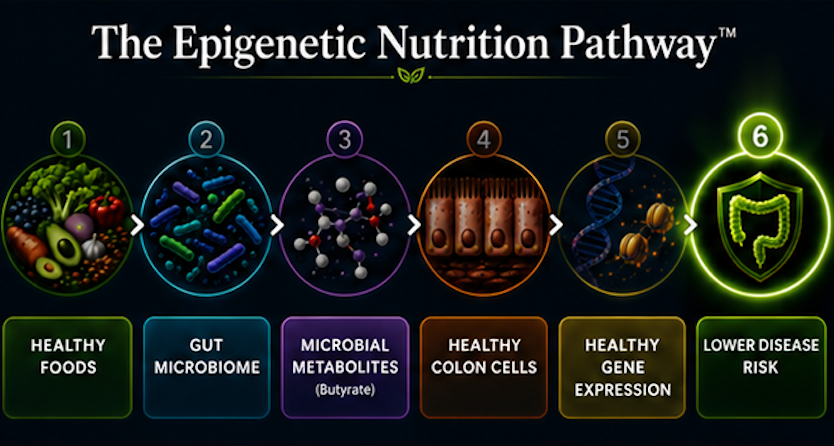
One of the strongest examples of this principle comes from studies of resistant starch, a dietary fiber that reaches the colon largely undigested and is fermented by beneficial bacteria to produce butyrate. Rather than acting directly on human cells, resistant starch first nourishes the gut microbiome, which then generates microbial metabolites that influence cellular metabolism and gene expression.
Human Evidence
The Australian Resistant Starch Studies
Among the most important human intervention studies are two Australian investigations that examined whether resistant starch could reduce the formation of colorectal adenomas and polyps in individuals at increased risk for colorectal cancer.
The AusFAP Study
The Australian Familial Adenomatous Polyposis (AusFAP) Study investigated whether resistant starch could reduce polyp development in patients with familial adenomatous polyposis (FAP), a condition characterized by the formation of hundreds of colorectal polyps.
Although resistant starch did not substantially reduce the total number of polyps, important biological effects were observed, including changes consistent with increased butyrate production and healthier epithelial function. These findings suggested that microbial fermentation may influence the biology of the colon even when dramatic changes in polyp counts are not immediately apparent.
The CAPP Study
The Colorectal Adenoma/Carcinoma Prevention Programme (CAPP) evaluated resistant starch supplementation in individuals with Lynch syndrome, an inherited disorder associated with a markedly increased risk of colorectal cancer.
Long-term follow-up demonstrated an unexpected and important finding. Although resistant starch had limited effects on colorectal cancer incidence, participants receiving resistant starch experienced a significant reduction in cancers occurring outside the colon, particularly cancers of the upper gastrointestinal tract. These observations support the concept that microbial metabolites generated within the colon can exert biological effects throughout the body.
Why These Studies Matter
These investigations illustrate an important principle of EpiNutrition™.
The goal of nutrition is not simply to change laboratory measurements or provide isolated nutrients. Instead, dietary fibers nourish beneficial microbial communities, increase production of metabolites such as butyrate, influence epigenetic regulation, and improve the biological environment in which cells function.
The benefits therefore begin long before disease develops. Healthy metabolism, balanced immune regulation, stronger epithelial barriers, and healthier patterns of gene expression create conditions that favor normal cellular function and long-term tissue health.
What This Means for You
Every meal represents an opportunity to influence biology.
Choosing foods rich in fermentable fiber does more than improve digestion. These foods nourish the gut microbiome, increase butyrate production, support healthy gene expression, and help maintain the physiological systems that protect the colon and the rest of the body.
The Australian resistant starch studies demonstrate that this pathway is not merely theoretical. Human intervention studies show that dietary changes capable of altering microbial metabolism can also influence clinically meaningful health outcomes, reinforcing the central principle of EpiNutrition™: healthy food choices shape biology, and healthy biology supports lifelong health.