Chapter 1
Healthy Foods: The Potential for Biological Information
For generations, nutrition has been described largely in terms of nutrients. We think about calories, protein, carbohydrate, fat, vitamins, minerals, and fiber. These remain essential ways of understanding food and health.
But food is chemically far more complex than its nutrition label suggests.
An apple contains carbohydrate, fiber, potassium, and vitamins, but it also contains numerous naturally occurring plant compounds. Berries contain anthocyanins and other polyphenols. Broccoli and other cruciferous vegetables contain glucosinolates. Oats, beans, lentils, whole grains, nuts, seeds, herbs, spices, tea, coffee, and many other plant foods contain their own complex mixtures of naturally occurring compounds.
A single whole food may contain hundreds or even thousands of chemical constituents.
Many of these substances help plants grow, defend themselves against environmental stress, communicate with their surroundings, attract pollinators, or protect themselves against insects and microorganisms. When we eat plants, we consume this chemical complexity along with their familiar nutrients.
This provides the starting point for Food as Information.
More Than Nutrients
A nutrition label is extremely useful, but it cannot describe everything contained within a food.
Consider blueberries. Their label might tell us how many calories, carbohydrates, grams of fiber, and vitamins they contain. It does not begin to describe the complete mixture of anthocyanins, flavonols, phenolic acids, and other phytochemicals naturally present in the fruit.
The same principle applies throughout the plant kingdom.
Whole grains contain fibers and resistant carbohydrates as well as phenolic compounds and other substances concentrated in the bran and germ. Legumes contain fermentable carbohydrates, resistant starch, polyphenols, minerals, and numerous other compounds. Cruciferous vegetables contain glucosinolates. Onions and garlic contain organosulfur compounds. Tomatoes contain carotenoids. Tea, cocoa, berries, herbs, and spices contain particularly diverse families of polyphenols.
These compounds are not interchangeable, nor should they all be assumed to have beneficial effects. Their importance depends on the food, the amount consumed, their chemical form, their availability, and what subsequently happens to them within the body.
The important point at this stage is simpler:
Food contains considerably more biological complexity than calories and essential nutrients alone.
Food Contains Potential
This leads to an important distinction.
Food itself should not be thought of as a set of instructions telling our cells what to do.
A serving of broccoli does not contain a message directing a particular gene to become active. A bowl of oatmeal does not instruct a colon cell to behave in a predetermined way. A blueberry does not arrive carrying a biological command.
Instead, foods contain potential.
They provide an enormous collection of chemical components that enter a living biological system when we eat them. Some will be absorbed. Some will be changed. Some will never reach human tissues at all. Others may eventually become biologically important.
The food provides the starting materials.
What happens to those materials is another story.
That distinction is central to the concept of Food as Information. It avoids the overly simplistic idea that individual foods directly control individual genes or determine health outcomes.
The relationship between food and human biology is much more interesting—and much more complex.
The Importance of the Whole Food
Foods are also not simply containers holding isolated chemicals.
They have structure.
A bean, oat kernel, blueberry, walnut, or broccoli floret contains its components within a physical food matrix. Fiber, starch, proteins, fats, micronutrients, phytochemicals, and water exist together within that structure.
Cooking, grinding, cooling, ripening, storage, and food processing can alter this structure. The physical form of a food can influence how quickly its components become available during digestion and where they ultimately travel within the gastrointestinal tract.
This is one reason why studying an isolated compound is not necessarily the same as studying the whole food from which it came.
The biological potential of food depends not only upon what is present, but also upon how it is packaged.
Diversity Creates Possibility
This chemical complexity provides another reason to think about dietary variety. Different foods bring different collections of potential components into the body.
Berries do not provide the same compounds as beans. Beans differ from broccoli. Broccoli differs from oats. Nuts differ from leafy vegetables. Herbs and spices introduce still other families of compounds.
A varied diet therefore exposes the human biological system to a much broader chemical environment than a diet built repeatedly from a small number of highly refined foods.
This does not mean that every meal must contain a particular collection of “superfoods.” Nor does it mean that more of every bioactive compound is necessarily better.
It means that food diversity creates biological possibility.
This is one reason dietary patterns emphasizing a variety of vegetables, fruits, legumes, whole grains, nuts, and seeds have attracted considerable scientific interest. Their importance may extend beyond supplying adequate amounts of individual nutrients.
They also provide chemical diversity.
The Same Food Does Not Always Mean the Same Thing
There is another important reason to describe food as potential rather than instruction.
People are different.
Two individuals can eat exactly the same meal and experience different biological responses. Age, genetics, digestive physiology, physical activity, medications, previous dietary patterns, and many other characteristics can influence what happens after food is eaten.
One particularly important source of variation is the intestinal microbiome—the enormous microbial ecosystem inhabiting the gastrointestinal tract.
The composition and activity of this ecosystem differ from person to person. As we will see in the next chapter, microorganisms can interact with food components in remarkably different ways.
Food therefore does not behave like computer code in which the same input always produces the same output.
It enters a living system. And living systems interpret what they receive.
That observation captures the central idea of this chapter.
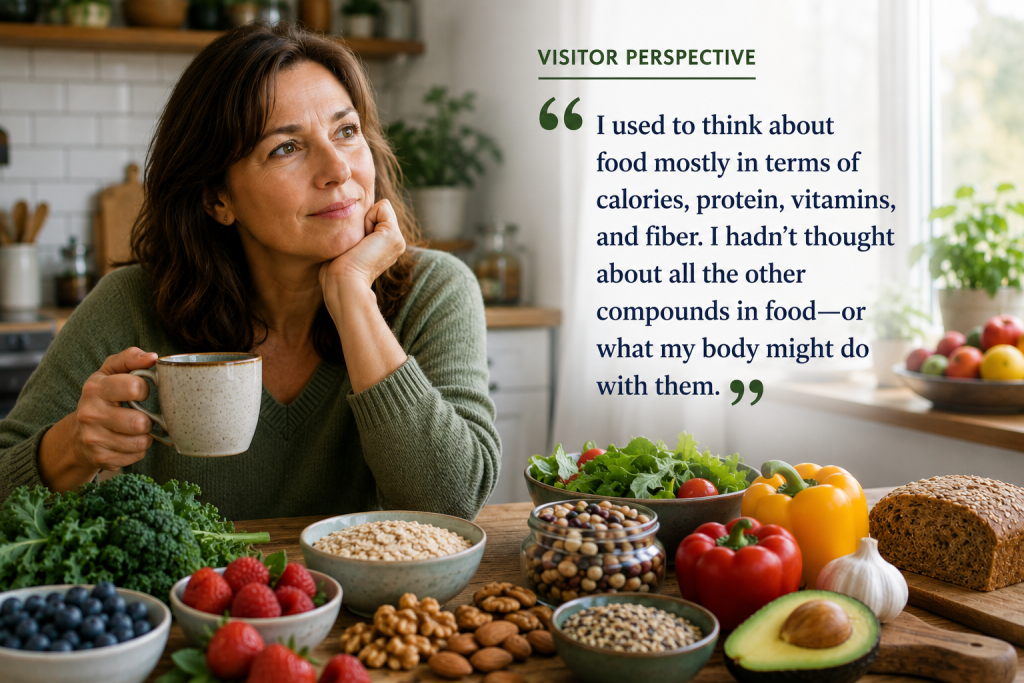
Healthy foods provide nutrients. They provide energy. They provide materials needed to build and maintain the body. But they also contain an extraordinary diversity of natural compounds. Those compounds represent biological potential.
Understanding what happens to that potential is where the Food as Information story really begins.
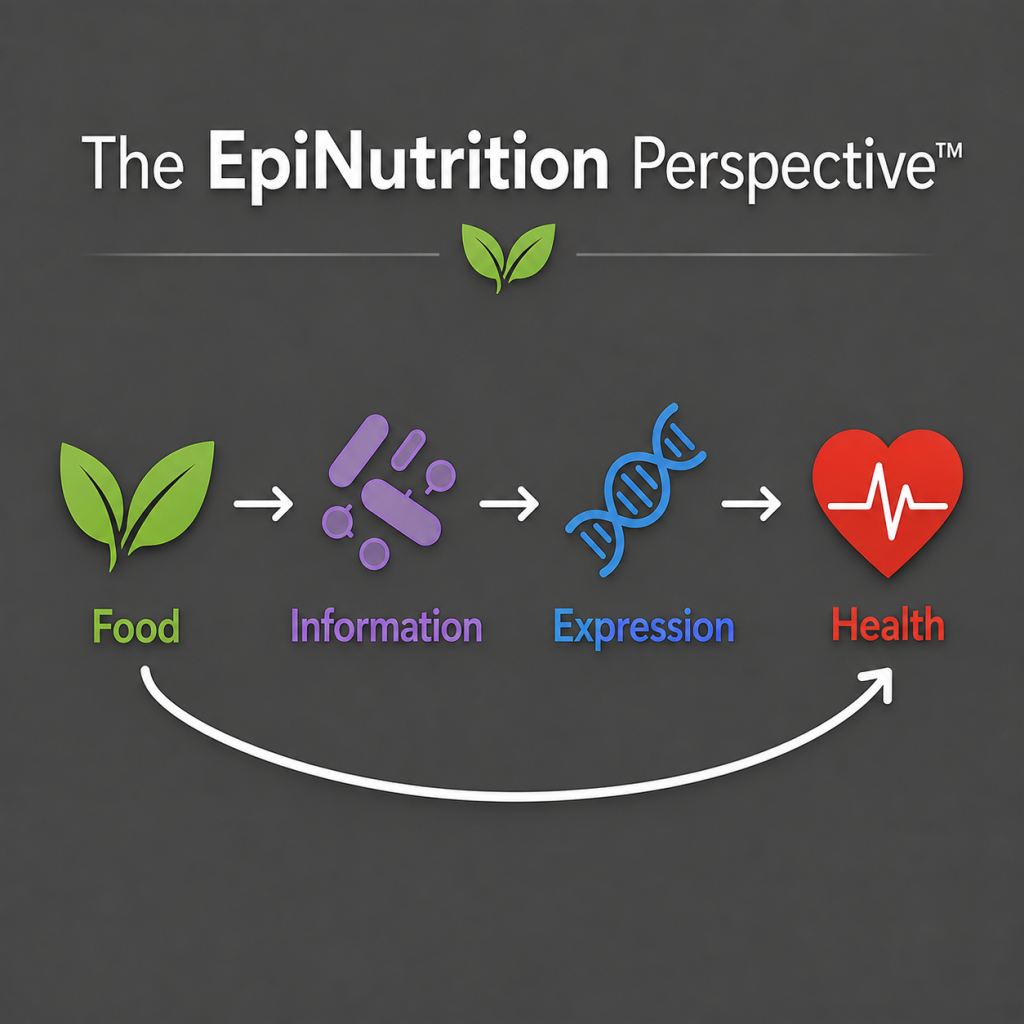
We do not need to think of food as medicine or as a collection of instructions for our genes. A more scientifically useful idea is that food provides possibilities.
Every meal introduces a complex collection of nutrients, fibers, phytochemicals, and other compounds into an equally complex human biological system.
The food supplies the raw materials.
The biology determines what happens next
Next: The Microbiome — The Information Processor
Before many components of food can become biologically meaningful, they encounter an extraordinary ecosystem living within us.
The intestinal microbiome is not simply a collection of bacteria. It is an active biochemical community capable of interacting with and transforming components of the foods we eat.
In Chapter 2, we will explore how the microbiome begins to unlock the biological potential contained within food.
Bibliography
- Liu RH. Health-promoting components of fruits and vegetables in the diet. Adv Nutr. 2013;4(3):384S–392S.
- Manach C, Scalbert A, Morand C, Rémésy C, Jiménez L. Polyphenols: food sources and bioavailability. Am J Clin Nutr. 2004;79(5):727–747.
- Crozier A, Jaganath IB, Clifford MN. Dietary phenolics: chemistry, bioavailability and effects on health. Nat Prod Rep. 2009;26(8):1001–1043.
- Del Rio D, Rodriguez-Mateos A, Spencer JPE, Tognolini M, Borges G, Crozier A. Dietary (poly)phenolics in human health: structures, bioavailability, and evidence of protective effects against chronic diseases. Antioxid Redox Signal. 2013;18(14):1818–1892.
- Weaver CM. Bioactive foods and ingredients for health. Adv Nutr. 2014;5(3):306S–311S.
- Parada J, Aguilera JM. Food microstructure affects the bioavailability of several nutrients. J Food Sci.2007;72(2)–R32.
- Grundy MML, Edwards CH, Mackie AR, Gidley MJ, Butterworth PJ, Ellis PR. Re-evaluation of the mechanisms of dietary fibre and implications for macronutrient bioaccessibility, digestion and postprandial metabolism. Br J Nutr.2016;116(5):816–833.
- Lampe JW. Interindividual differences in response to plant-based diets: implications for cancer risk. Am J Clin Nutr.2009;89(5):1553S–1557S.
- Johnson AJ, Vangay P, Al-Ghalith GA, et al. Daily sampling reveals personalized diet–microbiome associations in humans. Cell Host Microbe. 2019;25(6):789–802.e5.