
Benign Adenoma or Polyp
When an Abnormal Cell Population Becomes a Visible Lesion
A colorectal polyp is a growth that projects from, or develops along, the inner lining of the colon or rectum. “Polyp” is a descriptive term rather than a single diagnosis. Polyps differ in their microscopic structure, molecular features, and potential to progress.
An adenoma is a benign gland-forming tumor. Benign means that its abnormal cells remain confined to the tissue in which the lesion arose and have not invaded surrounding structures.
Although adenomas are not cancer, some are considered precancerous because a minority can acquire additional changes and progress toward malignancy over time.
Not All Polyps Are the Same
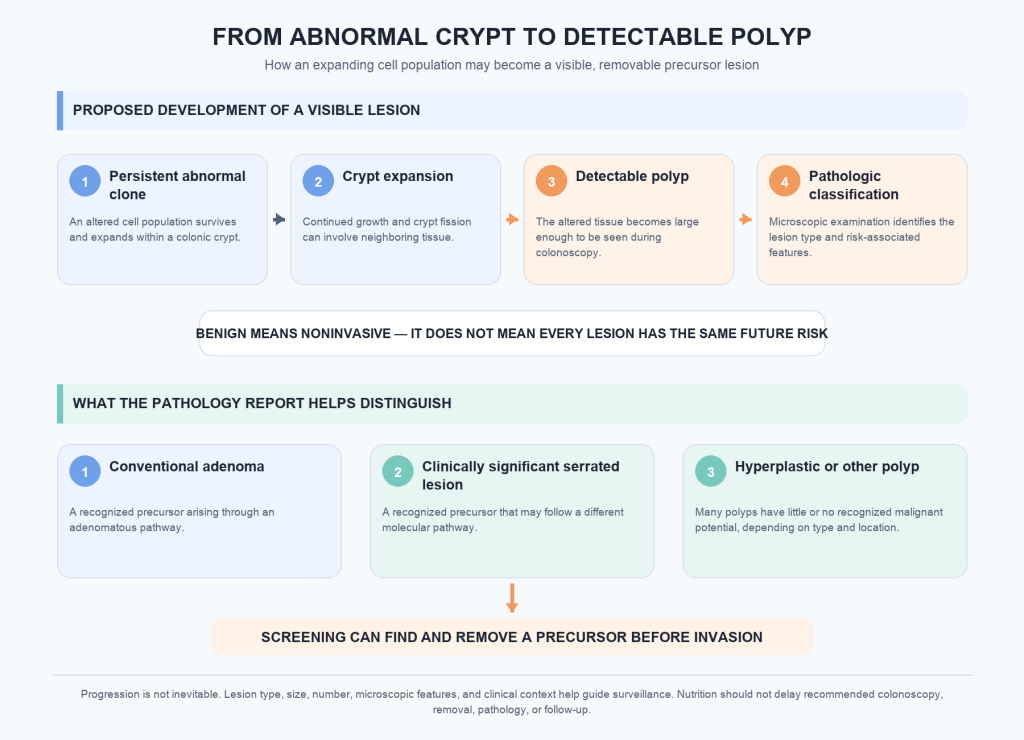
Pathologists classify colorectal polyps after examining removed tissue under a microscope. Major categories include:
- Conventional adenomas
- Serrated lesions
- Hyperplastic polyps
- Inflammatory and other non-neoplastic polyps
Conventional adenomas and certain serrated lesions are recognized colorectal cancer precursors, but they arise through different biological pathways.
Research examining human polyps at the single-cell level has found distinct cellular programs in conventional adenomas and serrated lesions. This diversity helps explain why colorectal cancers do not all develop through one identical sequence.
How an Adenoma Begins to Grow
A persistent abnormal cell population can expand within a colonic crypt. As altered cells replace normally regulated cells, the architecture of the crypt may begin to change.
Early adenomas can arise from a small number of abnormal crypts and enlarge through continued cell proliferation, crypt expansion, and involvement of neighboring tissue.
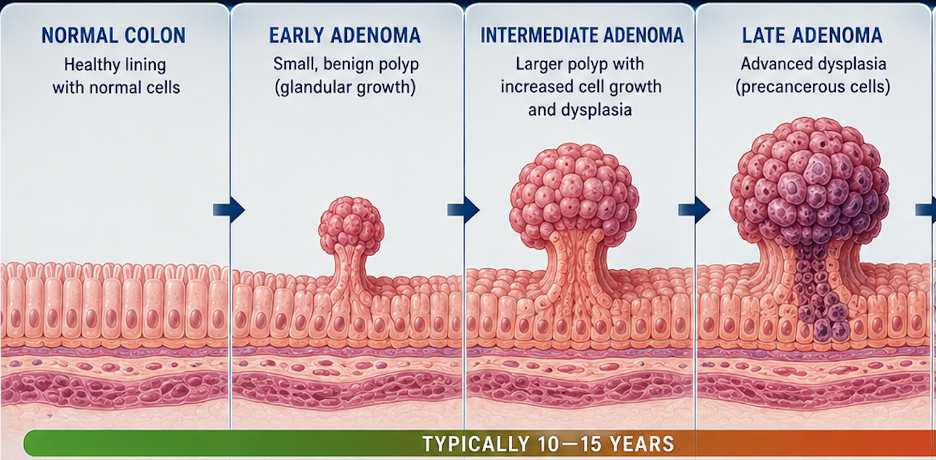
The developing lesion may display:
- Increased or misplaced cell proliferation
- Reduced normal differentiation
- Changes in crypt shape and organization
- Altered cell-survival and removal signals
- Accumulation of genetic and epigenetic changes
- Changes in interactions with immune, stromal, and microbial environments
The appearance of a polyp therefore reflects more than the presence of one abnormal cell. It represents the expansion and organization of an abnormal cell population into a detectable tissue structure.
Progression Is Not Inevitable
Most small polyps will not become colorectal cancer.
The likelihood of future progression varies with the lesion’s size, microscopic features, number, location, molecular pathway, and the presence or absence of dysplasia. Some lesions may remain stable for long periods, while others may enlarge or accumulate additional abnormalities.
An advanced adenoma generally has features associated with greater future risk, such as larger size, villous architecture, or high-grade dysplasia. Certain larger serrated lesions and serrated lesions containing dysplasia also warrant closer clinical attention.
These classifications describe patterns of risk; they do not predict with certainty what any individual polyp would have done if left in place.
Why Screening Is So Important
A polyp usually causes no symptoms. Screening provides an opportunity to identify colorectal cancer precursors before they become invasive.
During colonoscopy, many polyps can be removed and sent for pathological examination. Their number, size, location, and microscopic features help clinicians determine whether and when additional surveillance is appropriate.
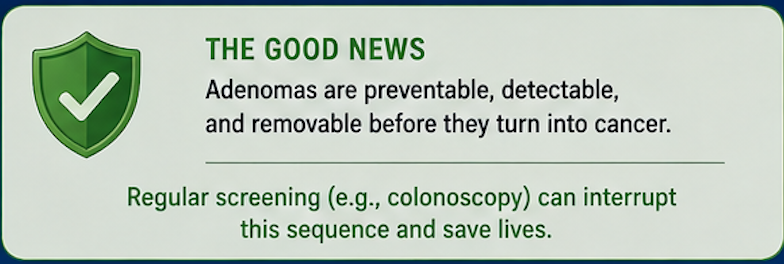
Long-term studies show that risk after adenoma removal differs according to the features of the original lesion and subsequent surveillance. Removing precursor lesions and following recommended surveillance remain central components of colorectal cancer prevention.
Summary
References
- Preston SL, Wong WM, Chan AO, Poulsom R, Jeffery R, Goodlad RA, et al. Bottom-up histogenesis of colorectal adenomas: origin in the monocryptal adenoma and initial expansion by crypt fission. Cancer Research. 2003;63(13):3819–3825. PMID: 12839979.
- Chen B, Scurrah CR, McKinley ET, Simmons AJ, Ramirez-Solano MA, Zhu X, et al. Differential premalignant programs and microenvironment chart distinct paths to malignancy in human colorectal polyps. Cell. 2021;184(26):6262–6280.e26. doi: 10.1016/j.cell.2021.11.031. PMID: 34910928; PMCID: PMC8941949.
- Cottet V, Jooste V, Fournel I, Bouvier AM, Faivre J, Bonithon-Kopp C. Long-term risk of colorectal cancer after adenoma removal: a population-based cohort study. Gut. 2012;61(8):1180–1186. doi: 10.1136/gutjnl-2011-300295. PMID: 22110052.