
When a Benign Precursor Becomes Invasive Cancer
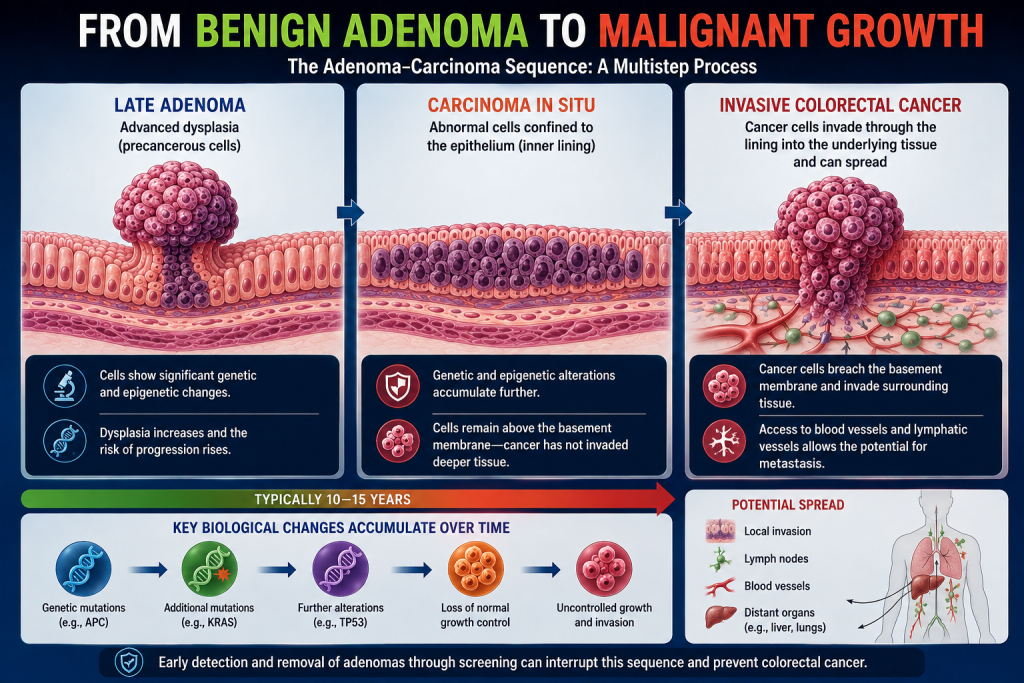
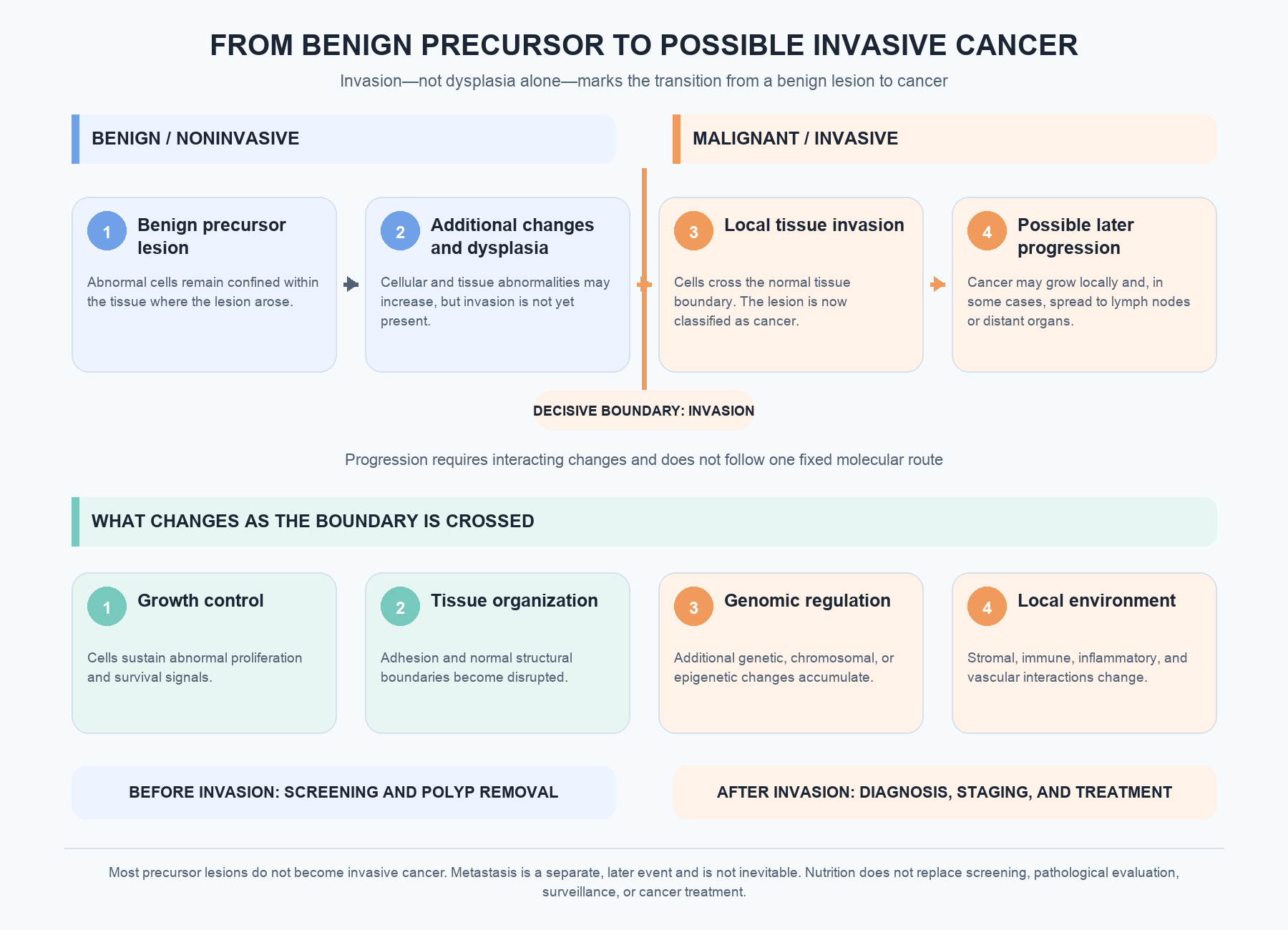
An adenoma or serrated precursor remains benign while its abnormal cells are confined to the tissue in which the lesion developed.
Malignant progression occurs when a population of abnormal cells acquires the ability to invade beyond its normal tissue boundary. Once invasion is present, the lesion is classified as colorectal cancer rather than a benign polyp.
This transition is not inevitable. Most small polyps will never become invasive cancer, and removing recognized precursor lesions is a central purpose of colorectal cancer screening.
Additional Changes Are Usually Required
Invasion is diagnosed when malignant cells cross the normal tissue boundary and grow into supporting tissue where those cells do not belong. This distinction is determined through pathological examination of removed tissue.
Progression from a benign precursor to invasive cancer generally involves the selection and expansion of cell populations carrying additional abnormalities.
These changes may affect:
- Growth-promoting and growth-restraining pathways
- DNA repair and genomic stability
- Cell differentiation and tissue organization
- Programmed cell death
- Cell adhesion and interaction with surrounding tissue
- Immune recognition and inflammatory signaling
- Blood-vessel formation
- The ability to invade neighboring tissue
The changes do not necessarily occur in one fixed order. Different colorectal cancers can follow different genetic, epigenetic, and cellular routes to malignancy.
Cancer Development Is an Evolutionary Process
A polyp may contain multiple related but biologically distinct cell populations. These populations compete within the changing tissue environment.
Some cell populations disappear. Others persist without becoming invasive. Occasionally, a population with a survival or growth advantage expands and acquires additional capabilities.
This process is often represented as a simple straight line from normal tissue to adenoma to cancer. Human tumor studies show that the underlying biology can be more branched and complex, with multiple evolving cell lineages.
Invasion and Metastasis Are Different Events
Local invasion is the defining transition from a benign precursor to cancer.
Metastasis is a later and separate process in which cancer cells spread to lymph nodes or distant organs. Not every colorectal cancer is metastatic when discovered, and finding cancer at an earlier stage generally permits more treatment options.
Screening is intended to prevent cancer by removing precursors and to detect cancer before symptoms or advanced spread occur.
What the Molecular Evidence Shows
Human colorectal cancers contain diverse combinations of mutations, chromosomal alterations, DNA-repair abnormalities, and epigenetic changes.
Frequently affected pathways include those involving APC and WNT signaling, KRAS, TP53, TGF-β signaling, PI3K signaling, and DNA mismatch repair. No single molecular alteration explains every colorectal cancer.
These findings reinforce that malignancy emerges through interacting changes in cell regulation rather than through one metabolic pathway, one food, or one microbial organism.
Summary
References
- Fearon ER, Vogelstein B. A genetic model for colorectal tumorigenesis. Cell. 1990;61(5):759–767. doi: 10.1016/0092-8674(90)90186-I. PMID: 2188735.
- Cancer Genome Atlas Network. Comprehensive molecular characterization of human colon and rectal cancer. Nature. 2012;487(7407):330–337. doi: 10.1038/nature11252. PMID: 22810696; PMCID: PMC3401966.
- Tsao JL, Tavaré S, Salovaara R, Jass JR, Aaltonen LA, Shibata D. Colorectal adenoma and cancer divergence: evidence of multilineage progression. American Journal of Pathology. 1999;154(6):1815–1824. doi: 10.1016/S0002-9440(10)65437-5. PMID: 10362806; PMCID: PMC2222548.