Chapter 7 Saccharolytic vs. Proteolytic Metabolism
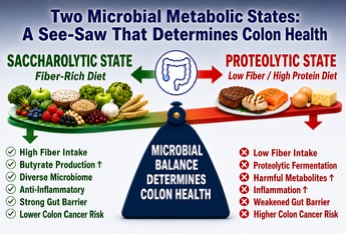
The colonic microbiome exists in a dynamic balance between two major metabolic states: saccharolytic fermentation and proteolytic fermentation.
Tap to enlarge. Rotate your phone or pinch to zoom.
Saccharolytic State
The saccharolytic state represents a metabolically efficient and biologically protective configuration of the colonic ecosystem. It develops when the diet consistently delivers fermentable carbohydrates, including resistant starch, soluble fiber, and other complex polysaccharides, to the colon. Under these conditions, microbial metabolism is directed primarily toward carbohydrate fermentation rather than amino acid degradation.
Fermentation produces abundant short-chain fatty acids, particularly butyrate. As discussed in Chapter 3, a healthy colonocyte depends primarily on mitochondrial oxidation of butyrate. This oxidative metabolism establishes the metabolic foundation of the saccharolytic state. In addition, butyrate’s epigenetic actions are particularly important.
Tap to enlarge. Rotate your phone or pinch to zoom.
The saccharolytic state also restrains inflammation. Butyrate suppresses NF-κB signaling, promotes regulatory T-cell development, strengthens epithelial tight junctions, and maintains barrier integrity. As a result, intestinal permeability remains low, microbial products are contained within the lumen, and inflammatory activation is minimized.
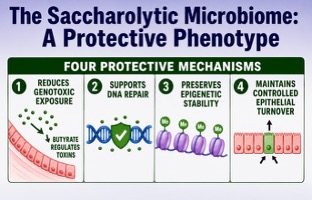
Clinically, the saccharolytic microbiome functions as a protective phenotype. It reduces genotoxic exposure, supports DNA repair, preserves epigenetic stability, and maintains controlled epithelial turnover, thereby suppressing multiple steps in the adenoma–carcinoma sequence simultaneously (O’Keefe SJD 2016).
Proteolytic State
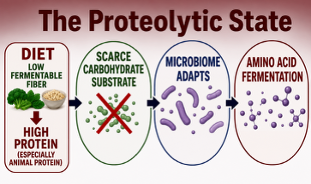
The proteolytic state develops when fermentable fiber becomes scarce and dietary protein, particularly animal protein, predominates. Unable to obtain sufficient carbohydrate substrate, the microbiome increasingly relies on amino acid fermentation for energy.
Tap to enlarge. Rotate your phone or pinch to zoom.
Protein fermentation generates numerous potentially harmful metabolites, including ammonia, hydrogen sulfide, phenols, p-cresol, indoles, N-nitroso compounds, and secondary bile acids. These metabolites promote oxidative stress, chronic inflammation, epithelial injury, and genomic instability (Windey K et al 2012).
At the cellular level, this altered metabolic environment activates nutrient-sensitive growth pathways, particularly mTOR. As the cell shifts toward anabolic growth and aerobic glycolysis, multiple epigenetic abnormalities begin to emerge.
Collectively, these changes shift the colonocyte away from oxidative metabolism and normal differentiation toward a proliferative phenotype characterized by metabolic stress and progressive epigenetic instability.
The proteolytic state therefore represents far more than a change in bacterial metabolism. It marks the transition from a metabolically coherent and epigenetically stable ecosystem to one characterized by inflammatory signaling, altered nutrient sensing, impaired epithelial regulation, and increasing susceptibility to colorectal carcinogenesis.
Conclusion
A dynamic balance exists between two fundamentally different metabolic states (Louis P et al 2014). In a healthy colon, saccharolytic metabolism predominates. Fermentation of dietary fiber generates butyrate and other short-chain fatty acids that nourish colonocytes, maintain epithelial integrity, suppress inflammation, and stabilize the epigenetic machinery responsible for normal cellular function.
When dietary fiber becomes inadequate and excessive protein reaches the colon, this balance gradually shifts toward proteolytic metabolism. The metabolites produced by protein fermentation differ dramatically from those generated during fiber fermentation. Instead of supporting epithelial health, they promote inflammation, impair barrier function, increase genotoxic stress, and alter gene regulation in ways that favor malignant transformation.
The distinction between these two metabolic states provides a unifying framework for understanding how diet influences colorectal cancer risk. Colon health is determined not simply by the composition of the microbiome, but by the metabolic products it generates. The goal of an epigenetically favorable diet is therefore not to eliminate protein, but to create conditions in which saccharolytic metabolism remains dominant and the protective metabolites of fiber fermentation continue to shape a healthy colonic ecosystem.
Looking Ahead
Saccharolytic metabolism represents the healthy metabolic state of the colon and proteolytic metabolism represents a potentially harmful one. But these are still dynamic states, responsive to the diet input. They are still on the teeter-totter. Eventually the proteolytic state can enter into a non-dynamic phase. This state is known as dysbiosis.
Dysbiosis is often described as a change in the composition of the microbiome, but this definition captures only part of the process. More importantly, dysbiosis represents a shift in microbial metabolism. As butyrate-producing organisms decline and protein-fermenting organisms become increasingly dominant, the biochemical environment of the colon changes profoundly. The metabolites that once maintained epithelial health are gradually replaced by compounds that promote inflammation, metabolic dysfunction, and epigenetic instability.
This metabolic transition has enormous consequences for the colonocyte. As butyrate production falls, the colonocyte loses both its preferred energy source and one of its most important epigenetic regulators. Cellular metabolism begins to change, gene expression becomes increasingly unstable, and the stage is set for the earliest events of malignant transformation.
The next chapter explores dysbiosis not simply as an alteration in bacterial populations, but as a progressive failure of the metabolic cooperation between diet, the microbiome, and the colonocyte. Understanding this transition provides the critical link between nutrition and the development of colorectal cancer.
References
- Louis P, Flint HJ. Formation of propionate and butyrate by the human colonic microbiota. Environ Microbiol. 2017;19(1):29-41.
- Flint HJ, Scott KP, Duncan SH, Louis P, Forano E. Microbial degradation of complex carbohydrates in the gut. Gut Microbes. 2012;3(4):289-306.
- Koh A, De Vadder F, Kovatcheva-Datchary P, Bäckhed F. From dietary fiber to host physiology: short-chain fatty acids as key bacterial metabolites. Cell. 2016;165(6):1332-1345.
- Donohoe DR, Garge N, Zhang X, et al. The microbiome and butyrate regulate energy metabolism and autophagy in the mammalian colon. Cell Metab. 2011;13(5):517-526.
- Donohoe DR, Collins LB, Wali A, et al. The Warburg effect dictates the mechanism of butyrate-mediated histone acetylation and cell proliferation. Mol Cell. 2012;48(4):612-626.
- Hamer HM, Jonkers D, Venema K, Vanhoutvin S, Troost FJ, Brummer RJ. Review article: the role of butyrate on colonic function. Aliment Pharmacol Ther. 2008;27(2):104-119.
- Louis P, Hold GL, Flint HJ. The gut microbiota, bacterial metabolites and colorectal cancer. Nat Rev Microbiol. 2014;12(10):661-672.
- O’Keefe SJD. Diet, microorganisms and their metabolites, and colon cancer. Nat Rev Gastroenterol Hepatol. 2016;13(12):691-706.
- O’Keefe SJD, Li JV, Lahti L, et al. Fat, fibre and cancer risk in African Americans and rural Africans. Nat Commun.
- Hughes R, Magee EA, Bingham S. Protein degradation in the large intestine: relevance to colorectal cancer. Curr Issues Intest Microbiol. 2000;1(2):51-58.
- Windey K, De Preter V, Verbeke K. Relevance of protein fermentation to gut health. Mol Nutr Food Res. 2012;56(1):184-196.
- Russell WR, Hoyles L, Flint HJ, Dumas ME. Colonic bacterial metabolites and human health. Curr Opin Microbiol. 2013;16(3):246-254.
- Makki K, Deehan EC, Walter J, Bäckhed F. The impact of dietary fiber on gut microbiota in host health and disease. Cell Host Microbe. 2018;23(6):705-715.
- Wong JMW, de Souza R, Kendall CWC, Emam A, Jenkins DJA. Colonic health: fermentation and short chain fatty acids. J Clin Gastroenterol. 2006;40(3):235-243.
- Tilg H, Zmora N, Adolph TE, Elinav E. The intestinal microbiota fuelling metabolic inflammation. Nat Rev Immunol. 2020;20(1):40-54.
- Garrett WS. Cancer and the microbiota. Science. 2015;348(6230):80-86.