Chapter 8 Dysbiosis
Dysbiosis is often described as an alteration in the composition of the intestinal microbiome (Louis P et al 2014). Human studies consistently demonstrate reductions in beneficial butyrate-producing bacteria together with increases in inflammatory microbial metabolites. These observations suggest that dysbiosis represents the failure of the metabolic partnership between diet, the microbiome, and the colonocyte.
Tap to enlarge. Rotate your phone or pinch to zoom.
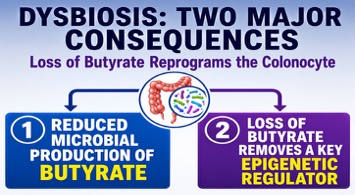
Once this partnership begins to fail, the consequences extend far beyond changes in bacterial populations. Fewer beneficial metabolites, particularly butyrate, are produced while increasing quantities of inflammatory and proteolytic compounds are generated. These biochemical changes simultaneously disrupt colonocyte metabolism and destabilize the epigenetic machinery that maintains normal cellular function (Bultman SJ 2017).
Butyrate
The reduced levels of butyrate deprive the colonocyte of its principal oxidative fuel. This forces colonocytes to rely increasingly on glucose metabolism.
Second, the loss of butyrate removes one of the colon’s most important endogenous epigenetic regulators, resulting in progressive detrimental alterations in gene expression. Together, these metabolic and epigenetic disturbances create a biological environment that increasingly favors colorectal carcinogenesis (Donohoe DR et al 2012).
Metabolic Stress
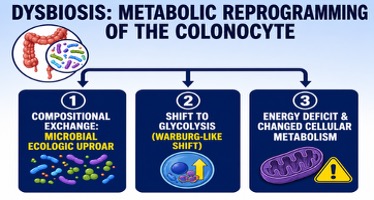
The loss of butyrate now begins to fundamentally alter colonocyte metabolism. Initially, this transition is an adaptive survival response. Increased glucose utilization allows the colonocyte to maintain ATP production despite declining butyrate availability.
As oxidative metabolism declines, the cell becomes increasingly dependent upon glucose metabolism.
Tap to enlarge. Rotate your phone or pinch to zoom.
Although this adaptation preserves short-term survival, it establishes the metabolic conditions that ultimately predispose the cell to malignant transformation. Human biopsy studies support this model (Song M et al 2019).
Loss of Epigenetic Stability
The consequences of butyrate depletion extend far beyond the loss of cellular energy. In the healthy colon, butyrate functions as one of the colonocyte’s principal epigenetic regulators, continuously reinforcing patterns of gene expression that maintain mitochondrial function, cellular differentiation, epithelial barrier integrity, antioxidant defenses, DNA repair, and normal cell-cycle control. In effect, butyrate helps preserve the epigenetic stability that allows the colonocyte to adapt to its environment while maintaining its normal identity.
As butyrate concentrations decline, this stabilizing influence progressively weakens. The colonocyte loses one of its most important epigenetic signals, and the coordinated regulation of gene expression begins to deteriorate. Protective genetic programs that support differentiation, oxidative metabolism, and genomic maintenance become less active, while stress-response pathways and growth-promoting signals become increasingly dominant. Rather than maintaining a stable, highly differentiated phenotype, the cell gradually shifts toward one focused on survival and proliferation.
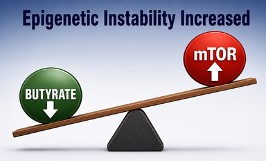
This transition also alters the balance between competing metabolic programs. Under healthy conditions, butyrate promotes oxidative metabolism and differentiation while providing an important physiological counterbalance to nutrient-sensing pathways that stimulate cellular growth. Among the most important of these pathways is mTOR, the master regulator of anabolic metabolism. Activated primarily by amino acids, insulin, and growth factors, mTOR drives protein synthesis, cell growth, and cellular proliferation. These processes are essential for normal tissue renewal but require careful regulation.
As butyrate availability falls, this regulatory balance is progressively lost. With diminished epigenetic signaling to support cellular differentiation and metabolic homeostasis, mTOR-driven anabolic programs exert greater influence over colonocyte behavior. Persistent mTOR activity suppresses autophagy, increases biosynthetic metabolism, and favors continued cellular growth rather than repair and differentiation (O’Keefe SJD 2015). The result is not uncontrolled mTOR activation, but the gradual loss of the normal physiological restraints that help keep proliferative signaling in balance.
Epigenetic instability therefore emerges as a direct consequence of metabolic instability (Flint HJ 2012, Donhoe DR et al 2011, Windey K et al 2012, Makki K et al 2018).
Dysbiosis first disrupts microbial metabolism, reducing butyrate production while increasing inflammatory and proteolytic metabolites.
Tap to enlarge. Rotate your phone or pinch to zoom.
These metabolic changes alter colonocyte function, destabilize the epigenetic machinery that governs gene expression, and gradually shift the mucosa toward a pro-carcinogenic phenotype. Long before visible dysplasia develops, the colonocyte has already begun to lose the epigenetic program that maintains normal cellular identity.
In this way, dysbiosis does more than deprive the colonocyte of its preferred fuel. It removes one of the colon’s most important epigenetic regulators, leaving growth-promoting pathways increasingly unopposed and creating the biological conditions from which colorectal cancer can ultimately emerge.
A Self-Reinforcing Cycle
Current evidence supports a self-reinforcing cycle in which metabolic stress and epigenetic instability amplify one another. Although this model has been developed largely through mechanistic studies, it closely mirrors the metabolic and epigenetic alterations observed in human colorectal tissues during early carcinogenesis.
Each reinforces the other. Reduced butyrate availability impairs mitochondrial metabolism, while altered gene expression further suppresses oxidative function and promotes dependence on glucose metabolism. At the same time, chronic low-grade inflammation generated by dysbiosis activates signaling pathways that amplify these changes and further destabilize the cellular environment.
Over time, this self-reinforcing cycle progressively reprograms the biology of the colonocyte. The cell remains viable, but it no longer functions as the highly differentiated epithelial cell characteristic of a healthy colon. Instead, it enters a transitional state in which normal metabolic regulation, gene expression, and barrier function are progressively compromised.
Conclusion
Human studies clearly demonstrate that dysbiosis reduces butyrate production, alters microbial metabolism, promotes inflammation, and is associated with colorectal cancer risk (Louis P et al 2017, Flint HJ et al 2012, Russell WR et al 2013). Experimental studies explain how these changes destabilize colonocyte metabolism and epigenetic regulation (Windey K et al 2012, Wong JMW et al 2006, Koh A et al 2016).
Together, these findings support a new way of understanding dysbiosis—not simply as an imbalance of bacterial species, but as a state of metabolic and epigenetic starvation.
The key question is: What does dysbiosis do?
The answer is that dysbiosis deprives the colonocyte of butyrate. It destabilizes metabolism. It destabilizes epigenetics.
Since the precipitating factor for these changes is the decreased nutritional substrate, particularly fiber, dysbiosis should be understood as a state of metabolic and epigenetic starvation, rather than simply an imbalance of bacterial species.
At this stage, the colonocyte is not yet malignant, but its biological trajectory has fundamentally changed. The foundation has been laid for the metabolic reprogramming that ultimately characterizes colorectal carcinogenesis.
Looking Ahead
The next chapter examines how this early metabolic adaptation to reduced butyrate evolves into the Warburg Effect, the defining metabolic hallmark of colorectal cancer. More than simply a change in fuel utilization, the Warburg Effect reshapes the epigenetic landscape of the colonocyte, driving the progressive loss of normal cellular regulation that ultimately culminates in malignant transformation.
References
- O’Keefe SJ, Li JV, Lahti L, Ou J, Carbonero F, Mohammed K, et al. Fat, fibre and cancer risk in African Americans and rural Africans. Nat Commun. doi:10.1038/ncomms7342.
- Louis P, Hold GL, Flint HJ. The gut microbiota, bacterial metabolites and colorectal cancer. Nat Rev Microbiol. 2014;12(10):661-672. doi:10.1038/nrmicro3344.
- Donohoe DR, Garge N, Zhang X, Sun W, O’Connell TM, Bunger MK, et al. The microbiome and butyrate regulate energy metabolism and autophagy in the mammalian colon. Cell Metab. 2011;13(5):517-526
- Donohoe DR, Collins LB, Wali A, Bigler R, Sun W, Bultman SJ. The Warburg effect dictates the mechanism of butyrate-mediated histone acetylation and cell proliferation. Mol Cell. 2012;48(4):612-626.
- Bultman SJ. Interplay between diet, gut microbiota, epigenetic events and colorectal cancer. Mol Nutr Food Res. 2017;61(1):1500902.
- Agus A, Planchais J, Sokol H. Gut microbiota regulation of tryptophan metabolism in health and disease. Cell Host Microbe. 2018;23(6):716-724.
- Koh A, De Vadder F, Kovatcheva-Datchary P, Bäckhed F. From dietary fiber to host physiology: short-chain fatty acids as key bacterial metabolites. Cell. 2016;165(6):1332-1345.
- Silva YP, Bernardi A, Frozza RL. The role of short-chain fatty acids from gut microbiota in gut-brain communication. Front Endocrinol (Lausanne).
- Hanahan D. Hallmarks of cancer: new dimensions. Cancer Discov. 2022;12(1):31-46.
- Fearon ER, Vogelstein B. A genetic model for colorectal tumorigenesis. Cell. 1990;61(5):759-767.
- Baylin SB, Jones PA. A decade of exploring the cancer epigenome—biological and translational implications. Nat Rev Cancer. 2011;11(10):726-734.
- Song M, Chan AT. Environmental factors, gut microbiota, and colorectal cancer prevention. Clin Gastroenterol Hepatol. 2019;17(2):275-289.
- Tilg H, Zmora N, Adolph TE, Elinav E. The intestinal microbiota fuelling metabolic inflammation. Nat Rev Immunol. 2020;20(1):40-54.
- Canani RB, Di Costanzo M, Leone L, Pedata M, Meli R, Calignano A. Potential beneficial effects of butyrate in intestinal and extraintestinal diseases. World J Gastroenterol. 2011;17(12):1519-1528.
- Topping DL, Clifton PM. Short-chain fatty acids and human colonic function: roles of resistant starch and nonstarch polysaccharides. Physiol Rev. 2001;81(3):1031-1064.