Chapter 12 Polyphenol Intervention Studies
Polyphenols have emerged as one of the most intensively studied classes of dietary molecules because of their remarkable ability to influence inflammation, metabolism, the intestinal microbiome, and gene expression.
In nature, polyphenols function as biological signaling molecules. Thousands of different polyphenols are present throughout the plant kingdom, including flavonoids, anthocyanins, catechins, ellagitannins, lignans, and stilbenes. Collectively they help plants defend themselves against external stress. Remarkably, many of these same compounds appear to activate protective pathways within human cells.
The epidemiologic evidence is impressive (Cardona F et al 2013, Tomas-Barberian A et al 2016). Populations consuming diets rich in fruits, vegetables, tea, coffee, cocoa, berries, olives, and whole grains consistently experience lower rates of cardiovascular disease, diabetes, neurodegenerative disorders, and colorectal cancer. While these observations cannot establish causation, they have stimulated numerous human intervention trials designed to determine whether increasing polyphenol intake produces measurable biological changes.
The results have been encouraging.
Intervention Studies Increase Beneficial Bacteria
One of the most consistent findings from human dietary intervention studies is that polyphenol-rich foods remodel the intestinal microbiome by selectively increasing populations of beneficial bacteria (Louis P et al 2014, Del Rio D et al 2013). Rather than acting as broad-spectrum antimicrobial agents, polyphenols function as ecological modulators, creating an intestinal condition that favors beneficial microbial communities while suppressing organisms associated with dysbiosis.
This concept represents an important shift in our understanding of nutrition. Polyphenols are not simply absorbed in the small intestine and delivered to the bloodstream. In fact, a substantial proportion of dietary polyphenols escapes absorption and reaches the colon intact, where they become substrates for microbial metabolism. There, they directly stimulate the growth of bacteria capable of metabolizing these complex plant compounds. The result is a healthier and more diverse microbial ecosystem.
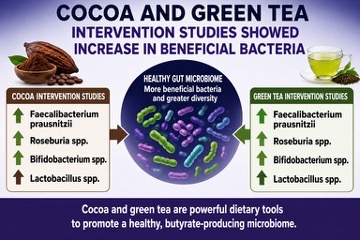
Numerous randomized human intervention studies have demonstrated this effect. Consumption of flavanol-rich cocoa for four weeks significantly increased populations of Bifidobacterium and Lactobacillus, two bacterial genera widely recognized for supporting intestinal health and suppressing pathogenic organisms. These microbial changes were accompanied by an overall increase in microbial diversity and favorable alterations in inflammatory markers
Tap to enlarge. Rotate your phone and pinch to zoom
Similarly, intervention studies using green tea catechins have demonstrated increased abundance of Faecalibacterium prausnitzii and other important butyrate-producing bacteria (Cardona F 2013). Because F. prausnitzii is one of the dominant producers of butyrate in the healthy human colon, its expansion represents a particularly important biological finding. Reduced abundance of this organism has been consistently associated with inflammatory bowel disease, metabolic dysfunction, and colorectal cancer.
Other polyphenol-rich foods including pomegranate, berries, grapes, red wine, olives, and coffee have demonstrated similar microbiome-modulating effects.
Although individual studies differ in the specific bacterial species affected, the overall pattern remains remarkably consistent: polyphenols increase bacterial diversity, enrich populations of beneficial saccharolytic organisms, and promote expansion of bacteria capable of producing short-chain fatty acids, particularly butyrate.
Importantly, these microbial changes occur rapidly. Several intervention studies have demonstrated measurable alterations in microbiome composition within only two to four weeks after increasing dietary polyphenol intake. Such rapid responses emphasize that the microbiome remains highly dynamic and continuously responsive to dietary choices (Tzounis X et al 2011).
The clinical implications extend well beyond changes in bacterial composition alone. Expansion of beneficial organisms increases production of butyrate and other short-chain fatty acids, strengthens epithelial barrier integrity, suppresses chronic inflammation, improves immune homeostasis, and promotes a more stable epigenetic environment within the colonocyte. Thus, polyphenols exert many of their health benefits not by acting directly on human cells, but by first improving the microbial ecosystem that continuously communicates with those cells.
These intervention studies reinforce one of the central themes of this book: the microbiome functions as the biochemical intermediary between diet and gene regulation. By selectively enriching beneficial bacteria, polyphenols amplify the production of microbial metabolites that help preserve normal colonocyte function and reduce the biological conditions that favor colorectal carcinogenesis.
Intervention Studies Increase Butyrate Production
One of the most consistent findings emerging from human intervention studies is that diets rich in polyphenols increase microbial production of butyrate. This observation is particularly important because butyrate serves as both the principal energy source for healthy colonocytes and one of the colon’s most powerful endogenous epigenetic regulators.
Unlike dietary fiber, which is directly fermented into short-chain fatty acids, polyphenols increase butyrate production primarily through indirect mechanisms. Many polyphenols reach the colon largely intact, where they selectively reshape the microbial ecosystem. Rather than acting as broad-spectrum antimicrobial agents, they favor the growth of beneficial saccharolytic bacteria, including Faecalibacterium prausnitzii, Roseburia species, and Eubacterium rectale, while suppressing organisms associated with dysbiosis and proteolytic metabolism. As these butyrate-producing bacterial populations expand, the capacity of the microbiome to ferment dietary fiber also increases, resulting in greater butyrate production.
Tap to enlarge. Rotate your phone and pinch to zoom
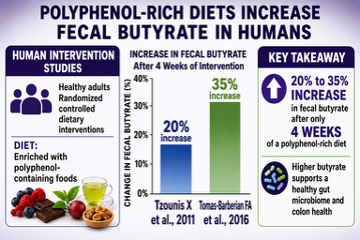
Several controlled human intervention studies have demonstrated this effect (Tzounis X et al 2011, Tomas-Barberian FA et all 2016). Diets enriched with polyphenol-containing foods have been associated with significant increases in fecal butyrate concentrations, generally ranging from approximately 20% to 35% after only four weeks of dietary intervention. Similar findings have been reported following supplementation with pomegranate polyphenols, which increased fecal butyrate concentrations by approximately 31% in healthy adults. Although the magnitude of the response varies depending on baseline diet, microbial composition, and the specific polyphenols consumed, the overall direction of change has been remarkably consistent.
These findings suggest that polyphenols function as biological amplifiers of fiber fermentation. By enriching populations of butyrate-producing bacteria, they increase the efficiency with which dietary fiber is converted into short-chain fatty acids. Consequently, the biological effects of fiber and polyphenols are not additive but synergistic. Fiber supplies the fermentable substrate, while polyphenols optimize the microbial community responsible for fermentation.
Increased butyrate production is the link that connects dietary polyphenols to improved metabolic health and enhanced epigenetic stability within the colonic epithelium (Louis P et al 2014).
Perhaps most importantly, these intervention studies illustrate a central principle of epigenetic nutrition. Polyphenols do not work in isolation. Their greatest biological impact occurs when they are consumed as part of a fiber-rich dietary pattern that provides the microbial substrate required for butyrate production. In this way, whole plant foods create a self-reinforcing biological system in which polyphenols improve the microbiome, which produces more butyrate, and butyrate helps maintain the normal epigenetic programming of the colonocyte.
Conclusion
Taken together, intervention studies demonstrate that dietary polyphenols modify multiple biological pathways known to participate in colorectal carcinogenesis. They reduce inflammation, reshape the microbiome, increase butyrate production, regulate cellular metabolism, and influence epigenetic programming.
No single polyphenol should be viewed as a miracle compound. Rather, the greatest benefits appear to arise from consuming a wide diversity of polyphenol-rich whole foods every day.
This observation reinforces one of the central themes of this book: health is determined not by isolated nutrients but by coordinated biological networks. Fiber and polyphenols work together to create an intestinal environment that favors metabolic stability, microbial diversity, and epigenetic resilience.
As our understanding of these interactions continues to evolve, nutrition is increasingly being recognized not simply as a means of supplying calories, but as one of the most powerful tools available for directing gene expression long before disease develops.
Looking Ahead
The intervention studies presented in this chapter demonstrate that polyphenols are capable of modifying the biology of the colon. They reshape the microbiome, strengthen the intestinal barrier, suppress inflammation, and influence the epigenetic machinery that regulates colonocyte behavior. These findings reinforce a central concept of epigenetic nutrition: dietary components function as biological signals capable of altering disease risk.
Yet polyphenols represent only one half of the equation. Large epidemiological studies have shown the value of a high fiber diet. Can a particularly potent version of fiber, resistant starch, show an even more compelling benefit?
The next chapter examines the one of the most important bodies of evidence in nutritional prevention: human intervention trials using resistant starch. Will these studies demonstrate how a simple dietary component can modify microbial metabolism, increase butyrate production, alter epigenetic regulation, and, in high-risk populations, reduce biomarkers and even the incidence of colorectal neoplasia?
References
- Tzounis X, Rodriguez-Mateos A, Vulevic J, Gibson GR, Kwik-Uribe C, Spencer JPE. Prebiotic evaluation of cocoa-derived flavanols in healthy humans by using a randomized, controlled, double-blind, crossover intervention study. Am J Clin Nutr. 2011;93(1):62-72.
- Tomás-Barberán FA, Selma MV, Espín JC. Interactions of gut microbiota with dietary polyphenols and consequences to human health. J Agric Food Chem. 2016;64(22):4183-4196.
- Cardona F, Andrés-Lacueva C, Tulipani S, Tinahones FJ, Queipo-Ortuño MI. Benefits of polyphenols on gut microbiota and implications in human health. J Nutr Biochem. 2013;24(8):1415-1422.
- Del Rio D, Rodriguez-Mateos A, Spencer JPE, Tognolini M, Borges G, Crozier A. Dietary (poly)phenolics in human health: Structures, bioavailability, and evidence of protective effects against chronic diseases. Antioxid Redox Signal. 2013;18(14):1818-1892.
- Louis P, Hold GL, Flint HJ. The gut microbiota, bacterial metabolites and colorectal cancer. Nat Rev Microbiol. 2014;12(10):661-672.
- O’Keefe SJD. Diet, microorganisms and their metabolites, and colon cancer. Nat Rev Gastroenterol Hepatol. 2016;13(12):691-706.
- Makki K, Deehan EC, Walter J, Bäckhed F. The impact of dietary fiber on gut microbiota in host health and disease. Cell Host Microbe. 2018;23(6):705-715.
- Louis P, Flint HJ. Formation of propionate and butyrate by the human colonic microbiota. Environ Microbiol. 2017;19(1):29-41.