Chapter 16 The Epigenetic Diet© Day
The Epigenetic Diet© begins with a different way of thinking about food. Rather than viewing meals simply as sources of calories or nutrients, it recognizes that every meal delivers biological information. Those signals are interpreted by the intestinal microbiome and ultimately translated into patterns of gene expression that shape the health of the colon.
The objective is therefore not simply to provide nutrition, but to create a stable metabolic environment that continually reinforces epithelial health while minimizing the biological conditions that favor neoplastic transformation.
Unlike conventional meal plans that focus primarily on calories or macronutrient balance, The Epigenetic Diet© is organized around time, microbial metabolism, and epigenetic regulation. Each meal performs a specific biological function, yet every meal also prepares the colon for the next phase of the day. Over twenty-four hours, the microbiome and the colonocyte function as an integrated biological system whose activities are synchronized through carefully selected foods and meal timing.
The Epigenetic Diet© also aligns microbial metabolism with the body’s natural circadian rhythms. Feeding occurs during the daytime when nutrient utilization is greatest, while overnight fasting allows systemic nutrient-sensing pathways to decline even as microbial fermentation continues within the colon.
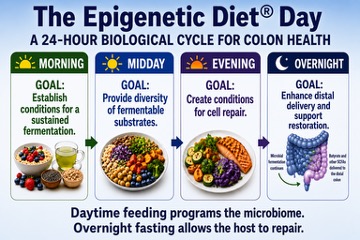
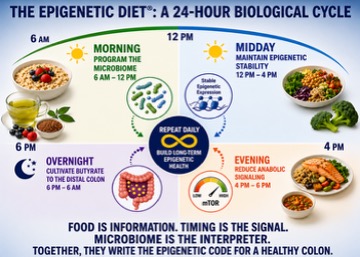
The day begins by programming the microbiome rather than by simply satisfying hunger. Breakfast combines viscous fibers such as psyllium with slowly fermentable carbohydrates including oats, flaxseed, and resistant starch. Together these foods create a physical matrix that slows bacterial access to fermentable substrate. Instead of producing a rapid burst of fermentation confined to the proximal colon, the meal establishes a prolonged wave of microbial activity that gradually progresses distally throughout the day.
At the same time, berries, green tea, cocoa, and other polyphenol-rich foods begin remodeling the microbial ecosystem itself. Beneficial butyrate-producing bacteria expand, microbial cross-feeding networks become established, and the colon is metabolically prepared for the larger and more diverse midday meal. Rather than generating a brief spike in microbial metabolism, breakfast establishes the conditions for sustained fermentation that will continue long after the meal has ended.
The morning establishes the microbial foundation. Midday builds upon that foundation by providing the greatest diversity of fermentable substrates and epigenetic signals encountered during the day.
Tap to enlarge. Rotate your phone and pinch to zoom.
Meals emphasize diversity—whole grains, legumes, vegetables, resistant starch, cruciferous vegetables, fruits, nuts, and seeds. Multiple fiber types are fermented simultaneously by different bacterial populations, producing a continuous supply of short-chain fatty acids, particularly butyrate.
During this phase, microbial metabolites and dietary polyphenols converge upon the colonocyte. Butyrate functions as both the primary mitochondrial fuel and an epigenetic regulator through histone deacetylase inhibition. Polyphenols influence DNA methylation, histone modification, chromatin remodeling, AMPK, SIRT1, and inflammatory signaling pathways. Together these complementary mechanisms regulate gene expression, promote epithelial differentiation, strengthen barrier integrity, and suppress inflammatory signaling. At no other point during the day are the microbiome and host so completely synchronized.
As evening approaches, the biological objective shifts from maximizing epigenetic signaling toward creating the conditions for cellular repair. Rather than prolonging nutrient abundance, the evening meal gently withdraws anabolic stimulation while preserving microbial fermentation. Protein intake is moderated and consumed within whole-food meals containing abundant fermentable fiber. This slows amino acid absorption, reduces the amplitude of leucine-induced mTOR activation, and allows nutrient-sensing pathways to return gradually toward baseline. Rather than maintaining continuous anabolic signaling, the colonocyte begins transitioning toward a physiological state favorable for maintenance and genomic stability.
Importantly, microbial metabolism does not end when eating stops. The resistant starches, viscous fibers, and slowly fermentable carbohydrates consumed earlier in the day continue moving through the colon, where bacteria remain actively fermenting them for many hours. As the host enters an overnight fast, the microbiome continues producing butyrate and other short-chain fatty acids, sustaining colonocyte metabolism even while systemic nutrient signaling declines.
This overnight period illustrates one of the central principles of The Epigenetic Diet©. The host and the microbiome work on complementary metabolic schedules. While the host enters a fasting state characterized by declining amino acids, reduced mTOR activity, and increased autophagy, the microbiome continues fermenting dietary fiber and delivering butyrate to the distal colon.
.
During fasting, circulating amino acids fall, mTOR activity declines, autophagy increases, and epithelial repair accelerates. Simultaneously, microbial fermentation continues within the distal colon and rectosigmoid, delivering butyrate precisely where substrate availability is normally lowest and early-onset colorectal cancer most commonly develops.
The prolonged delivery of butyrate transforms the biological environment of the distal colon. Luminal pH declines, potentially harmful proteolytic metabolites decrease, epithelial barrier function improves, inflammatory signaling is suppressed, and chromatin assumes a more permissive configuration for expression of genes involved in differentiation, apoptosis, DNA repair, and tumor suppression. Rather than allowing the rectosigmoid to exist in a state of metabolic deprivation, the overnight fermentation strategy provides continuous epigenetic support during the period when repair mechanisms are most active.
The daily cycle is only one level of organization. Across the seven-day rotation, different combinations of whole grains, legumes, fruits, vegetables, resistant starches, viscous fibers, and polyphenol-rich foods continually reshape microbial metabolism. No single fiber feeds every organism, and no single polyphenol activates every protective pathway. Rotating foods throughout the week maintains microbial diversity while preserving stable production of beneficial microbial metabolites.
Tap to enlarge. Rotate your phone and pinch to zoom
The effectiveness of The Epigenetic Diet© therefore does not arise from any single food, supplement, or meal. It emerges from the integration of biological events across time.
Morning meals determine where fermentation will occur hours later. Midday diversity maximizes microbial metabolism and epigenetic signaling. Evening restraint restores physiological oscillations in nutrient-sensing pathways. Overnight fermentation delivers sustained protection to the distal colon. Each phase prepares the next, creating a continuous cycle of biological regulation.
Conclusion
The Epigenetic Diet© is not built around calorie counting, restriction, or isolated “superfoods.” It is built around biology. Each meal delivers information to the intestinal microbiome. The microbiome converts that information into metabolites that regulate the epigenetic machinery of the colonocyte. Over time, these repeated biological signals create an intestinal environment that favors differentiation over uncontrolled proliferation, repair over injury, and genomic stability over progressive epigenetic dysfunction. Rather than prescribing isolated foods, The Epigenetic Diet© provides a daily biological strategy for preserving the health of the colon.
Looking Ahead
The twenty-four-hour cycle described in this chapter establishes the biological framework of The Epigenetic Diet©. The next chapter expands that framework into a complete seven-day nutritional program. Each day follows the same biological rhythm of morning programming, midday diversification, evening moderation, and overnight repair, but individual foods are intentionally varied throughout the week. Different fibers ferment at different rates, different polyphenols activate different microbial populations and epigenetic pathways, and different food matrices influence the delivery of metabolites to the distal colon. By systematically rotating these foods across seven days, The Epigenetic Diet© maintains microbial diversity, supports metabolic flexibility, and maximizes the complementary biological mechanisms that preserve colonocyte health.