Chapter 3
Metabolites: What the Microbiome Creates
In Chapter 2, we saw that the microbiome greatly expands what can happen to food after we eat it. Components that escape digestion in the stomach and small intestine can reach the colon, where they encounter trillions of microorganisms possessing biochemical capabilities very different from our own.
But microorganisms do more than break food apart.
They create new molecules.
These molecules are called metabolites.
Metabolites are small chemical compounds produced during biological processes. Human cells make metabolites continuously, but so do microorganisms. Within the colon, microbial communities can transform components of our diet into an extraordinary variety of new compounds that were not necessarily present in the original food. [1–3]
This represents an important transition in the Food as Information story.
The blueberry, bean, oat, walnut, or broccoli we eat provides the starting material. The microbiome processes some of those materials and changes their chemical form. What emerges can be a new collection of molecules with properties different from the compounds with which we began.
The food has been transformed.
From Food Components to New Molecules
Consider dietary fiber and resistant starch.
Humans lack many of the enzymes required to completely digest these complex carbohydrates. When portions reach the colon, microorganisms can use them as substrates. Through microbial fermentation, complex carbohydrates are progressively broken down and converted into smaller compounds.
Among the best-known products of this process are the short-chain fatty acids, particularly acetate, propionate, and butyrate. [1,4]
These compounds were not sitting inside the original oat kernel or bean waiting to be released.
They were created through microbial activity.
This distinction is important.
When we eat a fiber-rich food, we are not simply consuming fiber. We may also be providing the raw material from which microorganisms can manufacture an entirely different group of compounds.
The biological potential contained in food has begun to take a new form.
Butyrate: A Useful Example
Butyrate provides one of the clearest examples of this transformation.
Foods such as legumes, oats, whole grains, resistant starch-containing foods, fruits, and vegetables can provide carbohydrates that reach the colon and become available for microbial fermentation. Through interactions among different members of the microbial community, some of this material can contribute to the production of butyrate. [4–6]
Butyrate is therefore not simply a nutrient that we obtain directly from these foods.
It is, to an important extent, a product of the relationship between food and microorganisms.
That makes butyrate especially interesting from the Food as Information perspective.
The food provides the substrate. The microbial community performs the transformation. A new molecule appears within the intestinal environment.
We will encounter butyrate repeatedly later in this series because it provides an unusually useful example of how a molecule originating from microbial processing can become relevant to human biology.
For now, however, the important lesson is simply how it came to exist.
Plants Can Become Something New
Complex carbohydrates are not the only dietary components transformed by microorganisms.
Polyphenols provide another example.
Berries, tea, cocoa, apples, grapes, nuts, herbs, spices, and many other plant foods contain diverse families of polyphenols. Some are absorbed in the small intestine, but substantial portions of many polyphenols can continue into the colon.
There they encounter the microbiome.
Microorganisms can modify these compounds, breaking larger chemical structures into smaller molecules. The resulting microbial products can differ considerably from the polyphenols originally present in the food. [7–9]
This means that the compounds scientists measure in a blueberry or cup of tea do not necessarily tell us everything about the compounds that will eventually exist within the body after those foods are consumed.
Once again, the food provides potential.
The microbiome changes what that potential becomes.
A Chemical Community
The production of metabolites is not necessarily the work of a single microorganism.
Just as we saw in Chapter 2, the microbiome functions as a community. One microorganism may begin processing a dietary compound and release a product that another organism can use. That organism may then transform it further.
This phenomenon is sometimes described as cross-feeding.
Through these microbial networks, the products of one organism can become the substrates of another. The chemistry occurring within the colon therefore reflects not only which microorganisms are present but also how they interact with one another and which dietary materials are available to them. [5,6]
The result is a remarkably dynamic chemical environment.
Food enters.
Microorganisms interact with it.
Microorganisms interact with one another.
And new compounds emerge.
Not All Metabolites Are the Same
It would be a mistake, however, to think of all microbial metabolites as beneficial.
The microbiome can produce an enormous variety of compounds, and their biological properties differ substantially.
When microorganisms have access to fermentable carbohydrates, microbial communities can produce short-chain fatty acids and many other products. When different substrates become available, including amino acids and other components of undigested protein, microbial metabolism can generate a different chemical environment.
These products can include ammonia, phenols, p-cresol, hydrogen sulfide, indole derivatives, and other compounds. [10–12]
Some microbial products may support normal intestinal physiology. Others, particularly at certain concentrations or under particular biological conditions, may be less favorable. Still others have complex effects that cannot simply be classified as “good” or “bad.”
This is why the microbiome should not be thought of merely in terms of good bacteria and bad bacteria.
What may matter just as much is what the microbial community is doing.
And what it is doing depends partly upon what it has available to process.
The Same Food Can Produce Different Results
This brings us back to individual variation.
Two people can eat the same food but may not necessarily produce identical amounts or patterns of microbial metabolites.
Their microbial communities may differ. They may possess different abundances of organisms capable of performing particular chemical transformations. Their intestinal transit, habitual diet, and other biological characteristics may also influence the environment in which microbial processing occurs. [13,14]
The same starting material can therefore lead to somewhat different chemical outcomes.
This helps explain why the concept of Food as Information cannot be reduced to a simple formula in which one food always produces one biological effect.
There is an intermediate biology.
And the microbiome is an important part of it.
A New Chemical Environment
We can now see food differently than we did at the beginning of this series.
The food on our plate contains nutrients and an enormous diversity of other compounds.
We eat it.
Human digestion begins changing it.
Some components reach the microbiome.
Microorganisms continue the transformation.
And new molecules appear.
These metabolites create a chemical environment that did not exist in the original meal.
That may be one of the most important ideas in understanding the relationship between nutrition and human biology.
What matters is not only what is in our food.
What matters is also what our biology can make from it.
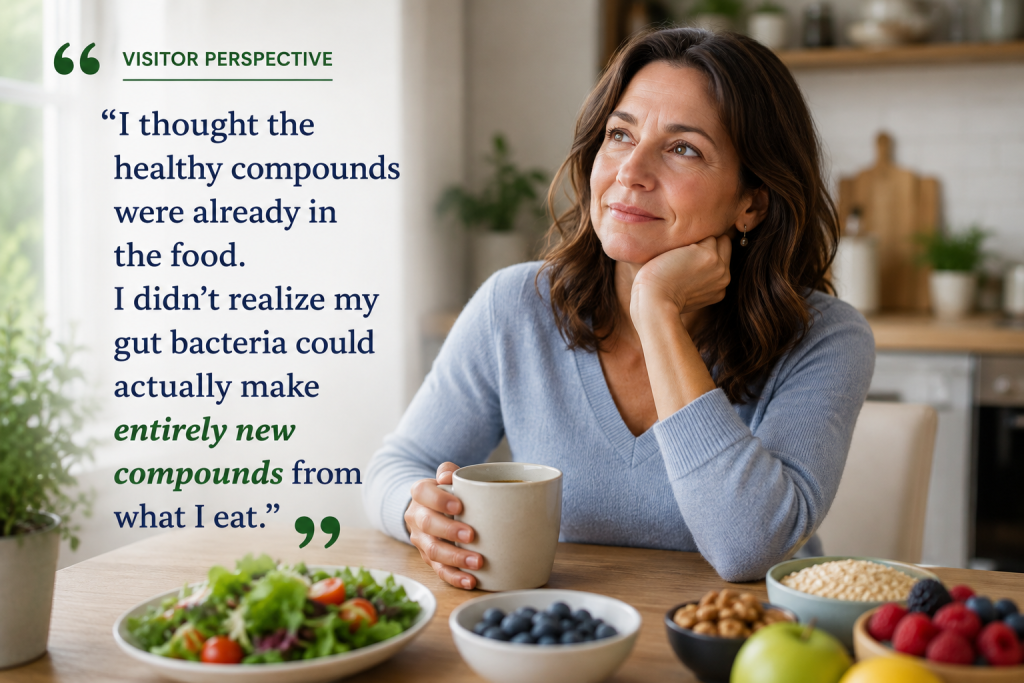
That realization captures the central discovery of this chapter.
Food is not biologically static after we swallow it.
It changes.
Some of those changes are produced by our own digestive system. Others are produced by microorganisms living within us.
The result is a new chemical world—a mixture of compounds derived from food, microorganisms, and human biology.
Those compounds are metabolites.
And now an important question emerges.
What happens when these molecules encounter us?
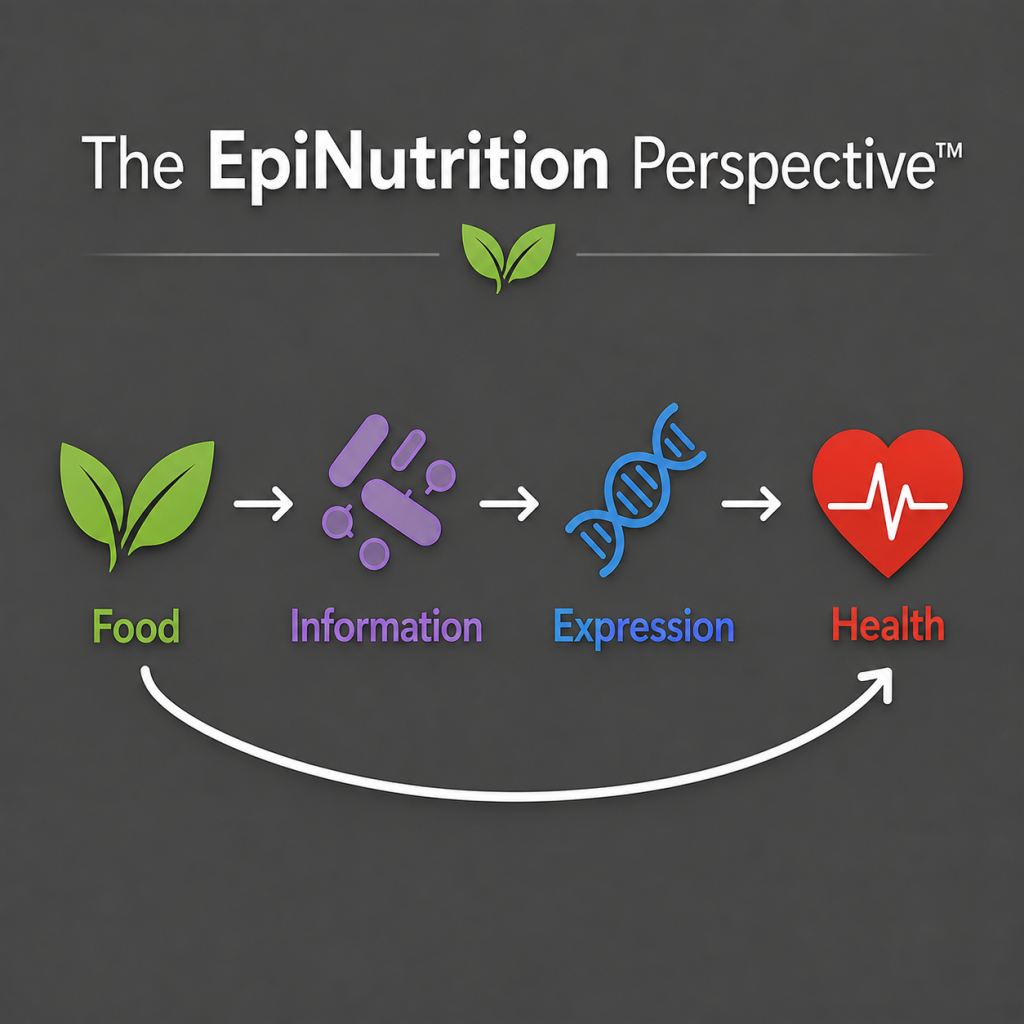
Food provides the starting materials.
The microbiome provides additional biochemical capabilities.
Together, they can generate molecules that were not present in the original food.
This is a crucial step in Food as Information because the biological potential contained within food has now been transformed into a new chemical environment.
Some of these compounds remain largely within the intestine. Others may be absorbed. Some may encounter human cells.
The microbiome has transformed the food.
The next step belongs to us.
Next: Human Cells — Receiving the Information
Our cells live within a constantly changing chemical environment.
They encounter nutrients, hormones, molecules produced by our own metabolism—and compounds whose origins can be traced back to food and the microorganisms that processed it.
But the presence of a molecule does not automatically make it meaningful.
A cell must be capable of recognizing or responding to it.
In Chapter 4, we will explore how human cells encounter this chemical environment and begin to turn the products of food and microbial metabolism into biological information.
Bibliography
- Koh A, De Vadder F, Kovatcheva-Datchary P, Bäckhed F. From dietary fiber to host physiology: short-chain fatty acids as key bacterial metabolites. Cell. 2016;165(6):1332–1345.
- Nicholson JK, Holmes E, Kinross J, et al. Host-gut microbiota metabolic interactions. Science.2012;336(6086):1262–1267.
- Agus A, Clément K, Sokol H. Gut microbiota-derived metabolites as central regulators in metabolic disorders. Gut.2021;70(6):1174–1182.
- Louis P, Flint HJ. Formation of propionate and butyrate by the human colonic microbiota. Environ Microbiol.2017;19(1):29–41.
- Flint HJ, Duncan SH, Scott KP, Louis P. Links between diet, gut microbiota composition and gut metabolism. Proc Nutr Soc. 2015;74(1):13–22.
- Rivière A, Selak M, Lantin D, Leroy F, De Vuyst L. Bifidobacteria and butyrate-producing colon bacteria: importance and strategies for their stimulation in the human gut. Front Microbiol. 2016;7:979.
- Duda-Chodak A, Tarko T, Satora P, Sroka P. Interaction of dietary compounds, especially polyphenols, with the intestinal microbiota: a review. Eur J Nutr. 2015;54:325–341.
- Ozdal T, Sela DA, Xiao J, Boyacioglu D, Chen F, Capanoglu E. The reciprocal interactions between polyphenols and gut microbiota and effects on bioaccessibility. Nutrients. 2016;8(2):78.
- Williamson G, Clifford MN. Colonic metabolites of berry polyphenols: the missing link to biological activity? Br J Nutr. 2010;104(S3)–S66.
- Windey K, De Preter V, Verbeke K. Relevance of protein fermentation to gut health. Mol Nutr Food Res.2012;56(1):184–196.
- Yao CK, Muir JG, Gibson PR. Review article: insights into colonic protein fermentation, its modulation and potential health implications. Aliment Pharmacol Ther. 2016;43(2):181–196.
- Diether NE, Willing BP. Microbial fermentation of dietary protein: an important factor in diet–microbe–host interaction. Microorganisms. 2019;7(1):19.
- Zeevi D, Korem T, Zmora N, et al. Personalized nutrition by prediction of glycemic responses. Cell.2015;163(5):1079–1094.
- Johnson AJ, Vangay P, Al-Ghalith GA, et al. Daily sampling reveals personalized diet–microbiome associations in humans. Cell Host Microbe. 2019;25(6):789–802.e5.