Chapter 5
Gene Expression: When Genetic Information Becomes Action
In the previous chapter, we introduced epigenetics as one of the systems cells use to regulate access to the information contained within DNA.
But having access to genetic information is not the same as using it.
For a gene to influence what a cell actually does, the information encoded within that gene must be put to work. Cells accomplish this through a fundamental biological process known as gene expression.
Gene expression is the process through which information contained within DNA is used to produce functional products, most commonly RNA and proteins. These products allow cells to build structures, perform chemical reactions, communicate, respond to their surroundings, repair damage, divide, differentiate, and carry out the thousands of activities required for life. [1–3]
In this sense, gene expression represents an important transition.
DNA stores information. Gene expression puts that information into action.
A Library of Genetic Information
The human genome contains approximately 20,000 protein-coding genes, along with extensive regions involved in regulating when and how genetic information is used. [1,2]
Yet no cell needs to use every gene at the same time.
A colon cell needs one pattern of activity. A liver cell requires another. A muscle cell needs proteins that allow it to contract, while an immune cell must be able to recognize and respond to potential threats.
These cells contain essentially the same DNA, but they use different portions of it.
One way to think about the genome is as an enormous biological library.
Every cell contains the library, but each cell selects different information from its shelves according to its identity and needs.
Gene expression is part of the process through which that selection becomes biological activity.
From DNA to RNA
For many genes, the first major step in gene expression is transcription.
During transcription, the information contained within a region of DNA is copied into a molecule of RNA. For protein-coding genes, this produces messenger RNA, or mRNA, which carries a working copy of the genetic information.
The DNA itself remains protected within the nucleus.
The cell makes a copy of the information it needs.
This provides an important layer of control. A cell does not need to permanently alter its DNA every time its circumstances change. Instead, it can change which genes are transcribed and how much RNA is produced.
A gene being used extensively may produce more RNA. Another gene may produce less. Others may remain relatively quiet.
Gene activity therefore behaves less like a collection of simple switches and more like a highly regulated control system. [3–5]
From RNA to Protein
For protein-coding genes, messenger RNA carries genetic instructions that can then be translated into protein.
Proteins perform much of the practical work of the cell.
Some proteins are enzymes that accelerate chemical reactions. Others form receptors that allow cells to detect their surroundings. Some provide cellular structure. Others transport molecules, repair DNA, regulate inflammation, control cell division, or help determine whether a damaged cell survives or is eliminated.
A change in gene expression can therefore change the amount of a particular protein available to the cell. And changing the proteins available to a cell can change what that cell is capable of doing.
This is where genetic information begins to become physiology.
Cells Do Not Express Genes at Random
Gene expression is carefully regulated.
Transcription factors can bind to particular regions of DNA and help increase or decrease the transcription of specific genes. Epigenetic mechanisms can influence whether regions of DNA are relatively accessible to this machinery. Hormones, growth factors, nutrients, cellular stress, inflammation, and many other conditions can influence regulatory pathways within the cell. [3–6]
These systems interact.
The cell continually integrates information about its identity, its internal condition, and its surroundings. That information helps determine which genes should be more active, which should be less active, and how long those responses should continue.
This responsiveness is essential to normal life.
When food becomes available, cells may adjust pathways involved in nutrient handling. When tissue is injured, cells can increase the activity of genes involved in repair. When an immune cell detects a threat, it can rapidly change expression of genes involved in defense.
Gene expression allows cells to respond without rewriting the underlying genome.
The Environment Around a Cell Matters
This brings us back to Food as Information.
In earlier chapters, we followed a progression from food to the microbiome and then to the new compounds produced through biological transformation. We then introduced epigenetics as one of the regulatory systems operating within human cells.
Gene expression helps us understand why that regulation matters.
Cells exist within a chemical environment. They encounter hormones, nutrients, microbial products, molecules generated by their own metabolism, signals from neighboring cells, and many other compounds.
Some of these conditions can activate cellular pathways that eventually influence the activity of particular genes. [5–8]
This does not mean that every molecule entering the body changes gene expression. Nor does it mean that eating a particular food predictably activates a particular gene.
Human biology is far too interconnected for that simple interpretation.
Instead, nutrition contributes to the biological environment in which cells make regulatory decisions.
The cell receives many inputs.
Gene expression is one way the cell responds.
Expression Is Dynamic
Gene expression is not fixed.
Some genes remain relatively stable in their activity because they support basic cellular functions. Others can change substantially over minutes, hours, days, or longer periods depending upon what the cell encounters.
These changes may be temporary.
A cell can increase expression of a gene when a particular protein is needed and reduce it when the need has passed. Other expression patterns are more persistent and help maintain the specialized identity of a cell.
This flexibility allows cells to adapt while preserving their fundamental characteristics.
It also explains why possessing a gene is not the same as continuously using that gene.
The genome contains possibilities.
Gene expression determines which of those possibilities are being used at a particular time.
Expression Becomes Behavior
This brings us to perhaps the most important idea in this chapter.
Genes do not directly create health. Genes provide information from which cells can produce the molecules needed to function. When patterns of gene expression change, the proteins and regulatory molecules within cells can also change. Those changes can influence what cells actually do.
A cell may alter how it uses energy. It may increase its defenses against cellular stress. It may repair damaged DNA. It may divide. It may mature into a more specialized state. It may communicate differently with neighboring cells. Or, when severely damaged, it may activate programs leading to its own elimination.
Gene expression therefore provides an important connection between information and cellular behavior.
This is why understanding gene expression matters.
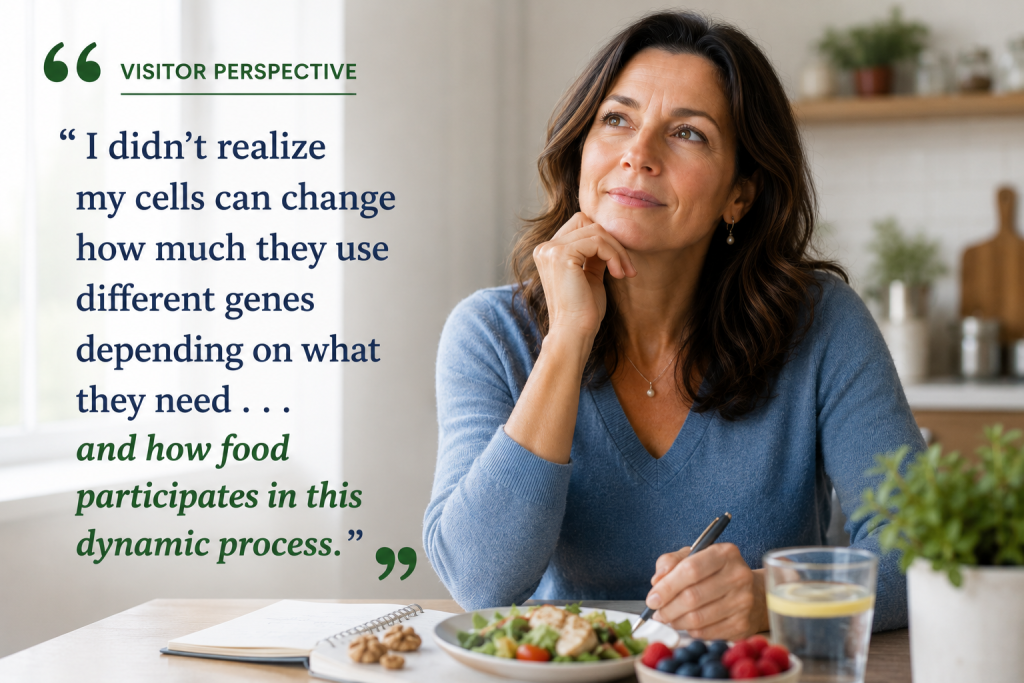
It takes us beyond what information a cell possesses and toward what the cell actually does with that information.
That observation captures one of the most important principles of modern biology.
Our genes are not all operating at maximum activity all the time.
Cells continually regulate which genetic information they use.
Some genes become more active. Others become less active. These changing patterns help cells adapt to their circumstances while continuing to perform their specialized functions.
Gene expression is therefore where stored genetic information begins to become biological action.
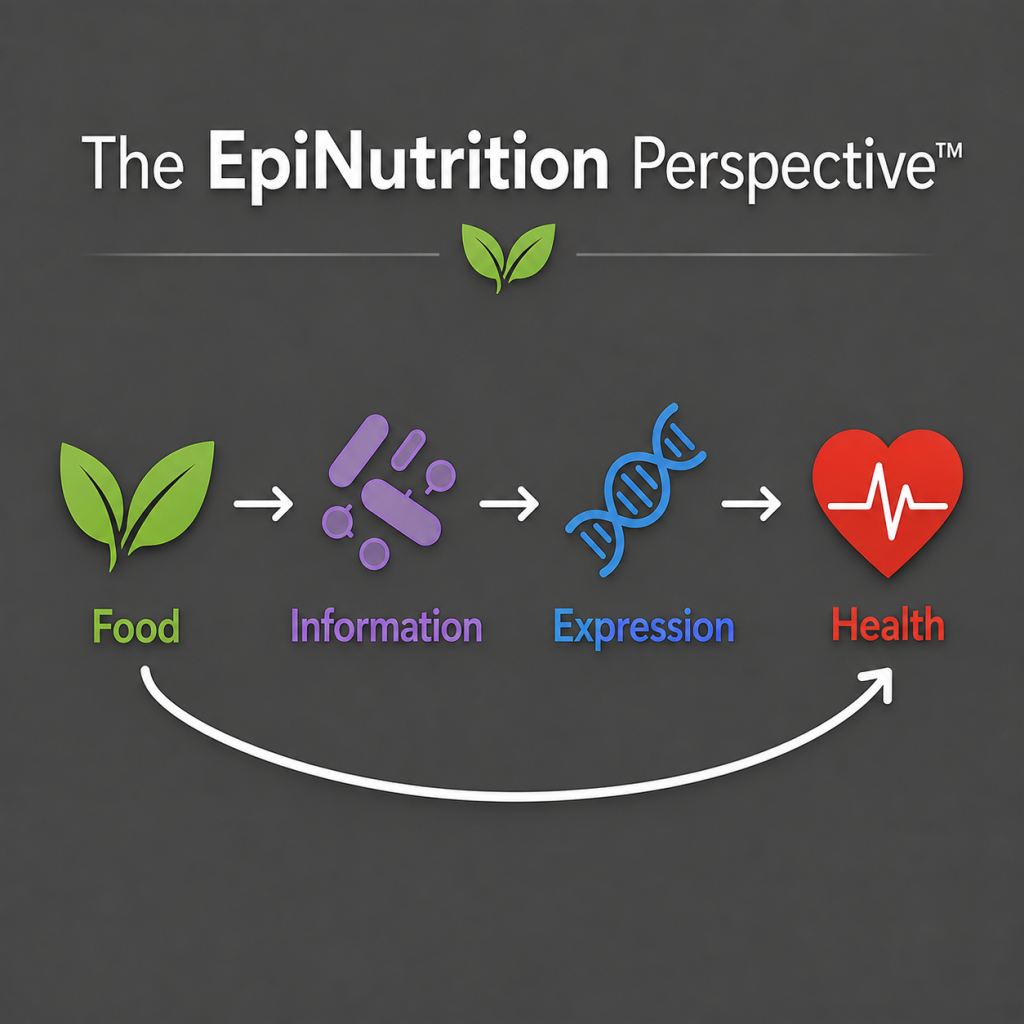
We began with food containing biological potential.
The microbiome expanded what could be done with that potential. Microbial activity created new compounds. Those compounds became part of the environment encountered by human cells.
Epigenetic mechanisms help regulate access to genetic information. And now gene expression allows that information to be used.
But gene expression is not the end of the story.
The proteins and other molecules produced by cells change what those cells actually do.
Information becomes function.
And when the behavior of many cells changes, the effects can extend beyond the individual cell to the tissues and organs those cells create.
That is where the Food as Information story goes next.
Next: From Gene Expression to Cell Function
A change in gene expression matters only if it ultimately changes biology.
Proteins must be produced. Enzymes must function. Cellular pathways must respond. Cells must maintain themselves, communicate, repair damage, divide appropriately, and perform the specialized tasks required by their tissues.
In the next chapter, we will examine the next transition in the information pathway:
How does changing gene expression become changing cell function?
Bibliography
- International Human Genome Sequencing Consortium. Finishing the euchromatic sequence of the human genome. Nature. 2004;431:931–945.
- ENCODE Project Consortium. An integrated encyclopedia of DNA elements in the human genome. Nature.2012;489:57–74.
- Alberts B, Johnson A, Lewis J, et al. Molecular Biology of the Cell. 6th ed. New York: Garland Science; 2015.
- Lee TI, Young RA. Transcriptional regulation and its misregulation in disease. Cell. 2013;152(6):1237–1251.
- Spitz F, Furlong EEM. Transcription factors: from enhancer binding to developmental control. Nat Rev Genet.2012;13:613–626.
- Cavalli G, Heard E. Advances in epigenetics link genetics to the environment and disease. Nature. 2019;571:489–499.
- Chandel NS. Navigating metabolism. Cold Spring Harb Perspect Biol. 2021;13(7).
- Efeyan A, Comb WC, Sabatini DM. Nutrient-sensing mechanisms and pathways. Nature. 2015;517:302–310.