Chapter 7
Tissue Health: When Healthy Cells Become Healthy Tissues
Until now, much of the Food as Information story has taken place at a microscopic level.
We began with food and followed its biological potential through the microbiome, the creation of new compounds, epigenetic regulation, gene expression, and cellular metabolism.
But human health does not exist at the level of a single cell. Cells live together. They communicate with one another, share resources, respond to common conditions, maintain physical structures, repair injury, and perform specialized functions as part of larger biological communities. Those communities are tissues.
A healthy tissue therefore requires more than healthy individual cells. It requires millions of cells to behave appropriately together.
This represents another important transition in Food as Information.
Cellular function must become coordinated tissue function.
A Cell Is Part of Something Larger
The human body contains hundreds of specialized cell types.
Muscle cells contract. Neurons transmit information. Liver cells perform complex metabolic functions. Immune cells defend against potential threats. Intestinal epithelial cells absorb, transport, communicate, and help maintain the boundary between the contents of the intestine and the rest of the body.
But none of these cells functions independently.
Cells are organized into tissues containing neighboring cells, blood vessels, nerves, immune cells, connective tissue, extracellular structures, and chemical signals that allow them to coordinate their activities.
The behavior of one cell can influence the cells around it.
The condition of the surrounding tissue can, in turn, influence the behavior of the individual cell.
Tissue health is therefore an emergent property—something that arises from the coordinated behavior of many interacting components. [1–3]
The Colon: A Living Community of Cells
The lining of the colon provides a particularly useful example.
The intestinal epithelium forms a continuous cellular barrier separating the enormous microbial community inside the intestinal lumen from the tissues beneath it. That barrier is only a single cell layer thick. Yet it must perform several demanding tasks simultaneously. Colon cells must obtain energy, maintain physical connections with neighboring cells, transport substances, communicate with immune cells, interact with microbial products, respond to injury, and preserve the integrity of the intestinal barrier. [4–6]
And they must do all of this while being continually replaced.
The intestinal epithelium is one of the most rapidly renewing tissues in the human body. Cells arise from stem cells located within intestinal crypts, proliferate, mature, perform specialized functions, and are eventually removed and replaced. [4,7]
Tissue health therefore requires a carefully coordinated balance between cell production, maturation, function, repair, and removal. Too little cell replacement can impair the barrier. Too much uncontrolled proliferation can also be dangerous.
The tissue must maintain balance.
Healthy Tissues Require Communication
Cells need to know what is happening around them.
They receive information from neighboring cells, immune cells, hormones, nerves, nutrients, microorganisms, and the extracellular environment. These signals help coordinate tissue behavior.
If the intestinal barrier is injured, cells can participate in repair. If microorganisms approach areas where they should not be present, immune and epithelial responses can be activated. If nutrients or energy availability change, cells can adjust their metabolic activity.
No single cell controls this process. Tissue function emerges from communication among many different cell populations. [2,5,8] This is why the biological effects of nutrition cannot be understood solely by asking what happens inside one isolated cell.
Cells exist in communities.
And communities create physiology.
The Importance of the Tissue Environment
The environment surrounding cells is sometimes called the tissue microenvironment.
It includes neighboring cells, immune cells, blood vessels, extracellular matrix, oxygen, nutrients, signaling molecules, microbial products, and many other components. This environment is not simply a background in which cells happen to live. It can influence how cells behave.
A healthy tissue environment can support appropriate cellular differentiation, communication, repair, and function. A persistently disturbed environment—such as one characterized by chronic inflammation, oxidative stress, barrier disruption, or abnormal cellular signaling—can alter the conditions experienced by the cells living within it. [8–10]
The relationship works in both directions.
Cells shape their environment. The environment shapes the cells.
This creates another biological feedback system.
Nutrition Becomes Part of the Tissue Environment
This brings nutrition back into the story.
The foods we eat do not arrive intact at our tissues. They are digested, transformed, absorbed, metabolized, and—in the colon—interacted with extensively by microorganisms. By the time nutrition influences a tissue, the original food has become part of a much larger biological environment.
This distinction matters.
A healthy dietary pattern does not simply “feed” an organ directly. Rather, nutrition can help shape the availability of substrates, microbial activity, circulating nutrients, metabolic conditions, and other aspects of the environment in which tissues function.
The effects can also differ among tissues.
The colon is exposed directly to the contents of the intestinal lumen and to products of microbial activity. The liver receives many absorbed substances through the portal circulation. Muscle responds strongly to physical activity and energy availability. Adipose tissue participates in energy storage and endocrine signaling.
Each tissue experiences nutrition through its own physiology.
Food enters one body, but different tissues experience it differently.
Tissue Health Is About Balance
Healthy tissues are remarkably dynamic.
Cells are continually being damaged and repaired. Proteins are constructed and dismantled. Old cells are removed. New cells replace them. Immune cells patrol tissues. Blood vessels deliver oxygen and nutrients. Cellular waste is cleared.
Health does not mean that nothing ever goes wrong.
Health depends upon the ability to maintain and restore balance.
Biologists often describe this ability as homeostasis.
Homeostasis is not a static condition. It is an active process through which biological systems continually adjust to changing circumstances while preserving essential functions. [1,11]
This is particularly evident in the intestine.
Every meal changes the intestinal environment. Microbial activity changes. Substrates change. The epithelial surface encounters mechanical and chemical challenges. Yet the tissue normally preserves its structure and function.
That resilience is one of the defining characteristics of healthy tissue.
When Cellular Changes Accumulate
A single temporary change in a cell does not necessarily change the health of an entire tissue. Tissues contain redundancy, repair mechanisms, immune surveillance, and systems for removing damaged cells. But when abnormal conditions persist, or when regulatory systems repeatedly fail, changes can begin to accumulate.
Chronic inflammation can alter the tissue environment. Persistent oxidative stress can increase cellular damage. Failure of normal repair can compromise tissue integrity. Abnormal proliferation can disrupt normal tissue architecture. Loss of appropriate differentiation can cause cells to behave less like the specialized cells the tissue requires. [9,10,12]
At that point, what began as cellular dysfunction can become tissue dysfunction.
This is an important transition.
Disease often does not begin with an entire organ suddenly becoming abnormal.
It can begin much earlier, as normal relationships among cells, their environment, and their regulatory systems gradually become disturbed.
From Cells to Human Biology
We can now see the Food as Information story at a much larger scale.
Food introduced biological potential.
The microbiome expanded and transformed some of that potential.
New compounds became part of the biological environment.
Cells encountered that environment.
Epigenetic regulation helped control access to genetic information.
Gene expression influenced cellular activity.
Metabolism determined how cells managed energy and resources.
But none of those processes occurs in isolation.
Millions of cells must coordinate their behavior to create functioning tissues.
And tissues must work together to create functioning organs.
The information that began with food has now entered human physiology.
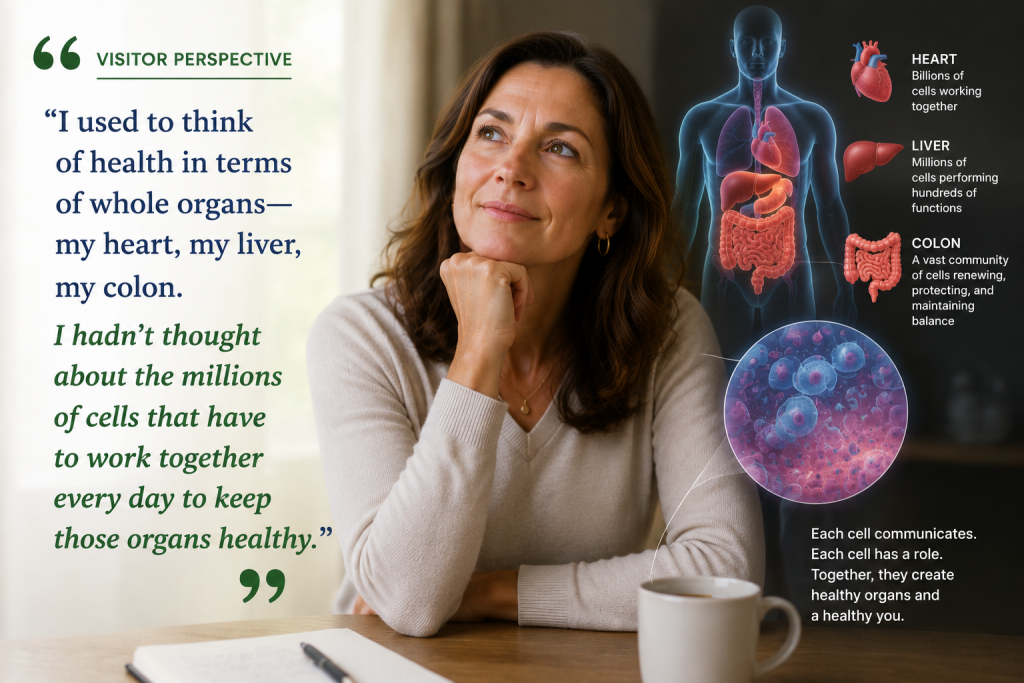
That observation captures the central message of this chapter.
An organ is not a single biological object.
It is a living community.
Its health depends upon cells obtaining appropriate resources, communicating with one another, maintaining their specialized functions, repairing damage, replacing aging cells, and preserving the structure of the tissue they create.
Nutrition participates in that environment.
But once again, it does not act alone.
Genetics, age, physical activity, sleep, hormones, medications, microorganisms, environmental exposures, immune activity, and many other influences contribute to tissue health.
Food is one participant in an interconnected biological system.
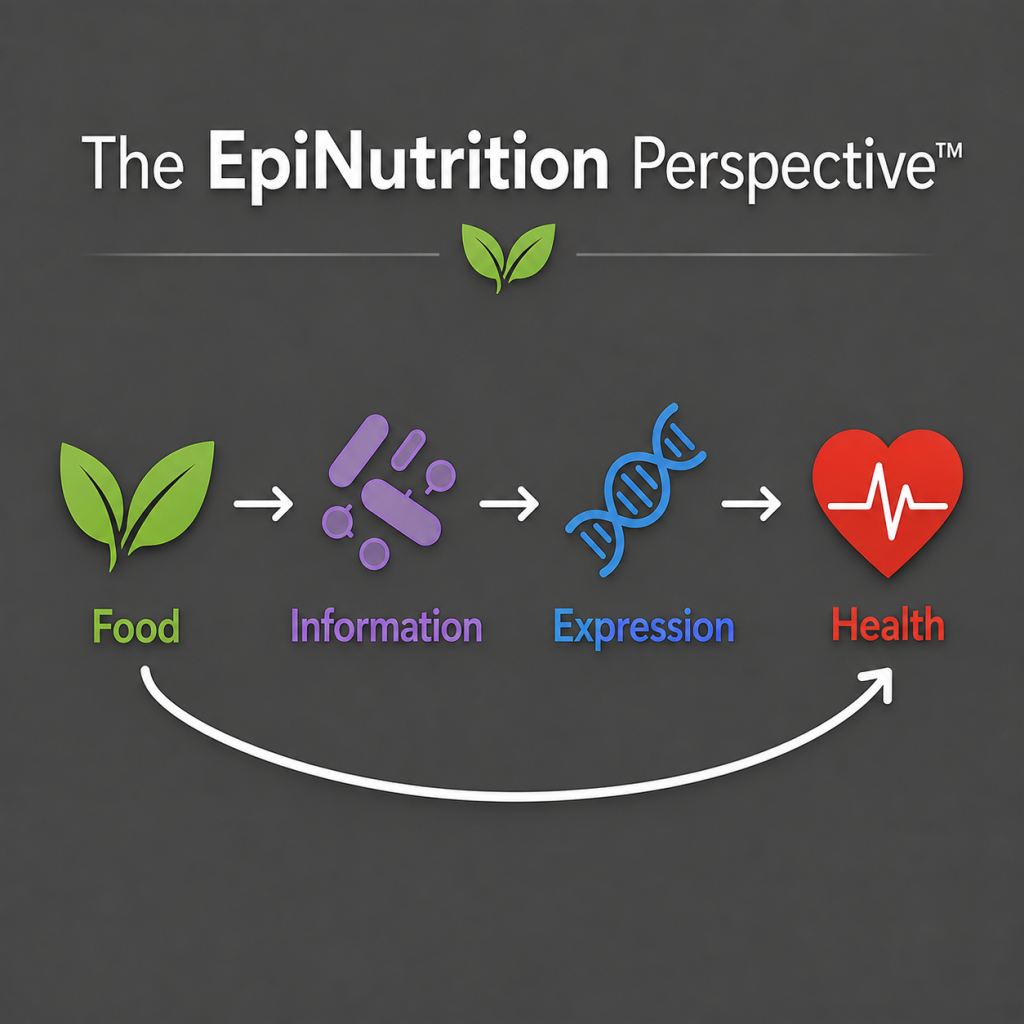
The Food as Information story has now traveled from the plate to the tissue.
At every stage, the original food has become less recognizable while its biological consequences have become more integrated into human physiology.
This is an important point.
Food does not determine tissue health.
Rather, nutrition participates in the biological environment that allows tissues to maintain themselves, adapt, repair, and function.
Healthy tissues emerge when enormous numbers of cells successfully coordinate these activities over time.
And when healthy tissues work together, something even larger emerges:
the health and function of the person.
Next: Health & Well-Being — The Whole Person
We began with a surprisingly simple question:
Can food be more than nutrition and fuel?
We have now followed that question from food through microorganisms, chemical transformation, epigenetics, gene expression, cellular metabolism, and tissue function.
But people do not experience health as pathways, genes, or cells.
We experience health as human beings.
We move.
We think.
We work.
We sleep.
We recover.
We age.
We live within families and communities.
In the next chapter, we will bring the Food as Information story back to the person and ask the question that ultimately matters:
What might all of this mean for health and well-being over a lifetime?
Bibliography
- Chovatiya R, Medzhitov R. Stress, inflammation, and defense of homeostasis. Mol Cell. 2014;54(2):281–288.
- Clevers H, Rafelski S, Elowitz M, et al. What is your conceptual definition of “cell type” in the context of a mature organism? Cell Syst. 2017;4(3):255–259.
- Bissell MJ, Hines WC. Why don’t we get more cancer? A proposed role of the microenvironment in restraining cancer progression. Nat Med. 2011;17:320–329.
- Barker N. Adult intestinal stem cells: critical drivers of epithelial homeostasis and regeneration. Nat Rev Mol Cell Biol. 2014;15:19–33.
- Peterson LW, Artis D. Intestinal epithelial cells: regulators of barrier function and immune homeostasis. Nat Rev Immunol. 2014;14:141–153.
- Allaire JM, Crowley SM, Law HT, Chang SY, Ko HJ, Vallance BA. The intestinal epithelium: central coordinator of mucosal immunity. Trends Immunol. 2018;39(9):677–696.
- Clevers H. The intestinal crypt, a prototype stem cell compartment. Cell. 2013;154(2):274–284.
- Medzhitov R. Origin and physiological roles of inflammation. Nature. 2008;454:428–435.
- Hanahan D. Hallmarks of cancer: new dimensions. Cancer Discov. 2022;12(1):31–46.
- Quail DF, Joyce JA. Microenvironmental regulation of tumor progression and metastasis. Nat Med. 2013;19:1423–1437.
- Cannon WB. Organization for physiological homeostasis. Physiol Rev. 1929;9(3):399–431.
- López-Otín C, Blasco MA, Partridge L, Serrano M, Kroemer G. Hallmarks of aging: an expanding universe. Cell.2023;186(2):243–278.