Hold a dry bean in your hand.
It is small, hard, and quiet. It does not look alive. It looks like something waiting to be soaked, simmered, and added to a meal.
But the bean has already traveled a remarkable distance.
It began with an earlier seed placed in soil. Water entered that seed and awakened its metabolism. A root emerged and grew downward. A shoot reached toward light. Leaves captured energy from the sun. Roots drew water and minerals from the soil. Microorganisms living near and within the roots helped the plant acquire nitrogen. Using carbon dioxide from the atmosphere, the plant assembled carbohydrates, proteins, fibers, and thousands of other molecules.
Some of those materials were eventually packed into a new seed.
The bean in your hand is that seed.
Inside its protective coat are two large cotyledons—the storage tissues that will nourish a young plant if the seed is planted. Between them lies an embryonic plant, complete with the beginnings of a root, stem, and leaves. The bean contains stored starch, protein, fiber, minerals, and many other compounds organized within cells and tissues.
It is not simply a collection of nutrients.
It is a biological structure containing possibilities.
Plant the bean under suitable conditions and it can resume growth. Cook and eat it, and those same materials enter a different living system. The bean will not grow into a plant inside us. Instead, cooking, digestion, microorganisms, and human metabolism will take it apart and transform it into something new.
This book follows that transformation.
Why follow a bean?
Beans are ordinary enough to be overlooked and important enough to help explain much of nutrition.
Common beans—Phaseolus vulgaris—include black, kidney, pinto, navy, cranberry, and many other familiar varieties. They have been cultivated for thousands of years and carried across continents through agriculture, trade, migration, and cultural exchange. Along with lentils, chickpeas, peas, cowpeas, and other pulses, beans have supplied affordable food to generations of people.
They can be dried and stored. They provide carbohydrate, protein, fiber, folate, potassium, iron, and other nutrients. They appear in soups, stews, salads, porridges, pastes, breads, side dishes, and meals paired with grains. Their preparation connects botany with cooking, tradition with food safety, and household practice with chemistry.
The bean also presents an unusually clear scientific journey.
Two pathways guide this book. The Biological Journey follows what happens to the bean. The Evidence Pathway identifies what science must demonstrate before a biological possibility can be considered a human health effect.
Pathway 1 — The Biological Journey
The Biological Journey can be organized as follows:
Soil → Seed → Plant → Bean → Kitchen → Digestion → Microbiome → Metabolites → Cellular Sensing → Gene Regulation → Metabolism → Tissue Function → Health
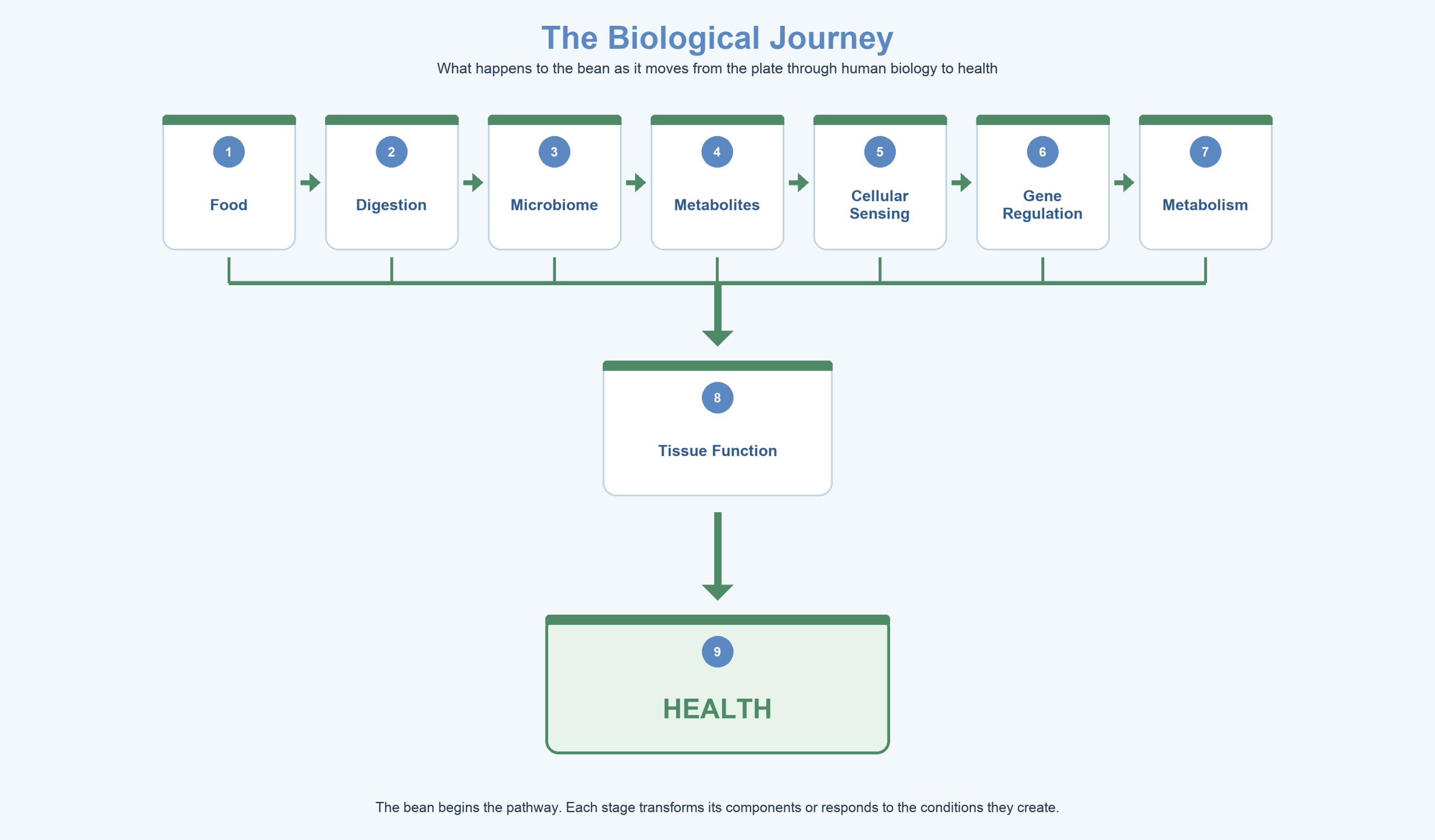
Each stage changes what the bean can become.
The soil supplies water and minerals and supports microbial relationships around the plant’s roots. The plant captures solar energy and uses it to build the seed. Agriculture selects, cultivates, harvests, stores, and distributes the bean. The kitchen hydrates and heats it, changing its structure and making it edible. Digestion dismantles it and separates its components into different routes.
Its starch and protein are enclosed within plant cells. Cooking softens its tissues and changes the organization of those nutrients. Chewing ruptures some cells while leaving others partly intact. Human enzymes digest what they can reach. Absorbable sugars, amino acids, minerals, and other compounds cross the intestinal surface through regulated pathways.
Not everything is absorbed.
Fiber, resistant starch, oligosaccharides, intact plant structures, and associated compounds continue toward the colon. There they encounter a dense microbial community with biochemical abilities different from our own. Microorganisms act on what human digestion leaves behind. In doing so, they produce metabolites that were not present in the original bean.
Some metabolites remain in the colon. Some interact with intestinal cells. Some enter circulation and are modified further by the liver. Cells detect these changing conditions through receptors, transporters, enzymes, and signaling pathways. Cellular responses influence gene activity, metabolism, communication, repair, and tissue function.
The bean that began in the soil has now become part of the biological environment of a person.
No stage acts alone.
Remove cooking, and some beans are unsafe or difficult to digest. Change the physical structure, and enzymes gain different access to starch and protein. Change the microbial community, and the products of fermentation may change. Change the meal, the person, or the dietary pattern, and the biological response may change with it.
The bean carries potential into the pathway. Living systems determine how that potential is expressed.
Following the evidence
Pathway 2 — The Evidence Pathway
Following the journey requires more than identifying what the bean contains.
Finding a compound in a bean does not establish that the compound reaches human tissues or improves health.
A second pathway must accompany the Biological Journey. This is the Evidence Pathway:
Content → Bioaccessibility → Bioavailability → Bioactivity → Health effect
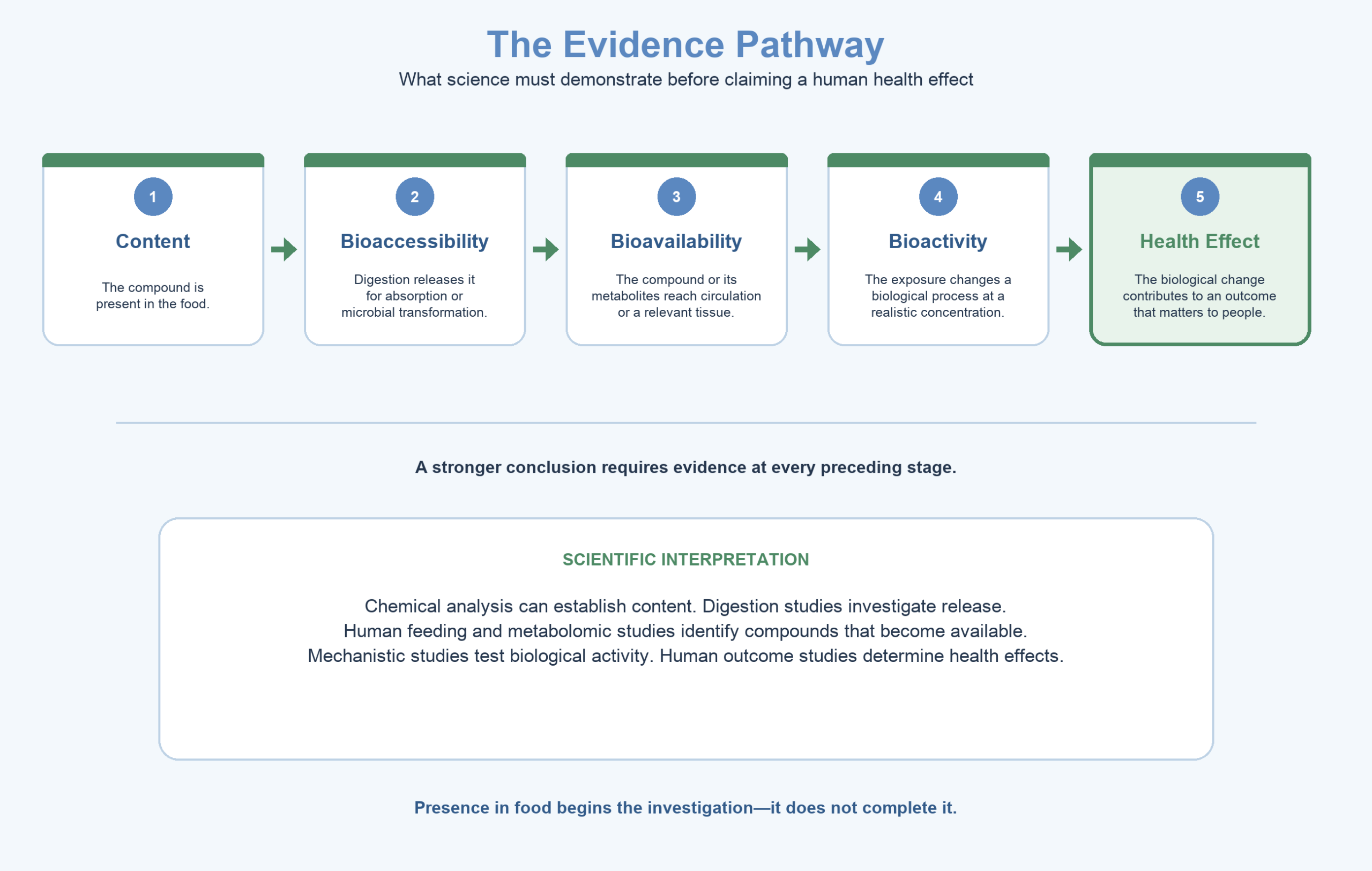
Content asks what is present in the bean.
Bioaccessibility asks what cooking and digestion release in a form available for absorption or microbial transformation.
Bioavailability asks whether the compound—or a metabolite made from it—reaches circulation, the intestinal environment, or another relevant site.
Bioactivity asks whether that exposure changes a biological process at a realistic concentration.
Health effect asks whether the biological change contributes to an outcome that matters to people.
Each question requires different evidence.
Chemical analysis can measure what a bean contains. Digestion studies can investigate what its matrix releases. Human feeding studies can identify nutrients and metabolites appearing in blood, urine, or feces. Cell and animal studies can explore mechanisms. Controlled human trials can measure physiological responses. Long-term studies can examine relationships between bean-containing dietary patterns and disease, function, or survival.
No single experiment completes the journey.
The claim becomes stronger when evidence connects the stages—when what is present in the food can be followed through transformation, exposure, biological response, and meaningful human outcomes.
The chapters ahead will make those connections visible. They will also identify where a connection remains uncertain.
An ordinary food with an extraordinary biography
The original bean eventually disappears, but its biological consequences remain. Its nutrients enter metabolism. Its resistant materials reach the microbiome. Its metabolites encounter human cells. Researchers can then ask whether these events alter tissue function and contribute to health.
This is the scientific biography of an ordinary bean:
Every food has a history before we eat it and a biological future after we do.
The bean allows us to follow both.
The journey begins
We will begin where the bean begins—as a seed.
Its dry exterior conceals a living embryo, stored reserves, protective structures, and the results of an entire growing season. To understand what cooking and digestion will later transform, we must first understand what the plant placed inside the bean and why it is there.
The bean is quiet in your hand.
Its journey is about to begin.