
When the Balance Between Cell Renewal and Cell Removal Begins to Change
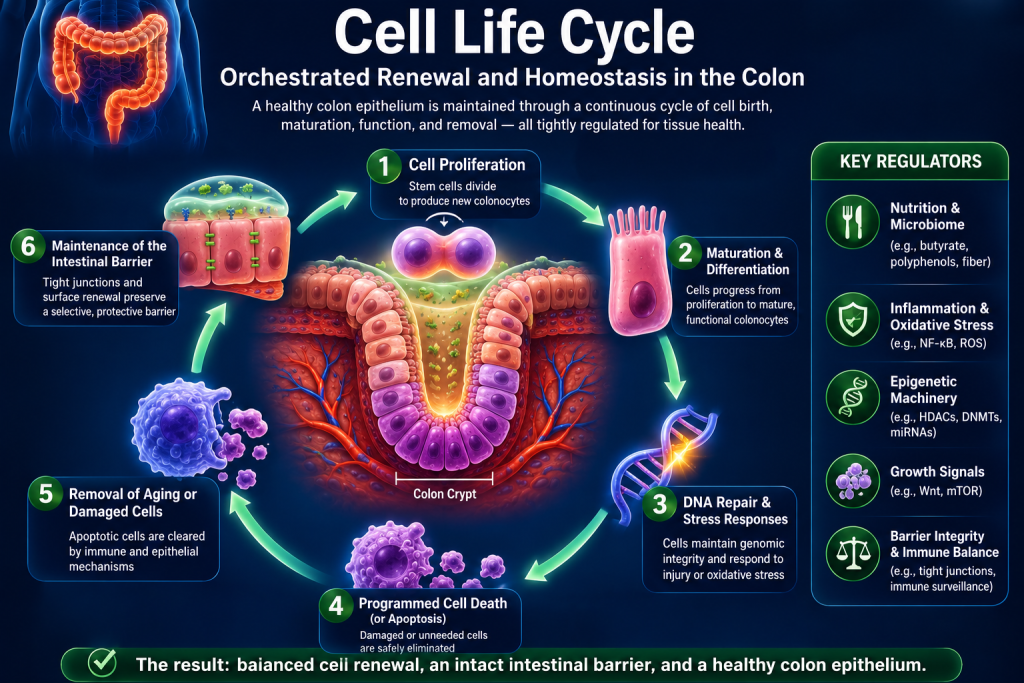
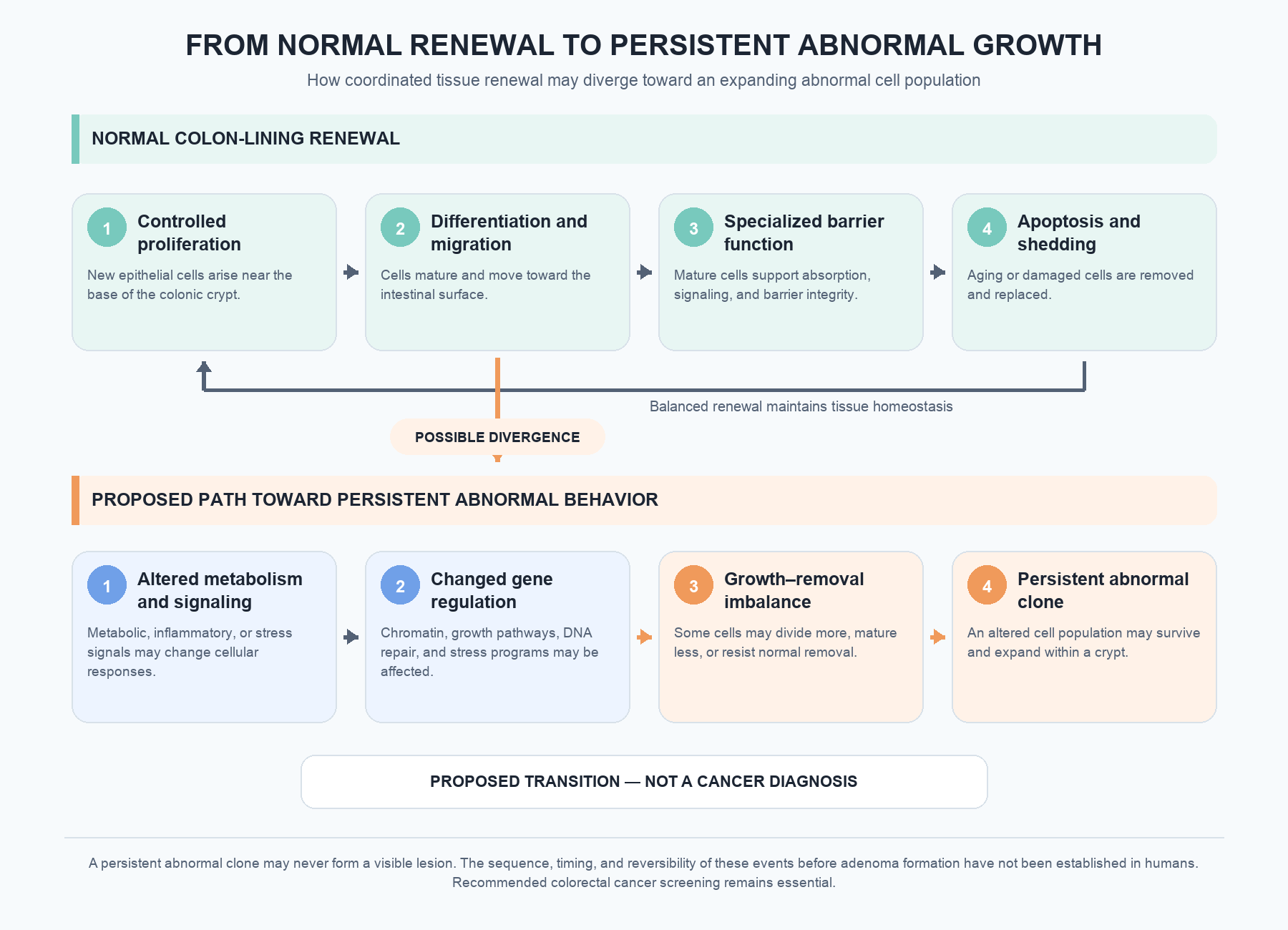
The colon lining is one of the body’s most actively renewed tissues. New epithelial cells arise near the base of the colonic crypt, mature as they move toward the intestinal surface, perform specialized functions, and are eventually removed and replaced.
When Abnormal Cell Behavior Begins
Abnormal cell behavior begins when parts of this coordinated system become persistently altered. Cells may divide when they should remain quiet, fail to mature normally, respond differently to stress, or remain alive when they would ordinarily be removed.
These changes do not necessarily mean that a cell is cancerous. Many molecular safeguards must be disrupted before a cell can form a persistent abnormal clone or visible lesion.
How Metabolism Can Influence Cell Behavior
Cellular metabolism does more than generate energy. It also determines the availability of molecules used in signaling, antioxidant defense, DNA synthesis, and the chemical modification of proteins and chromatin.
A Warburg-like metabolic pattern can therefore be associated with changes in:
- Growth and survival signaling
- Cellular stress responses
- Redox balance
- Production of materials needed for cell division
- Regulation of gene activity
- Interactions with immune and inflammatory signals
Metabolism and gene regulation influence one another. Genetic or epigenetic changes can alter metabolism, while metabolic changes can affect signaling and chromatin regulation.
The direction of cause and effect may differ among cells and stages of disease.
From an Altered Cell to a Visible Lesion
A single abnormal cell does not inevitably become a polyp or cancer.
For an altered cell population to persist, some cells must gain a selective advantage within the colonic crypt. Over time, additional genetic, epigenetic, metabolic, and environmental changes may allow an abnormal clone to expand.
Adenomas and serrated lesions are themselves biologically diverse. Studies of human precursor lesions show different patterns of proliferation, apoptosis, and regulatory proteins, reinforcing that colorectal carcinogenesis does not follow one identical pathway in every person.
Screening can identify and remove many of these visible precursor lesions before they progress further.
References
- Figueiredo JC, Passarelli MN, Wei W, Ahnen DJ, Morris JS, Corley L, et al. Proliferation, apoptosis and their regulatory protein expression in colorectal adenomas and serrated lesions. PLoS One. 2021;16(11). doi: 10.1371/journal.pone.0258878. PMID: 34762658; PMCID: PMC8580290.
- Donohoe DR, Collins LB, Wali A, Bigler R, Sun W, Bultman SJ. The Warburg effect dictates the mechanism of butyrate-mediated histone acetylation and cell proliferation. Molecular Cell. 2012;48(4):612–626. doi: 10.1016/j.molcel.2012.08.033. PMID: 23063526; PMCID: PMC3513569.
- Dela Cruz M, Ledbetter S, Chowdhury S, Tiwari AK, Momi N, Wali RK, et al. Metabolic reprogramming of the premalignant colonic mucosa is an early event in carcinogenesis. Oncotarget. 2017;8(13):20543–20557. doi: 10.18632/oncotarget.16129. PMID: 28423551; PMCID: PMC5400525.