
Why the Colon?
The Challenge We Face
Colorectal cancer is changing.
For decades, it was considered a disease of older adults. Today, however, colorectal cancer is increasing in adults in their 20s, 30s, and 40s, often in people with no family history and few recognizable risk factors.
Although routine screening has dramatically reduced colorectal cancer deaths in older adults, most average-risk screening programs begin at 45 years of age. Consequently, many younger adults develop colorectal cancer before they ever become eligible for routine screening.
This growing gap highlights an important challenge.
How can healthy behaviors support colon health during the years before routine screening begins?
Looking Earlier
Current screening remains essential and saves lives by detecting and removing precancerous polyps.
But screening is designed to find disease after biological changes have already occurred.
EpiNutrition explores a complementary question:
Could nutrition help support healthier colon biology before visible disease develops?
Rather than replacing screening, this approach seeks to understand whether everyday dietary choices can influence the biological environment in which colorectal cancer begins.
Why the Colon?
The colon is uniquely suited for nutritional prevention because it is one of the few organs that is continuously influenced by food, the gut microbiome, and the metabolites those microbes produce.
Every meal changes the biological environment within the colon.
Beneficial dietary patterns promote microbial production of compounds such as butyrate that nourish colon cells and influence epigenetic regulation. These signals help maintain normal cellular function, support healthy gene expression, and preserve the integrity of the colonic lining.
How Nutrition May Support Colon Health
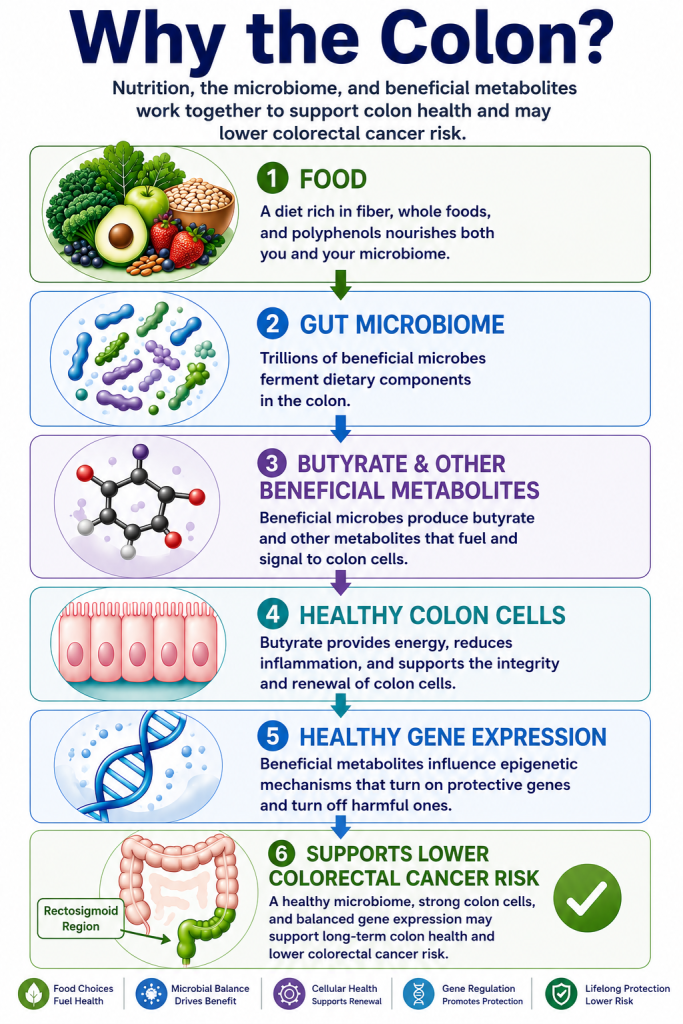
The Colon Is a Living Ecosystem
Unlike most organs, the colon functions as a complex biological ecosystem where nutrition, microbes, metabolism, and human cells interact continuously.
Healthy foods provide fuel for beneficial microorganisms.
These microorganisms generate metabolites—including butyrate—that serve not only as energy for colon cells but also as molecular signals that regulate inflammation, cellular repair, and gene expression.
Because this interaction occurs every day throughout life, the colon represents one of the body’s most dynamic opportunities for nutritional influence.
What This Means for You
The increasing incidence of colorectal cancer in younger adults reminds us that prevention may need to begin long before their first recommended screening test.
While screening remains one of the most effective tools for preventing colorectal cancer, maintaining a healthy colonic environment throughout life may provide an additional opportunity to support long-term colon health.
Understanding how nutrition influences the microbiome, microbial metabolites, and epigenetic signaling offers a new way of thinking about prevention—one that begins not in the endoscopy suite, but at the dinner table.
The goal of EpiNutrition is not to replace colorectal cancer screening. Our goal is to explore how nutrition may help support healthier colon biology during the years before routine screening begins
Current scientific guidance
- American Cancer Society 2026 colorectal cancer screening guideline
- National Cancer Institute: colorectal cancer prevention
- WCRF/AICR cancer-prevention recommendations as a pattern
Nutrition and activity may influence modifiable risk, but they do not replace recommended screening or evaluation of symptoms.