Chapter 9 Metabolic Reprogramming: The Beginning of Colorectal Cancer
For more than a century, colorectal cancer has been understood primarily as a genetic disease driven by the gradual accumulation of mutations (Fearon ER et al 1990). Although mutations in APC, KRAS, TP53, and numerous other genes undoubtedly contribute to tumor progression, this explanation is incomplete. Before these genetic alterations become established, the colonocyte undergoes a profound reprogramming of its metabolism in response to the stresses of dysbiosis. The question is: how does the colonocyte respond?
The Warburg Effect-The Pivotal Step
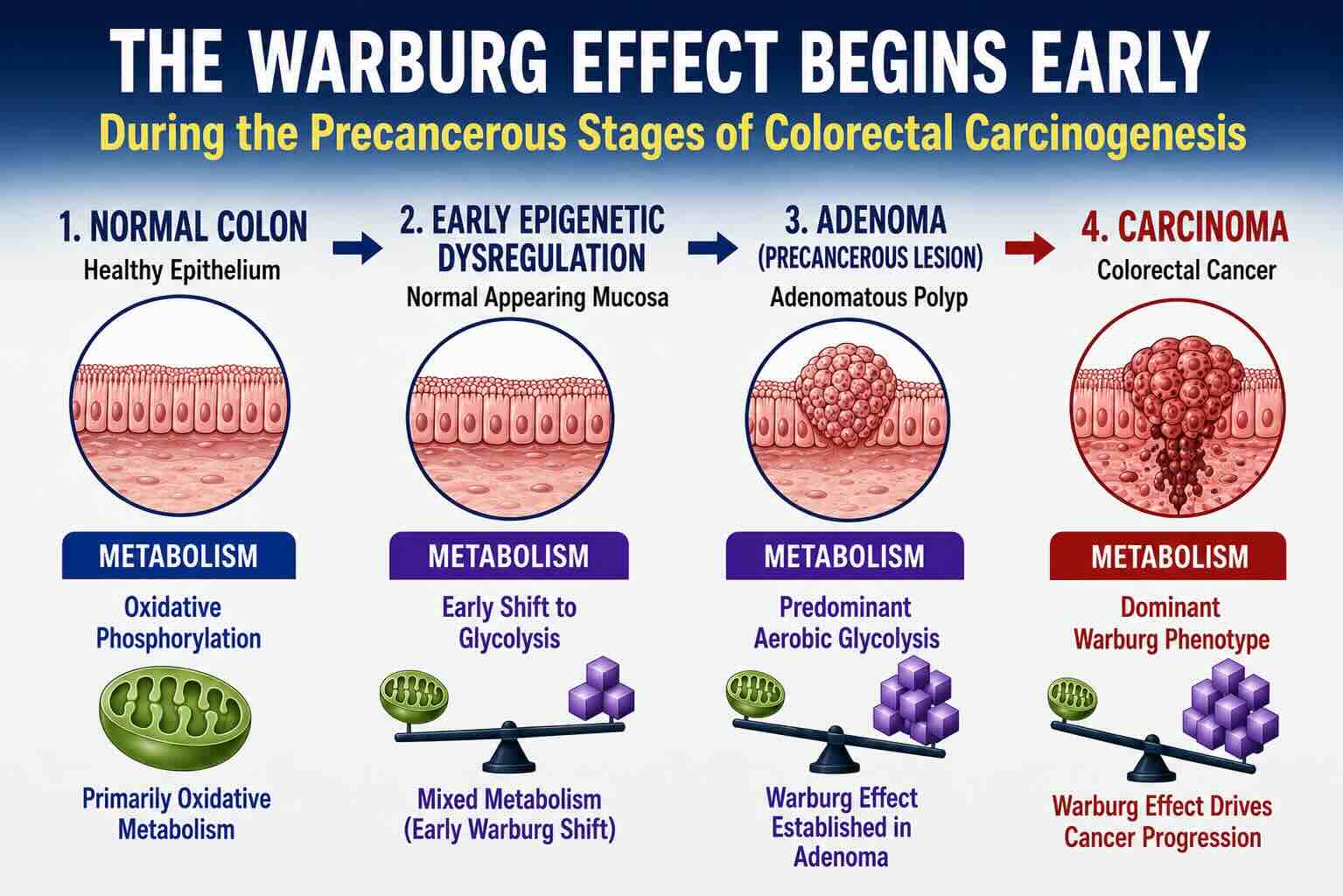
Current evidence suggests that, in response to persistent butyrate deficiency and metabolic stress, many colonocytes progressively adopt a Warburg-like metabolic phenotype (Libert MV et al 2016).
Initially, the colonocyte compensates for starvation by increasing glucose utilization to maintain energy production. Although this adaptation is initially protective, persistent butyrate deficiency gradually shifts the cell away from mitochondrial oxidative phosphorylation toward aerobic glycolysis despite the continued presence of oxygen. This metabolic transition is known as the Warburg Effect.
Although the Warburg Effect has traditionally been regarded as a hallmark of established cancer, increasing evidence suggests that it begins much earlier during the precancerous stages of colorectal carcinogenesis. Rather than representing a consequence of malignancy, it appears to be one of the earliest functional events that drives malignant transformation.
Tap to enlarge. Rotate phone and pinch to zoom
Evidence Base
Much of our current understanding of metabolic reprogramming comes from complementary lines of investigation. Human studies consistently demonstrate that metabolic alterations, increased glycolysis, lactate production, and dysregulated nutrient-sensing pathways are characteristic features of colorectal tumors and often appear in precancerous lesions. The detailed molecular mechanisms linking altered metabolism to epigenetic remodeling have been defined primarily through cell culture and animal models, where individual pathways can be experimentally manipulated. Together, these human, animal, and mechanistic studies support the concept that metabolic reprogramming is an early event in colorectal carcinogenesis (Hanrahan D 2022, DeBerardinis RJ et al 2016, Donohoe DR et al 2014).
How Warburg Effect Supports Cancer
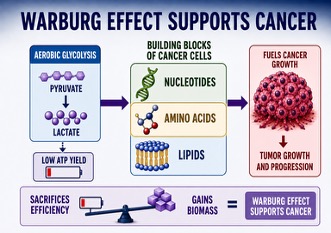
The Warburg effect does far more than alter cellular energy production. By shifting metabolism from mitochondrial oxidative phosphorylation to aerobic glycolysis, it creates an environment that actively supports every stage of tumor development.
One of its primary advantages is the rapid generation of biosynthetic precursors. Although aerobic glycolysis produces less ATP per molecule of glucose than oxidative phosphorylation, it diverts glucose intermediates into pathways that generate nucleotides, amino acids, and lipids.
Tap to enlarge. Rotate your phone and pinch to zoom
These building blocks are essential for DNA replication, membrane synthesis, and continuous cell division (Faubert B et al 2020). Rapidly proliferating cells therefore sacrifice metabolic efficiency in exchange for abundant raw materials needed for growth.
The Warburg effect also enhances glucose uptake. This metabolic rewiring enables tumor cells to consume glucose at exceptionally high rates, ensuring a continuous supply of carbon for proliferation.
A second major consequence is the production of large amounts of lactate. Once considered merely a waste product, lactate is now recognized as an important signaling molecule. Export of lactate acidifies the tumor microenvironment, facilitating degradation of the extracellular matrix, promoting local invasion, and enhancing metastatic spread.
The acidic environment also suppresses the activity of cytotoxic T lymphocytes and natural killer cells, allowing cancer cells to evade immune surveillance.
The Warburg phenotype further supports survival by reducing dependence on normal mitochondrial respiration. Although mitochondrial function is not completely lost, decreased reliance on oxidative phosphorylation allows many cancer cells to tolerate fluctuating oxygen concentrations within poorly vascularized tumors. This metabolic flexibility improves survival during hypoxia and other forms of cellular stress.
Metabolic reprogramming also interacts closely with oncogenic signaling pathways. Persistent activation of PI3K, AKT, and mTOR stimulates glycolysis while simultaneously promoting protein synthesis, cell growth, and proliferation. These pathways reinforce one another, creating a positive feedback loop in which anabolic signaling sustains the Warburg phenotype, and glycolytic metabolism further activates growth-promoting pathways.
Perhaps most importantly, the Warburg effect contributes directly to epigenetic dysregulation (Esteller M 2008, Baylin SB 2016).
Metabolism Rewrites the Epigenetic Program
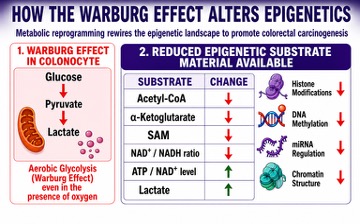
Metabolism and epigenetic regulation are inseparable (Lu C 2012, Kaelin WG Jr 2013). Cellular metabolism supplies the molecular substrates required for DNA methylation, histone modification, chromatin remodeling, and numerous other epigenetic processes. Consequently, when cellular metabolism changes, the epigenetic landscape changes with it.
As glycolytic metabolism becomes established, widespread alterations occur in DNA methylation, histone acetylation, chromatin accessibility, and microRNA expression. These changes progressively silence tumor suppressor genes while activating pathways that promote inflammation, proliferation, angiogenesis, and resistance to apoptosis. In this way, altered metabolism becomes a major driver of the epigenetic instability that characterizes early colorectal carcinogenesis.
One important consequence of this metabolic transition is the progressive loss of butyrate oxidation. Healthy colonocytes rapidly metabolize butyrate within their mitochondria. Glycolytic colonocytes, however, lose much of this oxidative capacity.
Additional nutrient-sensing pathways reinforce this altered metabolic state. Persistent activation of the mechanistic target of rapamycin (mTOR), stimulated in part by amino acids such as leucine, further promotes glycolysis, protein synthesis, angiogenesis, and resistance to apoptosis while interacting extensively with the epigenetic machinery governing gene expression.
Tap to enlarge. Rotate your phone and pinch to zoom
Rather than functioning independently, metabolism, nutrient sensing, and epigenetic regulation become increasingly integrated into a self-reinforcing network that drives malignant progression.
Conclusion
Viewed from this perspective, colorectal cancer is not simply a disease of accumulated mutations. It is a disease of progressive metabolic reprogramming that ultimately reshapes the epigenetic landscape of the colonocyte. The earliest detectable abnormalities are functional rather than structural. Long before tumors become visible, colonocytes lose their dependence on butyrate, adopt Warburg metabolism, undergo widespread epigenetic reprogramming, and create a biological environment that increasingly favors the later accumulation of irreversible genetic mutations.
The genome provides the blueprint, but metabolism determines how that blueprint is interpreted. As oxidative metabolism gives way to glycolysis, the colonocyte progressively abandons the differentiated program that maintains normal tissue homeostasis and acquires the proliferative phenotype characteristic of malignant transformation.
Although many of the molecular details have been established experimentally, the convergence of human pathology, molecular biology, and translational research provides strong evidence that metabolic reprogramming is not merely a consequence of colorectal cancer but an important driver of its earliest development.
The Warburg Effect is therefore not simply a hallmark of established colorectal cancer; it is the biological engine that drives its earliest development.
Looking Ahead
The Warburg Effect represents one of the pivotal metabolic transitions in colorectal carcinogenesis. As colonocytes lose their ability to efficiently oxidize butyrate and become increasingly dependent on aerobic glycolysis, the metabolic program that once maintained normal cellular differentiation is replaced by one that favors proliferation, survival, and epigenetic instability. At first glance, this transition appears to mark a point of no return.
Remarkably, however, this metabolic reprogramming creates an unexpected vulnerability.
Healthy colonocytes rapidly consume butyrate as their primary mitochondrial fuel, leaving little available to influence gene expression. In contrast, colonocytes that have adopted Warburg metabolism oxidize butyrate inefficiently. Rather than being consumed for energy, butyrate begins to accumulate within the nucleus, where it assumes an entirely different role—as one of the body’s most powerful naturally occurring epigenetic regulators.
This remarkable shift gives rise to what has become known as the Butyrate Paradox. The very metabolic defect that contributes to malignant transformation simultaneously creates the conditions under which butyrate can oppose that transformation. Instead of fueling the cell, butyrate begins to reshape gene expression, suppress glycolysis, promote cellular differentiation, and activate pathways that restore normal cellular behavior.
The next chapter explores this fascinating paradox and explains why one of the microbiome’s principal metabolites may represent not only a marker of colon health, but also one of nature’s most elegant mechanisms for resisting the earliest stages of colorectal cancer.
References
- Warburg O. On the origin of cancer cells. Science. 1956;123(3191):309-314.
- Hanahan D. Hallmarks of cancer: new dimensions. Cancer Discov. 2022;12(1):31-46. doi:10.1158/2159-8290.CD-21-1059.
- Vander Heiden MG, Cantley LC, Thompson CB. Understanding the Warburg effect: the metabolic requirements of cell proliferation. Science. 2009;324(5930):1029-1033. doi:10.1126/science.1160809.
- Liberti MV, Locasale JW. The Warburg effect: how does it benefit cancer cells? Trends Biochem Sci. 2016;41(3):211-218.
- DeBerardinis RJ, Chandel NS. Fundamentals of cancer metabolism. Sci Adv. 2016;2(5):
- Pavlova NN, Thompson CB. The emerging hallmarks of cancer metabolism. Cell Metab. 2016;23(1):27-47.
- Faubert B, Solmonson A, DeBerardinis RJ. Metabolic reprogramming and cancer progression. Science. 2020;368(6487)
- Fearon ER, Vogelstein B. A genetic model for colorectal tumorigenesis. Cell. 1990;61(5):759-767.
- Baylin SB, Jones PA. Epigenetic determinants of cancer. Cold Spring Harb Perspect Biol. 2016;8(9):a019505.
- Esteller M. Epigenetics in cancer. N Engl J Med. 2008;358(11):1148-1159. doi:10.1056/NEJMra072067.
- Kaelin WG Jr, McKnight SL. Influence of metabolism on epigenetics and disease. Cell. 2013;153(1):56-69.
- Etchegaray JP, Mostoslavsky R. Interplay between metabolism and epigenetics: a nuclear adaptation to environmental changes. Mol Cell. 2016;62(5):695-711.
- Martinez-Reyes I, Chandel NS. Cancer metabolism: looking forward. Nat Rev Cancer. 2021;21(10):669-680. doi:10.1038/s41568-021-00378-6.
- Saxton RA, Sabatini DM. mTOR signaling in growth, metabolism, and disease. Cell. 2017;168(6):960-976.
- Mossmann D, Park S, Hall MN. mTOR signalling and cellular metabolism are mutual determinants in cancer. Nat Rev Cancer. 2018;18(12):744-757. doi:10.1038/s41568-018-0074-8.
- Lunt SY, Vander Heiden MG. Aerobic glycolysis: meeting the metabolic requirements of cell proliferation. Annu Rev Cell Dev Biol
- Donohoe DR, Collins LB, Wali A, et al. The Warburg effect dictates the mechanism of butyrate-mediated histone acetylation and cell proliferation. Mol Cell. 2012;48(4):612-626.
- Donohoe DR, Holley D, Collins LB, et al. A gnotobiotic mouse model demonstrates that dietary fiber protects against colorectal tumorigenesis through butyrate-mediated regulation of the Warburg effect. Cancer Discov. 2014;4(12):1387-1397. doi:10.1158/2159-8290.CD-14-0501.
- Louis P, Hold GL, Flint HJ. The gut microbiota, bacterial metabolites and colorectal cancer. Nat Rev Microbiol. 2014;12(10):661-672. doi:10.1038/nrmicro3344.
- O’Keefe SJD. Diet, microorganisms and their metabolites, and colon cancer. Nat Rev Gastroenterol Hepatol. 2016;13(12):691-706. doi:10.1038/nrgastro.2016.165.
- Lu C, Thompson CB. Metabolic regulation of epigenetics. Cell Metab. 2012;16(1):9-17.