Chapter 10 The Butyrate Paradox
One of the most remarkable discoveries in nutritional epigenetics is that the biological effects of butyrate depend entirely on the metabolic state of the colonocyte (Donohoe DR 2012, Fung KYC et al 2012).
In the healthy colon, butyrate functions primarily as fuel. Colonocytes rapidly transport butyrate into their mitochondria, where it undergoes β-oxidation to generate approximately 60–70% of the ATP required for normal cellular function. In this setting, very little butyrate remains available to influence nuclear gene regulation because it is efficiently consumed as an energy source.
As colonocytes begin the earliest stages of malignant transformation, however, this relationship changes dramatically.
During early neoplastic transformation, however, colonocytes progressively shift away from mitochondrial oxidative phosphorylation toward aerobic glycolysis, becoming increasingly dependent on glucose despite adequate oxygen availability. This metabolic adaptation, known as the Warburg Effect, is one of the earliest hallmarks of colorectal carcinogenesis.
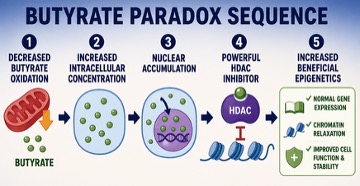
This metabolic shift produces an unexpected consequence. Because transformed colonocytes oxidize butyrate inefficiently, intracellular butyrate concentrations begin to rise (Donohoe DR et al 2012). Instead of being consumed within mitochondria, increasing amounts of butyrate accumulate within the nucleus, where they assume an entirely different biological role. What was once primarily a metabolic fuel has transformed into a powerful epigenetic regulator of gene expression.
Tap to enlarge. Rotate your phone and pinch to zoom
Remarkably, laboratory studies have demonstrated that increasing intracellular butyrate concentrations can oppose many features of this metabolic reprogramming. Rather than fueling the transformed cell, butyrate functions as a potent histone deacetylase (HDAC) inhibitor, altering the expression of hundreds of genes involved in cellular metabolism, differentiation, proliferation, DNA repair, and apoptosis.
HDAC inhibition relaxes chromatin structure, permitting re-expression of genes that had become progressively silenced during early carcinogenesis. Many of these genes promote mitochondrial function, oxidative metabolism, cellular differentiation, and genomic stability while suppressing uncontrolled proliferation. In essence, butyrate shifts the cellular program away from one optimized for rapid growth and back toward one designed to maintain normal tissue homeostasis.
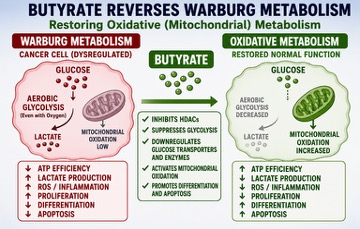
Rather than reinforcing the Warburg phenotype, butyrate begins to reverse it. Experimental studies demonstrate reductions in glycolytic flux, decreased expression of glucose transporters and glycolytic enzymes, restoration of mitochondrial oxidative metabolism, increased cellular differentiation, and activation of programmed cell death (Donohoe DR et al 2012, Vander Heiden MG et al 2009). Collectively, these changes move the transformed colonocyte away from the metabolic program characteristic of malignancy and toward one that more closely resembles the metabolism of a healthy colonocyte.
These observations illustrate one of the central principles of epigenetic nutrition. The earliest metabolic abnormalities of colorectal carcinogenesis are not necessarily irreversible. By modifying the epigenetic machinery that regulates gene expression, microbial metabolites such as butyrate can influence cellular behavior long before invasive cancer develops.
This phenomenon gives rise to what may be called the Butyrate Paradox.
In healthy colonocytes, butyrate is rapidly consumed as the cell’s principal energy source. In transforming colonocytes, however, the Warburg Effect prevents efficient butyrate oxidation, allowing butyrate to accumulate within the nucleus where it functions as an epigenetic regulator.
The very metabolic defect that contributes to malignant transformation simultaneously creates a unique therapeutic vulnerability by permitting butyrate to oppose that transformation.
Rather than acting simply as an energy source, butyrate becomes a metabolic sensor and epigenetic signaling molecule capable of influencing one of the defining hallmarks of colorectal cancer.
Tap to enlarge. Rotate your phone and pinch to zoom
Conclusion
The Butyrate Paradox fundamentally changes how we think about colorectal cancer prevention.
For decades, butyrate was viewed primarily as a nutrient that nourished the colonocyte. While that remains true for healthy tissue, it represents only part of its biological function. As colonocytes begin to undergo malignant transformation, the loss of butyrate oxidation allows this microbial metabolite to accumulate within the nucleus, where it becomes a powerful regulator of gene expression.
The very metabolic abnormality that characterizes the earliest stages of carcinogenesis creates an opportunity for epigenetic intervention. Rather than simply supporting cellular energy production, butyrate begins to oppose the metabolic program driving malignant progression.
This observation carries profound implications. It suggests that the earliest events leading toward colorectal cancer may remain biologically reversible long before invasive cancer develops. Cellular metabolism, once thought to be merely a consequence of cancer, may instead represent one of its most modifiable features.
In this sense, butyrate is far more than a microbial metabolite. It represents one of nature’s most elegant examples of epigenetic medicine, a dietary molecule capable of sensing the metabolic state of the cell and responding in fundamentally different ways to preserve normal cellular identity.
The Butyrate Paradox reveals perhaps the most hopeful principle in colorectal cancer prevention: the earliest metabolic changes that initiate cancer may also create their own epigenetic vulnerability.
Looking Ahead
If butyrate can oppose the Warburg Effect and reprogram the epigenetic landscape of the transforming colonocyte, the next question becomes obvious:
Can we intentionally increase butyrate production through diet?
The answer depends not on butyrate supplementation alone, but on the coordinated interaction among dietary fiber, resistant starch, polyphenols, meal timing, and the microbial communities responsible for fermentation. The microbiome is not simply a passive collection of bacteria; it is the biological factory that manufactures the epigenetic signals capable of influencing colonocyte behavior.
The remaining chapters of this book translate these mechanistic discoveries into practical prevention. We will examine how specific dietary strategies can reshape microbial metabolism, enhance butyrate production, strengthen epigenetic regulation, and create a colonic ecosystem that becomes progressively less favorable for malignant transformation.
The ultimate goal is no longer simply to detect precancerous lesions after they have formed. It is to create a biological condition in which those lesions are less likely to arise in the first place. That is the promise of epigenetic nutrition—and the central message of this book.
References
- Donohoe DR, Collins LB, Wali A, Bigler R, Sun W, Bultman SJ. The Warburg effect dictates the mechanism of butyrate-mediated histone acetylation and cell proliferation. Mol Cell. 2012;48(4):612-626.
- Donohoe DR, Garge N, Zhang X, Sun W, O’Connell TM, Bunger MK, Bultman SJ. The microbiome and butyrate regulate energy metabolism and autophagy in the mammalian colon. Cell Metab. 2011;13(5):517-526.
- Louis P, Hold GL, Flint HJ. The gut microbiota, bacterial metabolites and colorectal cancer. Nat Rev Microbiol. 2014;12(10):661-672. doi:10.1038/nrmicro3344.
- Davie JR. Inhibition of histone deacetylase activity by butyrate. J Nutr. 2003;133(7 Suppl):2485S-2493S. doi:10.1093/jn/133.7.2485S.
- Vander Heiden MG, Cantley LC, Thompson CB. Understanding the Warburg effect: the metabolic requirements of cell proliferation. Science. 2009;324(5930):1029-1033. doi:10.1126/science.1160809.
- Liberti MV, Locasale JW. The Warburg effect: How does it benefit cancer cells? Trends Biochem Sci. 2016;41(3):211-218.
- Fung KYC, Cosgrove L, Lockett T, Head R, Topping DL. A review of the potential mechanisms for the lowering of colorectal oncogenesis by butyrate. Br J Nutr. 2012;108(5):820-831. doi:10.1017/S0007114512001948.
- Bultman SJ. Interplay between diet, the gut microbiota, epigenetic events, and colorectal cancer. Mol Nutr Food Res. 2017;61(1):1500902. doi:10.1002/mnfr.201500902.