Chapter 11 Fiber Intake and Colorectal Cancer: What the Epidemiology Shows
Among all dietary factors studied in colorectal cancer prevention, few have demonstrated a more consistent association with reduced cancer risk than dietary fiber. Over the past three decades, large prospective cohort studies involving hundreds of thousands of participants have repeatedly shown that individuals consuming the highest amounts of fiber experience substantially lower rates of colorectal cancer than those consuming the least.
Importantly, the protective association appears to be dose dependent. Rather than requiring dramatic dietary changes, even modest increases in fiber intake are associated with measurable reductions in risk. Meta-analyses indicate that for every 10 g/day increase in total dietary fiber, colorectal cancer risk decreases by approximately 7–10%. This finding has been remarkably consistent across multiple populations and dietary patterns (Aune D et al 2011, Reynolds A et al 2019).
The source of fiber also appears to matter. Fiber derived from whole grains has shown the strongest and most reproducible association with lower colorectal cancer risk, although fibers from fruits, vegetables, and legumes also contribute. Whole grains provide not only fermentable fiber but also resistant starch, polyphenols, vitamins, minerals, and numerous phytochemicals that likely work together to support a healthier colonic environment.
Epidemiological Observation Studies
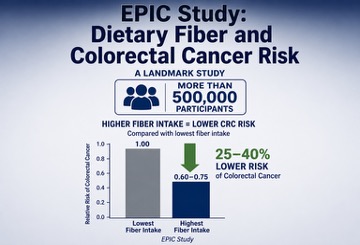
One of the landmark observations came from the European Prospective Investigation into Cancer and Nutrition (EPIC), which followed more than 500,000 individuals across ten European countries. Participants consuming the highest amounts of fiber had approximately a 25–40% lower risk of colorectal cancer compared with those consuming the lowest amounts, with cereal fiber demonstrating particularly strong protective effects (Murphy N et al 2012).
Tap to enlarge. Rotate your phone and pinch to zoom
Epidemiological Interventional Studies
Interventional feeding studies further support the protective role of fiber. Diets enriched with resistant starches and fermentable fibers consistently increase fecal butyrate concentrations, lower colonic pH, reduce secondary bile acid production, and suppress epithelial proliferation markers associated with carcinogenesis (Bultman SJ 2017, Topping DL et al 2001).
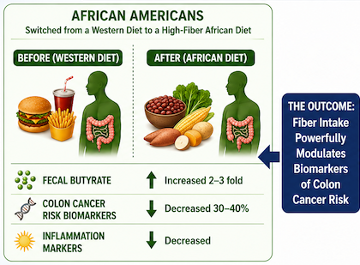
One of the most compelling demonstrations that diet can rapidly alter the biological environment of the colon was published by O’Keefe and colleagues in 2015. Rather than simply comparing populations with different dietary habits, the investigators performed a controlled dietary crossover intervention involving African Americans, a population with one of the world’s highest incidences of colorectal cancer, and rural South Africans, who have one of the lowest.
Participants exchanged their customary diets for two weeks. African Americans abandoned a typical Western diet rich in animal fat and low in fiber and instead consumed a traditional rural African diet characterized by high intakes of whole grains, legumes, vegetables, and other fermentable plant foods.
Tap to enlarge. Rotate your phone and pinch to zoom
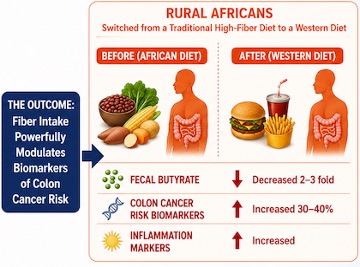
Conversely, rural Africans switched from their traditional high-fiber diet to a Western-style diet high in fat and animal products and low in fiber.
The biological changes occurred with remarkable speed.
Among African Americans, the high-fiber diet produced a profound shift in the colonic environment. Fecal butyrate concentrations increased, secondary bile acid production declined, microbial metabolism shifted toward saccharolytic fermentation, and colonoscopic biopsies demonstrated reduced epithelial proliferation together with favorable changes in biomarkers associated with colorectal cancer risk. These improvements developed after only 14 days of dietary intervention.
Equally striking were the changes observed in rural Africans. Within the same two-week period, adoption of a Western-style diet produced the opposite metabolic profile. Butyrate production fell, secondary bile acid concentrations increased, microbial metabolism shifted toward proteolytic fermentation, and biomarkers associated with colorectal carcinogenesis became significantly less favorable.
Tap to enlarge. Rotate your phone and pinch to zoom
The importance of this study extends well beyond its individual findings. It demonstrated that the colonic ecosystem is extraordinarily dynamic and highly responsive to dietary composition. The metabolic environment of the colon can change within days, accompanied by measurable alterations in microbial metabolism, epithelial biology, and molecular markers linked to colorectal cancer risk.
Perhaps most importantly, the study challenged the notion that population differences in colorectal cancer are determined primarily by genetics. Instead, it showed that the biological processes underlying colorectal cancer risk are strongly influenced by diet and can be modified rapidly through nutritional intervention.
For the concept of epigenetic nutrition, the implications are profound. By increasing fermentation of dietary fiber and enhancing butyrate production, dietary change does not merely improve digestion—it reshapes the metabolic and epigenetic environment of the colon. The O’Keefe study provides direct human evidence that food can rapidly modify the microbial metabolites that regulate colonocyte function, supporting the central premise that dietary choices influence gene expression long before cancer develops.
The protective effects of fiber likely extend beyond microbial metabolism alone. High-fiber diets improve insulin sensitivity, reduce obesity-associated inflammation, decrease postprandial glucose excursions, and may attenuate chronic activation of nutrient-sensing pathways such as mTOR signaling.
From an epigenetic perspective, these epidemiologic observations are biologically plausible. Increased fiber intake enhances microbial fermentation, increases production of short-chain fatty acids, particularly butyrate, and promotes a saccharolytic microbiome. These microbial metabolites influence DNA methylation, histone acetylation, chromatin remodeling, inflammatory signaling, and epithelial differentiation. Thus, the epidemiologic association is supported by well-established mechanistic pathways linking dietary fiber to maintenance of normal colonocyte function.
Importantly, the epidemiology suggests that protection does not arise from fiber acting as an isolated nutrient. Individuals with higher fiber intake generally consume more whole plant foods, which simultaneously provide resistant starch, polyphenols, vitamins, minerals, and thousands of other bioactive compounds. The resulting interaction between diet, the microbiome, microbial metabolites, and the epigenetic machinery likely explains why whole-food dietary patterns consistently outperform isolated nutrient supplementation.
A Practical Perspective
Most adults in Western countries consume only 15–18 g of fiber per day, substantially below the recommended 25–38 g/day. Based on current epidemiologic evidence, increasing intake by only 10 g/day—roughly the amount found in one cup of cooked beans, one-half cup of oats, or several servings of fruits and vegetables—may reduce colorectal cancer risk by approximately 7–10%.
Achieving recommended fiber intake therefore represents one of the simplest, safest, and most evidence-based dietary strategies currently available for reducing colorectal cancer risk.
In the framework of epigenetic nutrition, these epidemiologic studies provide more than statistical associations. They suggest that every additional serving of fermentable plant foods helps restore the biochemical signals that maintain normal colonocyte metabolism, preserve epigenetic stability, and oppose the earliest stages of malignant transformation.
Conclusion
The epidemiologic evidence supporting dietary fiber as a protective factor against colorectal cancer is both extensive and remarkably consistent. Across diverse populations, study designs, and dietary patterns, higher fiber intake has repeatedly been associated with lower colorectal cancer incidence, while even modest increases in consumption appear capable of producing measurable reductions in risk.
Although epidemiology cannot prove causation, its findings become far more compelling when viewed alongside our growing understanding of microbiome biology and epigenetics. Fiber is no longer regarded simply as a bulking agent that accelerates intestinal transit. Instead, it serves as the primary substrate for microbial fermentation, generating metabolites that regulate inflammation, preserve epithelial integrity, maintain normal colonocyte metabolism, and influence the epigenetic machinery that governs gene expression.
These observations help explain why whole-food dietary patterns rich in fermentable fiber consistently outperform isolated nutritional interventions. Fiber does not act alone. Its biological effects emerge through a complex partnership with the intestinal microbiome, which transforms dietary substrates into thousands of signaling molecules that help maintain normal cellular function.
The epidemiologic data therefore provide more than reassurance that fiber is beneficial. They demonstrate that relatively small, achievable dietary changes can influence one of the most common malignancies in the developed world. Increasing daily fiber intake represents one of the safest, simplest, and most evidence-based strategies currently available for reducing colorectal cancer risk.
Viewed through the lens of epigenetic nutrition, these studies suggest an even more profound concept: every meal has the potential to influence gene expression (Bultman SJ 2017, Baylin SB et al 2011). Rather than serving merely as a source of calories, dietary fiber delivers biological information that helps preserve the differentiated state of the colonocyte and resist the earliest stages of malignant transformation.
Looking Ahead: Polyphenol Intervention Studies
Dietary fiber is only one component of the biological conversation occurring between food, the microbiome, and the colonocyte. While fiber provides the fermentable substrate that fuels microbial metabolism, another major class of plant compounds actively shapes that microbial ecosystem and directly regulates the epigenetic machinery itself—polyphenols.
Increasingly, intervention studies demonstrate that these compounds can favorably alter the intestinal microbiome, increase butyrate-producing bacteria, suppress pro-inflammatory pathways, and modify molecular biomarkers associated with colorectal carcinogenesis.
The next chapter examines the clinical evidence supporting these effects. Rather than focusing solely on laboratory mechanisms, we will explore human intervention studies that evaluate whether polyphenol-rich foods and dietary patterns can favorably influence the biological pathways that underlie colorectal cancer development. Together with fiber, these studies reveal that plant foods function not simply as nutrients, but as powerful regulators of the molecular environment that determines colonocyte health.
References
- Aune D, Chan DSM, Lau R, Vieira R, Greenwood DC, Kampman E, Norat T. Dietary fibre, whole grains, and risk of colorectal cancer: systematic review and dose-response meta-analysis of prospective studies. BMJ. 2011
- Murphy N, Norat T, Ferrari P, Jenab M, Bueno-de-Mesquita B, Skeie G, et al. Dietary fibre intake and risks of cancers of the colon and rectum in the European Prospective Investigation into Cancer and Nutrition (EPIC). PLoS One. 2012;7(6.
- Reynolds A, Mann J, Cummings J, Winter N, Mete E, Te Morenga L. Carbohydrate quality and human health: a series of systematic reviews and meta-analyses. Lancet. 2019;393(10170):434-445. doi:10.1016/S0140-6736(18)31809-9.
- O’Keefe SJD, Li JV, Lahti L, Ou J, Carbonero F, Mohammed K, Posma JM, Kinross J, Wahl E, Ruder E, Vipperla K, Naidoo V, Mtshali L, Tims S, Puylaert PGB, DeLany J, Krasinskas A, Benefiel AC, Kaseb HO, Newton K, Nicholson JK, de Vos WM, Gaskins HR, Zoetendal EG. Fat, fibre and cancer risk in African Americans and rural Africans. Nat Commun
- Louis P, Hold GL, Flint HJ. The gut microbiota, bacterial metabolites and colorectal cancer. Nat Rev Microbiol. 2014;12(10):661-672. doi:10.1038/nrmicro3344.
- Koh A, De Vadder F, Kovatcheva-Datchary P, Bäckhed F. From dietary fiber to host physiology: short-chain fatty acids as key bacterial metabolites. Cell. 2016;165(6):1332-1345.
- Donohoe DR, Garge N, Zhang X, Sun W, O’Connell TM, Bunger MK, Bultman SJ. The microbiome and butyrate regulate energy metabolism and autophagy in the mammalian colon. Cell Metab. 2011;13(5):517-526.
- Bultman SJ. Interplay between diet, the gut microbiota, epigenetic events, and colorectal cancer. Mol Nutr Food Res. 2017;61(1):1500902. doi:10.1002/mnfr.201500902.
- Baylin SB, Jones PA. A decade of exploring the cancer epigenome—biological and translational implications. Nat Rev Cancer. 2011;11(10):726-737. doi:10.1038/nrc3130.
- Song M, Chan AT. Environmental factors, gut microbiota, and colorectal cancer prevention. Clin Gastroenterol Hepatol. 2019;17(2):275-289
- Topping DL, Clifton PM. Short-chain fatty acids and human colonic function: roles of resistant starch and nonstarch polysaccharides. Physiol Rev. 2001;81(3):1031-1064. doi:10.1152/physrev.2001.81.3.1031.
- Wong JMW, de Souza R, Kendall CWC, Emam A, Jenkins DJA. Colonic health: fermentation and short chain fatty acids. J Clin Gastroenterol. 2006;40(3):235-243. doi:10.1097/00004836-200603000-00015.
- Hanahan D. Hallmarks of cancer: new dimensions. Cancer Discov. 2022;12(1):31-46. doi:10.1158/2159-8290.CD-21-1059.