Chapter 8
Health & Well-Being: The Whole Person
We began this journey with food.
At first, the question seemed simple: What happens when we eat?
But as we followed food through human biology, the answer became progressively more interesting.
Food contains far more than calories, protein, carbohydrate, fat, vitamins, and minerals. It contains fibers, resistant carbohydrates, polyphenols, phytochemicals, and thousands of other compounds representing biological potential.
Some of that potential encounters the microbiome. Microorganisms can transform components of food and create new compounds. Those compounds become part of the environment experienced by human cells.
Cells regulate access to genetic information through epigenetic mechanisms. They adjust gene expression. They manage energy and resources through cellular metabolism. Millions of cells then coordinate their activities to maintain healthy tissues and functioning organs.
At every step, the biology becomes more complex.
And eventually, all of those systems become something much more familiar.
They become us.
Health Is More Than the Absence of Disease
When people talk about health, they often mean the absence of a diagnosed disease.
But human health is broader than that.
We experience health through our ability to move, think, work, sleep, digest food, respond to stress, recover from injury, fight infection, maintain muscle, preserve cognitive function, and continue doing the things that matter to us as we age.
Underlying those everyday experiences are biological systems working continuously to maintain function. Our cardiovascular system delivers oxygen and nutrients. Our liver manages an enormous range of metabolic activities. Our gastrointestinal tract processes food while maintaining a barrier between the outside world and our internal tissues. Our immune system must defend us without remaining unnecessarily activated. Our muscles must generate force while adapting to use and disuse.
Health emerges from the coordinated function of all of these systems.
No single pathway creates it.
The Body Is an Interconnected System
Throughout this series, we have separated biology into chapters so that we could understand it.
The body does not make those separations. The microbiome does not operate independently of nutrition. Metabolism does not operate independently of gene expression. Gene expression does not operate independently of cellular conditions.
Cells do not operate independently of tissues. And organs do not operate independently of one another.
The systems continually communicate.
The liver influences the nutrients circulating through the body. Muscle activity changes energy demands. Hormones influence metabolism. Immune activity alters tissue environments. The nervous system communicates with organs throughout the body. The microbiome interacts with the intestinal environment, while the intestinal environment helps determine which microorganisms can thrive.
Biology is therefore not a simple chain.
It is a connected network. [1–4]
That distinction is important for understanding nutrition.
Food enters this network.
It does not control it.
Where Food Fits
Nutrition is essential to life.
Food supplies energy.
It supplies amino acids required for proteins, fatty acids used in membranes and other biological structures, vitamins and minerals required for countless chemical reactions, and carbohydrates that can provide energy and microbial substrates.
But the Food as Information perspective asks us to recognize something additional.
Food also contributes to the biological environment in which our cells and tissues function.
The foods we repeatedly eat help determine which substrates enter the gastrointestinal tract, which resources become available to the microbiome, which nutrients are absorbed, and which compounds eventually become available to tissues.
This does not mean that a particular food creates health. It means that nutrition is one of the recurring environmental influences experienced by human biology. And unlike many influences on health, eating is something we do several times every day.
Patterns Matter More Than Individual Foods
This is one reason nutrition science increasingly emphasizes dietary patterns rather than individual foods or isolated nutrients.
A single serving of broccoli does not determine health.
Neither does a bowl of oatmeal, a handful of blueberries, or one meal containing legumes.
Human biology operates continuously over years and decades. What matters more is the pattern repeatedly presented to that biology. Dietary patterns rich in vegetables, fruits, legumes, whole grains, nuts, seeds, and other minimally processed plant foods have consistently been associated with favorable health outcomes in large populations. Dietary patterns such as the Mediterranean diet have also been tested in randomized clinical trials, providing evidence that dietary patterns can influence important cardiovascular outcomes. [5–8]
The mechanisms underlying these associations are numerous.
No single nutrient, microorganism, metabolite, gene, or pathway explains them.
That is exactly what we should expect from an interconnected biological system.
Food Is Only Part of the Story
Nutrition matters.
But nutrition does not exist in isolation.
Physical activity changes muscle, metabolism, cardiovascular function, and cellular signaling. Sleep affects hormonal, metabolic, immune, and neurological systems. Medications can profoundly alter physiology. Environmental exposures influence cellular conditions. Age changes tissues and their ability to respond to stress. Genetics influences biological susceptibility. Social and environmental conditions can affect access to food, opportunities for physical activity, sleep, stress, and health care.
Even the microbiome we have emphasized throughout this series is influenced by far more than diet alone.
This is why Food as Information should never become Food as Destiny. The same dietary pattern will not produce identical outcomes in every person.
Food participates in health.
It does not determine health by itself.
Health Requires Adaptation
One of the recurring themes throughout human biology is the ability to adapt.
Our environment is constantly changing.
We eat and then fast.
We exercise and then recover.
We encounter microorganisms.
We experience injury.
Energy availability rises and falls.
Cells are damaged and replaced.
Tissues must repair themselves.
The body continually adjusts while attempting to preserve essential functions.
This ability to maintain stability while responding to change is fundamental to homeostasis and biological resilience. [1,9]
Health therefore should not be imagined as a perfectly stable biological state.
A healthy system changes.
What matters is its ability to respond appropriately and return toward functional balance.
Nutrition can participate in supporting that capacity by providing energy, structural materials, micronutrients, and substrates that become part of the biological environment in which adaptation occurs.
Small Inputs, Repeated Over Time
There is another reason food is particularly interesting.
Eating is repetitive.
One meal represents a relatively brief biological event.
But meals are repeated day after day, year after year. This creates repeated exposure to dietary patterns. The significance of nutrition may therefore lie less in dramatic effects from individual foods and more in the accumulation of many modest biological influences over long periods.
This is also why nutritional claims require caution.
Human health develops over decades and reflects genetics, environment, behavior, chance, aging, medical care, and countless biological interactions.
No food guarantees protection from disease.
No dietary pattern makes someone biologically invulnerable.
But repeated dietary choices can become part of the environment within which health develops.
That is a more modest claim.
It is also a more scientifically defensible—and potentially more meaningful—one.
From Food to the Person
We can now return to where we started.
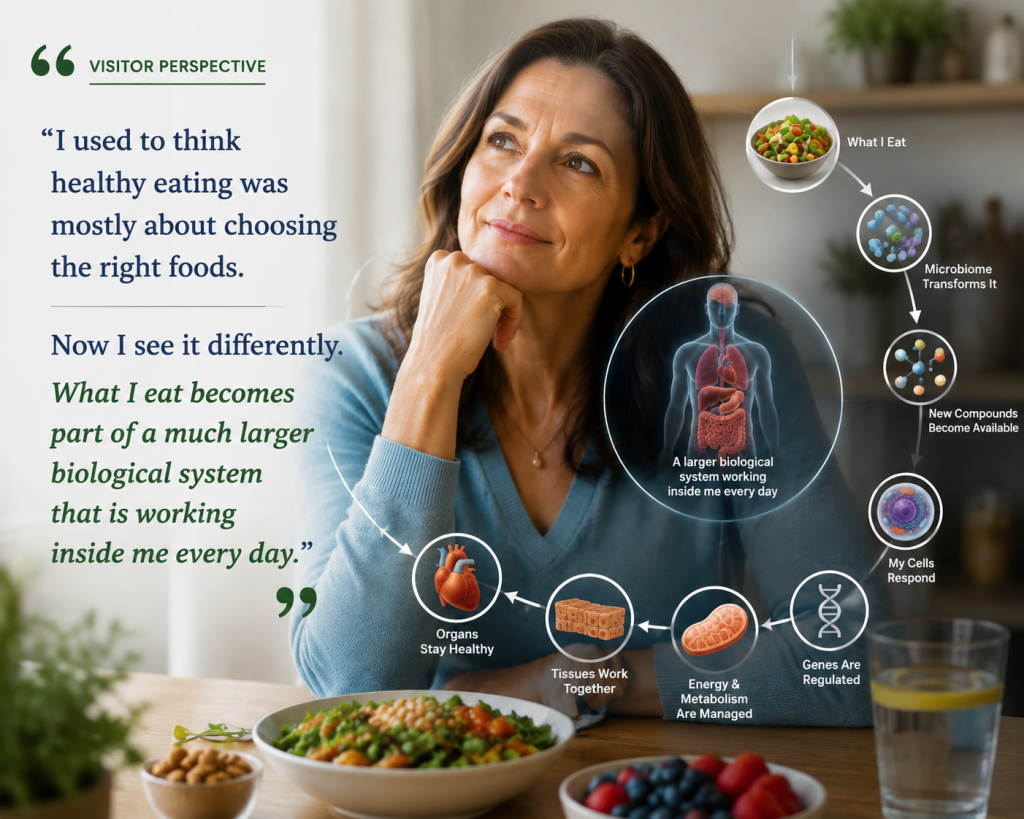
Imagine a person sitting down to eat a meal. On the plate may be vegetables, beans, whole grains, berries, nuts, herbs, spices, or many other foods. At first glance, it is simply food.
But biologically, an extraordinary process is about to begin. The food will be broken apart.
Some components will be absorbed. Others will travel farther through the gastrointestinal tract.
Microorganisms may encounter them. New compounds may be created.
Human cells will encounter a changing chemical environment. Those cells will regulate genes, manage energy, communicate with neighboring cells, repair themselves, divide, mature, and eventually be replaced.
Millions of those cells will cooperate to maintain tissues. Tissues will sustain organs. Organs will interact to sustain the person.
The original meal has disappeared.
But its components have entered biology. This is what we mean by Food as Information.
Not that food contains literal instructions telling our genes what to do. Not that food controls our health.
And not that nutrition can be reduced to a simple sequence in which one food produces one biological outcome.
The idea is more subtle.
Food becomes part of the information-rich environment to which living systems continually respond.
That observation brings us back to the person.
Understanding Food as Information does not require us to memorize pathways, microorganisms, genes, or metabolites every time we choose a meal.
Its value is in changing how we think about food. Food is not simply something we consume and then forget.
It enters a living system. And that system responds.
Food is nutrition.
Food is fuel.
Food provides structural materials.
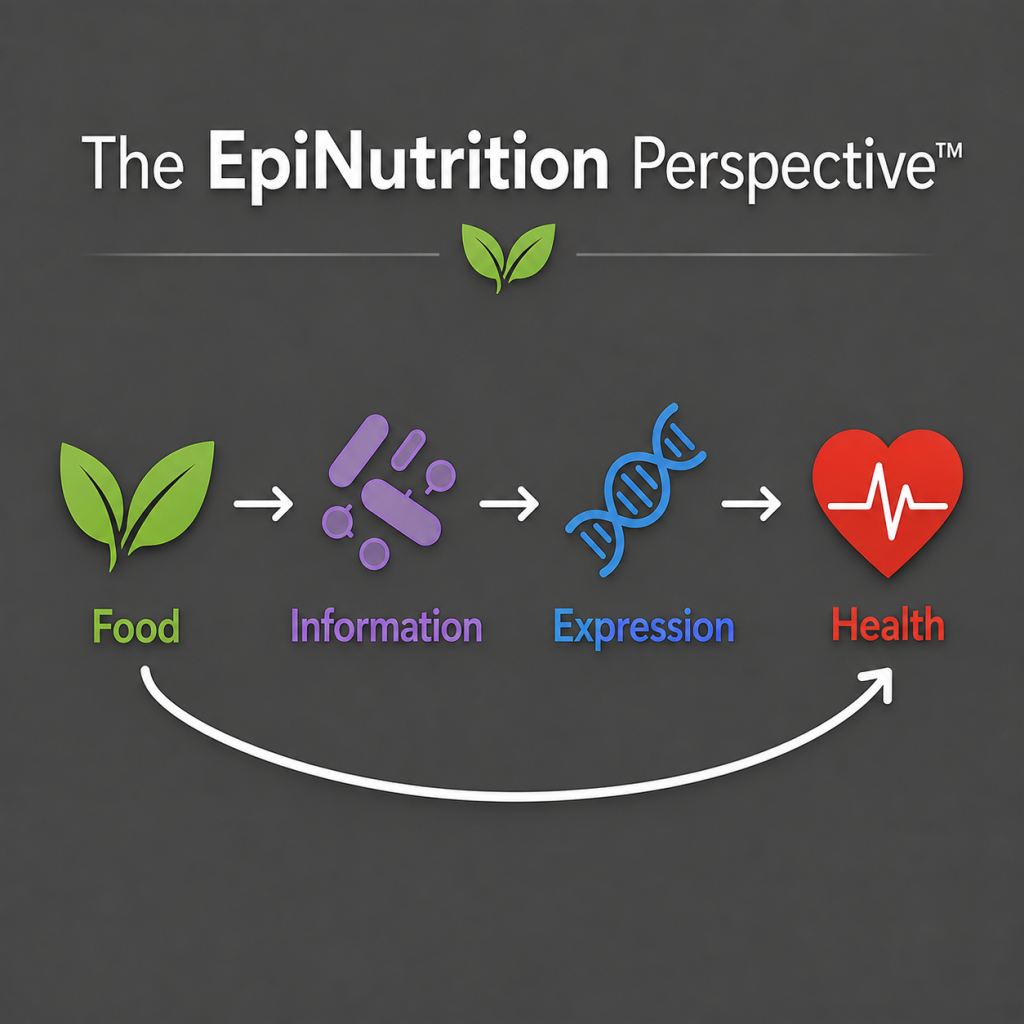
But food can also contribute to biological information.
The information does not reside in a single nutrient or molecule. It emerges from interactions among food, microorganisms, metabolism, cellular regulation, gene expression, tissues, organs, and the many other influences that shape human physiology.
This perspective does not give food more power than the science supports.
It places food where it belongs:
This is the foundation of EpiNutrition.
inside an interconnected biological system.
Genetics matters. Age matters. Physical activity matters. Sleep matters. Medications matter. Environment matters. The microbiome matters. And nutrition matters. Health emerges from their interaction over time.
That is why the most important question may no longer be simply:
“What nutrients are in this food?”
We can also ask:
“What biological possibilities am I introducing when I eat it?”
That is the idea at the heart of Food as Information.
The Journey
Healthy Foods → Microbiome → Metabolites → Epigenetics → Gene Expression → Cellular Metabolism → Tissue & Organ Health → Health & Well-Being
Each step adds another layer of biology.
But the pathway should never be interpreted as a simple one-way chain. Feedback occurs throughout the system. The microbiome changes in response to diet. Cellular metabolism influences gene regulation. Gene expression influences metabolism. Tissue conditions influence cells. Human behavior influences food choices.
The pathway is therefore best understood as a way of organizing an extraordinarily interconnected biological system.
Food is where our journey began.
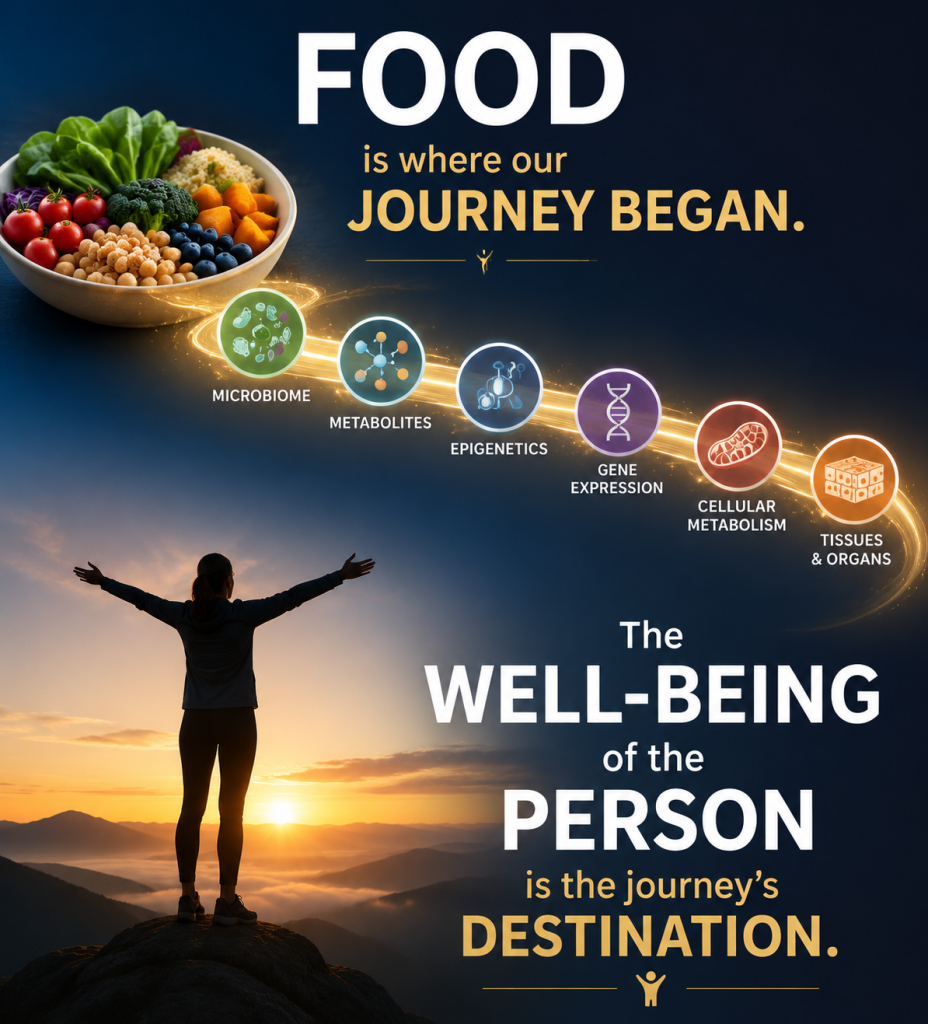
The well-being of the person is the journey’s destination.
Bibliography
- Chovatiya R, Medzhitov R. Stress, inflammation, and defense of homeostasis. Mol Cell. 2014;54(2):281–288.
- Kitano H. Biological robustness. Nat Rev Genet. 2004;5:826–837.
- Nicholson JK, Holmes E, Kinross J, et al. Host-gut microbiota metabolic interactions. Science.2012;336(6086):1262–1267.
- Shapiro JA. Revisiting the central dogma in the 21st century. Ann N Y Acad Sci. 2009;1178:6–28.
- Estruch R, Ros E, Salas-Salvadó J, et al. Primary prevention of cardiovascular disease with a Mediterranean diet supplemented with extra-virgin olive oil or nuts. N Engl J Med. 2018;378.
- Martínez-González MA, Gea A, Ruiz-Canela M. The Mediterranean diet and cardiovascular health. Circ Res.2019;124(5):779–798.
- Schwingshackl L, Bogensberger B, Hoffmann G. Diet quality as assessed by the Healthy Eating Index, Alternate Healthy Eating Index, Dietary Approaches to Stop Hypertension score, and health outcomes: an updated systematic review and meta-analysis of cohort studies. J Acad Nutr Diet. 2018;118(1):74–100.e11.
- Cena H, Calder PC. Defining a healthy diet: evidence for the role of contemporary dietary patterns in health and disease. Nutrients. 2020;12(2):334.
- Woods HA, Wilson JK. An information hypothesis for the evolution of homeostasis. Trends Ecol Evol.2013;28(5):283–289.