The bean’s journey begins in stillness.
A dry bean may remain in a sack, jar, market bin, or kitchen cupboard for months. Its surface gives little indication that it once grew inside a pod or that it contains the beginnings of another plant.
Yet a viable bean is alive.
Its metabolism has slowed dramatically. Its tissues contain little water. Growth has stopped. The seed waits for conditions that will allow its life cycle to continue.
Add water, warmth, oxygen, and a suitable environment, and the stillness ends. Membranes reorganize. Enzymes become active. Stored materials begin to move. A root breaks through the seed coat. A shoot follows.
The bean was never an inert package of starch and protein.
It was biological potential waiting for a future.
The Bean’s Journey Continues: open the seed
If you soak a dry bean and gently separate its two halves, most of what you see consists of the cotyledons.
Cotyledons are part of the plant embryo. In the common bean, they are also large storage organs. They contain much of the starch and protein that will support the young seedling before its leaves can produce enough energy through photosynthesis.
Nestled between them is the embryonic axis. One end contains the radicle, which can become the primary root. The other contains the developing shoot. Structures that look insignificant beside the large cotyledons hold the plant’s next generation.
Around them is the seed coat, or testa. This protective outer layer developed from tissue of the parent plant. It helps shield the embryo and its reserves from physical damage, water loss, microorganisms, and the outside environment.
The small scar on the seed coat is the hilum, the place where the developing seed was attached inside the pod. Nearby is the micropyle, a small opening involved in water entry and gas movement during germination.
These structures have different jobs, but they operate as one survival system:
- the seed coat protects;
- the cotyledons store; and
- the embryonic axis begins new growth.
The bean we recognize as food was constructed first for the needs of a plant.
A seed designed to cross time
A plant cannot move its offspring to safety or feed them after birth. It must prepare them in advance.
The seed solves this problem.
During seed development, the parent plant transfers carbon, nitrogen, minerals, and other materials into the growing bean. Cells in the cotyledons accumulate starch and storage proteins. The seed coat matures around them. Water content falls. Metabolic activity slows, and the seed enters a state capable of surviving separation from the parent plant.
Dryness is part of this strategy. Many mature bean seeds tolerate the loss of most of their water while maintaining structures needed for future germination. Low moisture also slows many chemical reactions and limits microbial growth, helping people store dried beans as food.
The same properties that help a seed survive between generations help make beans useful to human societies.
A ripe fruit may spoil quickly. A leafy vegetable wilts. A dry bean can be transported and stored until water and heat give it another future.
The seed’s ability to cross biological time became part of its value as food.
What the bean stores
The bean’s cotyledons contain a reserve assembled for germination and early growth.
Starch provides a large share of the stored carbohydrate. Proteins supply amino acids and nitrogen needed to build enzymes, transporters, membranes, and new plant tissues. The bean also contains fiber, minerals, vitamins, small amounts of fat, and many compounds involved in plant structure, defense, pigmentation, and metabolism.[1–3]
Food-composition databases allow these components to be measured. On a dry-weight basis, common beans are generally rich in carbohydrate and protein and relatively low in fat, but no single number describes every bean.[1,2]
Composition varies with:
- variety and seed color;
- growing environment;
- soil and water conditions;
- maturity at harvest;
- storage time and temperature;
- preparation and processing; and
- the analytical method used.
A black bean, kidney bean, pinto bean, and navy bean all belong to Phaseolus vulgaris, but they are not chemically identical. Even beans of the same variety can differ because the plant developed under different conditions.
The word bean names a biological family resemblance, not a standardized chemical formula.
Starch: energy stored as structure
Plants capture energy from sunlight and use it to build carbohydrate from carbon dioxide and water. Some carbohydrate is later stored in the seed as starch.
Starch consists mainly of two glucose polymers: amylose and amylopectin. These molecules are organized into granules rather than scattered freely through the cotyledon. The granules are contained within plant cells and associated with proteins and other cellular structures.
This organization matters.
A laboratory can grind a bean, break open its cells, and measure its total starch. A digestive enzyme encounters a different problem. It must gain access through the structures that remain after cooking and chewing.
Research on cooked legumes shows that intact cell walls can restrict enzyme access to enclosed starch. Mechanical disruption increases access. The amount of starch present may remain the same while its accessibility changes.[4–6]
The seed therefore stores more than chemical energy. It stores energy within an architecture.
That architecture will become important in the kitchen, the digestive tract, and the colon.
Protein: nitrogen saved for a new plant
Protein is another major reserve.
The embryo will need amino acids to construct the machinery of growth, but a newly germinating seed cannot obtain them from soil as ready-made proteins. The parent plant stores protein in the cotyledons before the seed matures.
When germination begins, proteolytic enzymes help dismantle these storage proteins. Their amino acids and nitrogen can then be redistributed into the growing root and shoot.[7]
When a person eats the bean, human digestion attempts a parallel transformation for a different purpose. Gastric and intestinal enzymes break accessible bean proteins into peptides and amino acids. Once absorbed, those amino acids lose their identity as parts of a plant. They enter human metabolic pools and may be used to build proteins of the intestine, liver, immune system, muscle, or other tissues.
The storage protein has no predetermined final owner.
Its biological destination depends on which living system opens the seed.
Fiber: protection, architecture, and a future substrate
Much of the bean’s fiber began as plant structure.
Cell-wall polysaccharides help cells maintain shape, resist mechanical stress, control expansion, and organize plant tissues. The seed coat provides additional protective layers. These structures were not built to satisfy a human fiber recommendation. Their nutritional importance emerges when the plant’s biology encounters ours.
Human digestive enzymes cannot completely dismantle many of these carbohydrates. Some retain water or contribute to stool structure. Some influence the physical environment of digestion. Some reach the colon and become substrates for microorganisms.
Fiber therefore has two identities in the bean’s story.
For the seed, it is part of the architecture.
For the person and the microbiome, it becomes a physical influence and a source of possible microbial transformation.
The same molecule can acquire a different biological meaning in a different system.
Minerals and other compounds
The bean also stores minerals needed by the developing plant.
Phosphorus, for example, is stored partly in phytate. This form provides the seed with a concentrated reserve, but it can bind minerals and influence their accessibility during human digestion. Iron, zinc, magnesium, potassium, and other minerals are distributed among seed tissues and chemical associations.
The bean contains phenolic compounds and other phytochemicals as well. Colored seed coats may contain different profiles and concentrations from pale seed coats. Some compounds contribute to pigmentation or defense. Some may be released or transformed during soaking, cooking, digestion, or microbial fermentation.
Their presence is scientifically interesting, but presence is the beginning of the investigation.
To matter elsewhere in the body, a compound must follow a path: it must become accessible, reach a relevant location in an appropriate form, and produce an effect at the exposure created by eating the food.
The bean contains chemical possibilities. Biology determines which possibilities proceed.
Two possible futures
The dry bean can enter one of two very different pathways.
Planted in soil
Water enters the seed. The bean swells. Metabolism accelerates, and stored reserves begin to be mobilized. The radicle emerges first, establishing the beginning of a root system. The hypocotyl elongates and lifts the cotyledons above the soil during the common bean’s characteristic epigeal germination.
The young seedling uses stored carbon and nitrogen while it builds roots and opens leaves. Once photosynthesis becomes established, dependence on the cotyledon reserves declines. The materials stored by the parent plant have helped create another plant.
Prepared as food
Water also enters a bean during soaking and cooking, but the result is different.
Heat prevents the bean from continuing normal development. It softens tissues, changes proteins, hydrates and gelatinizes starch, alters some compounds, and makes the bean edible. Chewing and digestion continue the dismantling.
The same reserves that could have supported a seedling now enter human and microbial metabolism.
This is the turning point in the bean’s biography.
The bean was built to carry biological potential from one plant generation to the next. Human beings redirect that potential into food.
From content to consequence
Because the bean contains protein, fiber, iron, starch, and phytochemicals, it is tempting to move directly from composition to health.
Science must take the longer route.
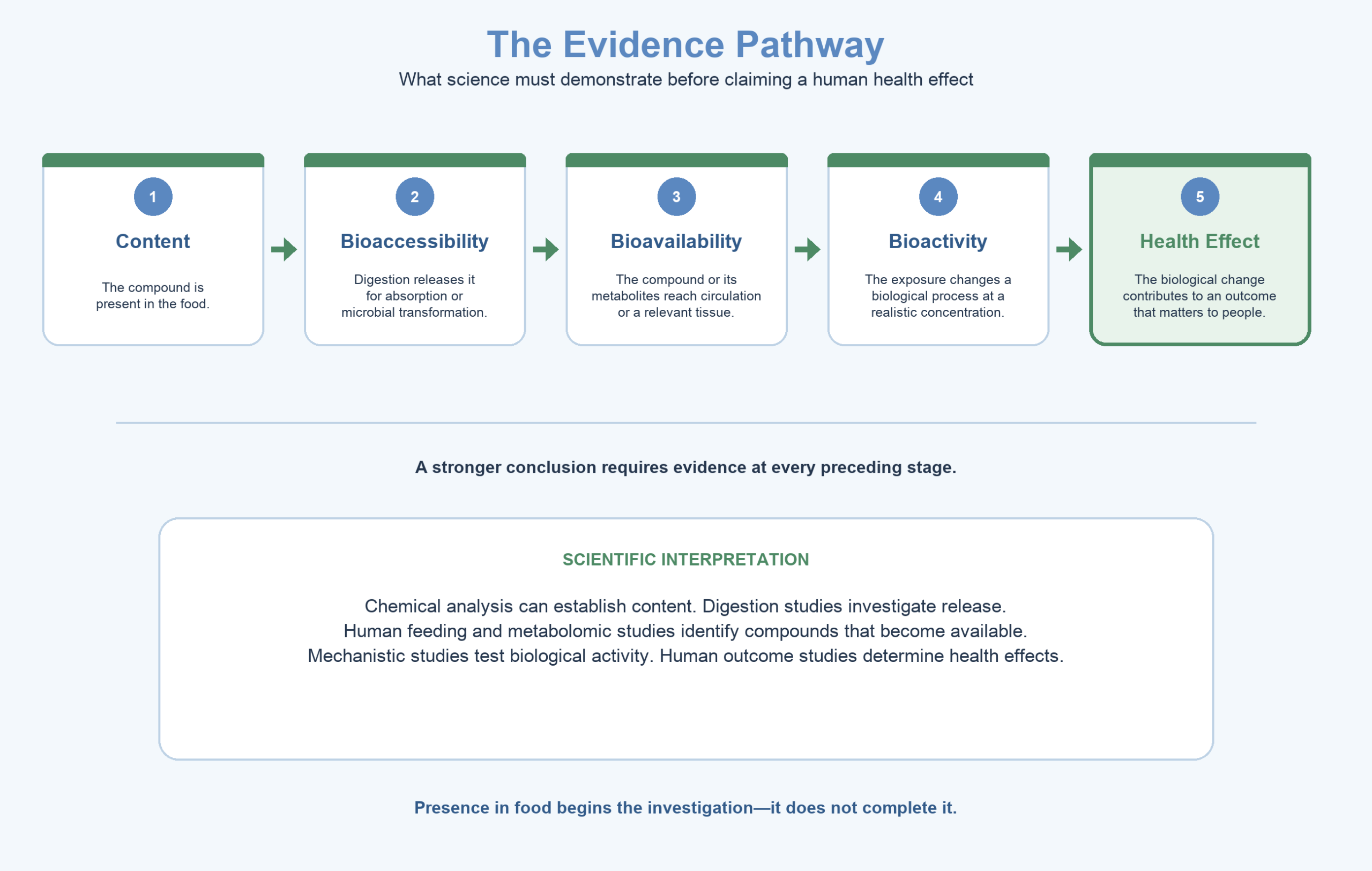
Content
Chemical analysis establishes what is present in the bean and how much is measured in the sample.
Bioaccessibility
Preparation and digestion determine what is released from the seed matrix for absorption or microbial transformation.
Bioavailability
Human studies determine whether a nutrient, parent compound, or metabolite reaches circulation, the intestinal environment, or another relevant site.
Bioactivity
Mechanistic and feeding studies test whether the exposure changes a biological process at a realistic concentration.
Health effect
Clinical trials and long-term human studies investigate whether the biological response contributes to an outcome that matters to people.
This sequence protects the bean from becoming a miracle-food story.
The seed contains biological potential. It does not contain a guaranteed clinical outcome.
What the evidence can establish at the seed stage
At this point in the journey, several scientific tools can tell us a great deal.
Botanical observation and microscopy reveal the seed coat, cotyledons, embryo, cells, starch granules, protein bodies, and other structures. Chemical analysis measures nutrients and other compounds. Genetic and agricultural studies compare varieties and growing conditions. Germination experiments show how the living seed mobilizes its reserves.
Together, these methods can establish:
- how the seed is organized;
- what materials it stores;
- how composition varies;
- how its structures protect and contain those materials; and
- how the seed uses its reserves during germination.
They cannot establish that eating the bean prevents disease or improves health.
That question lies much farther along the journey.
The Bean at This Stage
At this stage of our journey, the bean is a living seed in a state of suspended growth.
Its seed coat protects an embryo and two storage cotyledons. Its starch contains chemical energy captured ultimately from sunlight. Its proteins preserve carbon and nitrogen for future construction. Its cell walls organize and protect those reserves. Its minerals and other compounds reflect the biology of the plant and the environment in which it grew.
Nothing in the bean exists solely for human nutrition.
Its nutritional value emerges because human beings learned to cultivate, store, prepare, and eat a structure built for another biological purpose.
The bean at this stage contains potential:
- potential energy;
- potential building material;
- potential microbial substrates;
- potential cellular exposures; and
- potential health effects that must still be demonstrated.
Before this bean reaches the kitchen, however, we need to understand how the plant created it.
The next stage begins when the seed is placed in soil.
Next — The Plant: Biological Potential Requires an Ecosystem
The dry bean waits. Water ends the waiting.
Germination turns stored reserves into growth. Roots enter the soil. Leaves enter the light. Microorganisms gather around the root system. Carbon from the atmosphere and nitrogen acquired through plant and microbial metabolism begin to form the tissues of a new plant.
The next chapter follows the bean plant as it constructs another seed.
Notes and selected references
- Food and Agriculture Organization of the United Nations. FAO/INFOODS Global Food Composition Database for Pulses, Version 1.0 (uPulses1.0). Rome: FAO; 2017.
- Mudryj AN, Yu N, Aukema HM. Nutritional and health benefits of pulses. Applied Physiology, Nutrition, and Metabolism. 2014;39(11):1197–1204. doi:10.1139/apnm-2013-0557.
- Margier M, Georgé S, Hafnaoui N, et al. Nutritional composition and bioactive content of legumes: characterization of pulses frequently consumed in France and effect of the cooking method. Nutrients. 2018;10(11):1668. doi:10.3390/nu10111668.
- Capuano E, Janssen AEM. Food matrix and macronutrient digestion. Annual Review of Food Science and Technology. 2021;12:193–212. doi:10.1146/annurev-food-032519-051646.
- Dhital S, Bhattarai RR, Gorham J, Gidley MJ. Intactness of cell wall structure controls the in vitro digestion of starch in legumes. Food & Function. 2016;7(3):1367–1379. doi:10.1039/C5FO01104C.
- Duijsens D, Gwala S, Pallares Pallares A, Pälchen K, Hendrickx M, Grauwet T. How postharvest variables in the pulse value chain affect nutrient digestibility and bioaccessibility. Comprehensive Reviews in Food Science and Food Safety. 2021;20(5):5067–5096. doi:10.1111/1541-4337.12826.
- Rosental L, Nonogaki H, Fait A. Activation and regulation of primary metabolism during seed germination. Seed Science Research. 2014;24(1):1–15. doi:10.1017/S0960258513000391.