The molecular biology explains why food quality matters. The next question is how to translate that biology into meals that people can prepare, enjoy, and sustain.
The EpiNutrition meal program does not depend on a single food, supplement, or rigid menu. It creates a dietary pattern that repeatedly supplies the intestinal microbiome and human cells with beneficial nutritional inputs.
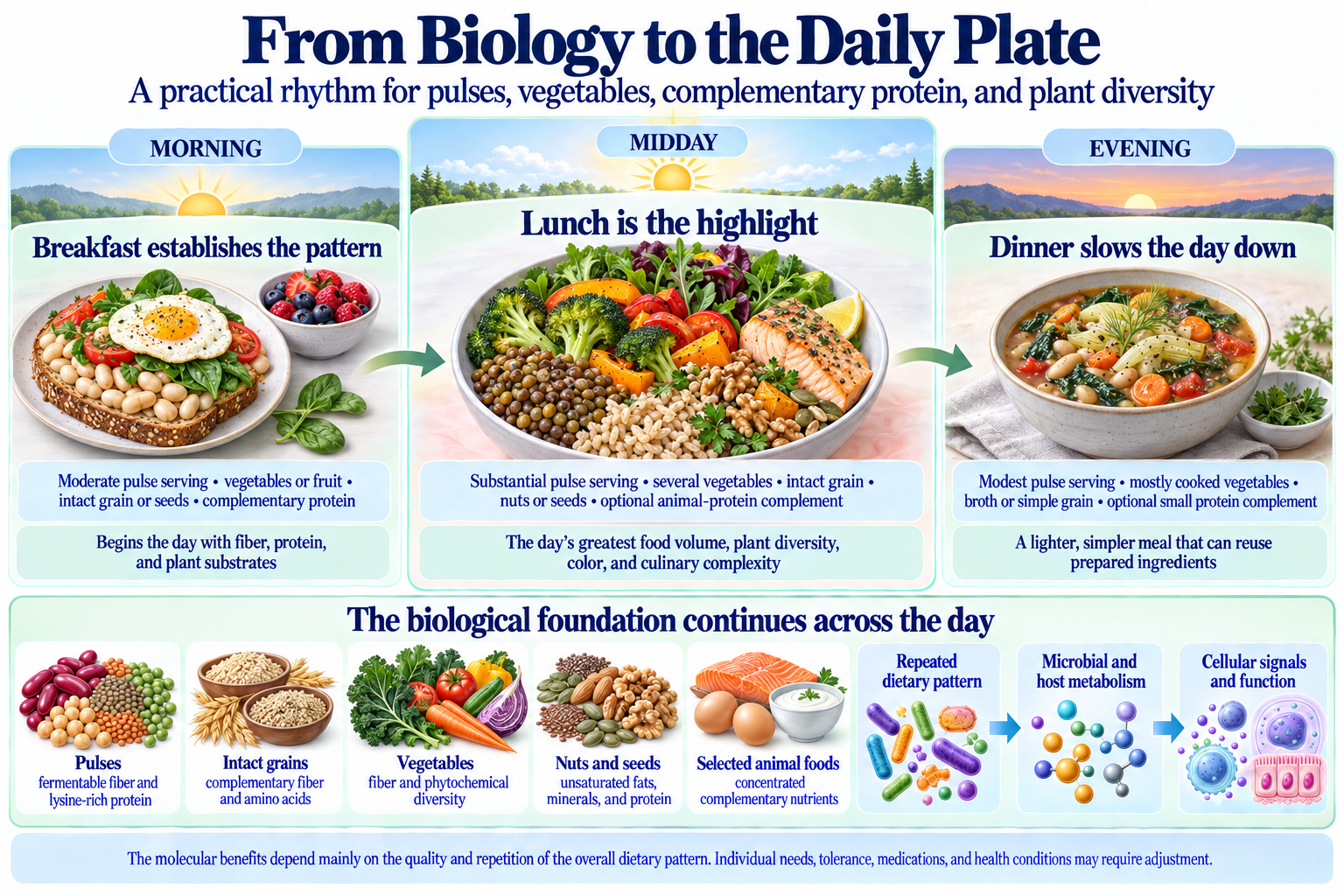
The practical structure is simple: pulses provide the foundation. Vegetables create diversity. Intact grains, nuts, and seeds broaden the nutritional pattern. Selected animal foods provide complementary protein and nutrients.
Begin with pulses
Beans, lentils, chickpeas, and peas form the center of the program because they combine several valuable properties:
- Fermentable fiber and resistant starch
- Plant protein
- Slowly digested carbohydrate
- Folate, potassium, magnesium, and iron
- A food matrix that supports satiety
- Low cost and long storage life
- Adaptability to many culinary traditions
Different pulses provide different amounts and types of fiber, starch, protein, minerals, and phytochemicals. Rotating among them is preferable to relying on a single bean. A practical rotation can include lentils, chickpeas, black beans, pinto beans, white beans, black-eyed peas, and split peas.
The objective is not to eat the greatest possible quantity at one time. The objective is to make pulses a regular and well-tolerated part of the diet.
Add several kinds of vegetables
Vegetables supply much of the program’s biological and culinary diversity. They provide fibers, vitamins, minerals, carotenoids, polyphenols, glucosinolates, and other compounds that complement those found in pulses.
Rather than treating vegetables as a small side dish, the program uses them as major meal components. A strong lunch might contain a leafy green, a cruciferous vegetable, a red or orange vegetable, an onion-family vegetable, and another seasonal vegetable or herb. These categories do not have to appear at every meal. They represent a pattern to achieve across the day and week.
Color offers a useful practical guide. Green, red, orange, yellow, purple, and white vegetables contain overlapping but different phytochemicals. Eating several colors increases the range of compounds presented to the microbiome and human cells.
Variety also improves flavor and texture. A satisfying meal might combine roasted squash, crisp cabbage, tender beans, leafy greens, tomato salsa, herbs, and seeds. Nutritional diversity then becomes part of the pleasure of eating rather than a separate obligation.
Use intact grains strategically
Brown rice, barley, oats, bulgur, farro, corn, and other minimally processed grains contribute additional fibers and resistant starch. They also complement the amino-acid pattern of pulses.
Pulses contain all essential amino acids, but they are commonly lower in the sulfur-containing amino acids methionine and cysteine. Many grains provide proportionally more of these amino acids while being relatively lower in lysine, which pulses supply more abundantly. Combining pulses and grains across the day therefore strengthens the overall essential-amino-acid pattern.
Examples include lentils with brown rice, chickpeas with bulgur, pinto beans with corn, white beans with whole-grain bread, black-eyed peas with barley, and lentils with farro.
These foods do not need to be combined in an exact ratio or eaten in the same mouthful. The body maintains an amino-acid pool and can use complementary proteins consumed across the day.
Grain portions should support the meal without displacing pulses and vegetables. In most highlight lunches, the pulse and vegetables occupy more of the plate than the grain.
Include nuts and seeds in modest portions
Walnuts, pumpkin seeds, chia seeds, flaxseed, sesame, and other nuts and seeds contribute unsaturated fats, protein, fiber, magnesium and other minerals, polyphenols, and additional amino-acid complementation.
Because nuts and seeds are energy-dense, relatively small portions can make a meaningful contribution. A tablespoon of seeds or a small handful of nuts is often enough to enrich a meal without overwhelming it. They may be added to breakfast oats, vegetable bowls, salads, yogurt sauces, or pulse-based spreads.
Use animal protein as a complement
The program can include fish, eggs, yogurt, and modest amounts of poultry. These foods provide concentrated protein and nutrients that may be more difficult to obtain in adequate quantities from a poorly planned plant-only diet. Depending on the food selected, they may contribute vitamin B12, highly bioavailable protein, calcium, iron and zinc, iodine, vitamin D, and long-chain omega-3 fatty acids.
Animal protein does not need to dominate the plate. It can be used in a smaller portion alongside pulses and vegetables. Examples include white beans with tuna and vegetables, lentils with a small portion of fish, chickpeas with yogurt sauce, black beans with an egg, or a vegetable and pulse bowl with a modest amount of chicken.
When lunch includes fish, poultry, or another concentrated animal protein, dinner can usually remain plant-centered. This preserves variety and avoids unnecessary repetition.
Red and processed meats are not required for nutritional completeness. If used, they should be less frequent and should not displace pulses, vegetables, or intact grains.
Use herbs, spices, acidity, and healthy fats
A biologically thoughtful diet must also taste good. Herbs, spices, citrus, vinegar, garlic, onions, and modest amounts of olive oil allow pulse-centered meals to be deeply satisfying.
These ingredients provide more than flavor. Many contain phytochemicals that interact with microbial and human metabolic pathways. Their most immediate value, however, is behavioral: they make health-supporting food enjoyable enough to eat repeatedly.
Flexible flavor systems include lemon, olive oil, garlic, parsley, and dill; lime, cilantro, cumin, tomato, and mild chili; ginger, turmeric, cumin, coriander, and yogurt; vinegar, mustard, herbs, and black pepper; or tomato, fennel, basil, and olive oil.
This flexibility allows the program to preserve its nutritional structure while accommodating different cultures and preferences.
Prepare pulses for tolerance
Fermentation of pulse carbohydrates can initially increase gas, bloating, or abdominal discomfort. This does not necessarily mean that pulses are unsuitable. It may mean that the quantity increased too quickly or that preparation and portion size need adjustment.
A gradual introduction is preferable:
- Begin with a small, comfortable serving.
- Eat that amount regularly for several days.
- Increase the portion gradually.
- Introduce one new pulse at a time when sensitivity is a concern.
- Maintain adequate fluid intake.
- Adjust texture and preparation as needed.
Lentils and canned, thoroughly rinsed beans may be easier for some people to introduce. Pureed beans, thin lentil soups, and smaller portions incorporated into familiar dishes can also help.
Dry beans should be soaked and cooked appropriately for the variety. Red kidney beans require adequate boiling because raw or undercooked kidney beans can contain harmful phytohaemagglutinin activity. A slow cooker should not be assumed to make improperly prepared raw kidney beans safe.
Tolerance is individual. People with irritable bowel syndrome or sensitivity to fermentable carbohydrates may require smaller portions, selected pulse varieties, or professional guidance.
Preserve the structure of the whole food
Processing changes how food reaches the digestive system. Grinding, pureeing, cooling, reheating, and cooking can alter particle size, starch accessibility, resistant starch, texture, and the rate of digestion.
The program therefore uses several forms: intact beans and chickpeas for structure and slower eating; lentils and split peas for easier preparation; pureed pulses for sauces, soups, and gradual introduction; cooled cooked grains or potatoes when appropriate; minimally processed intact grains; and both raw and cooked vegetables.
No preparation method is universally superior. The aim is to combine nutritional quality, safety, tolerance, convenience, and enjoyment.
Make lunch the highlight
Lunch is the program’s most substantial and diverse meal. It is the best opportunity to assemble pulses, intact grains, multiple vegetables, herbs, seeds, and optional animal protein.
A highlight lunch generally contains:
- A substantial pulse serving
- A moderate portion of intact grain or another quality carbohydrate
- Several vegetables
- A leafy green or cruciferous vegetable
- Nuts or seeds
- Herbs, spices, and an acidic element
- Optional complementary animal protein
Lunch should feel abundant rather than restrictive. It can offer the greatest variety of colors, flavors, and textures during the day.
Making lunch the highlight also creates ingredients that can be reused. Extra beans, lentils, grains, and roasted vegetables can become part of a lighter dinner or the next morning’s breakfast.
Let dinner slow the day down
Dinner uses many of the same biological principles but applies them with less volume and complexity.
A slowdown dinner might be a thin lentil and vegetable soup, white beans with fennel and greens, chickpeas with tender cooked vegetables, a mushroom, barley, and bean broth, lentil puree with vegetables and a small portion of fish, or a modest pinto-bean and squash soup.
Cooked vegetables, broth-based preparations, restrained portions, and simpler flavors help distinguish dinner from lunch.
Dinner is not nutritionally unimportant. It is intentionally quieter. It completes the day without repeating the scale of the highlight meal.
Let breakfast establish the pattern
Breakfast introduces protein, fiber, and plant foods without becoming excessively large.
Savory breakfasts make it easier to include pulses and vegetables. Examples include white-bean toast with spinach, tomato, and egg; red lentils with oats and vegetables; a chickpea-flour vegetable pancake; a black-bean and egg tostada; or a chickpea and vegetable scramble.
A sweeter breakfast can still follow the pattern. Oats with seeds, walnuts, berries, and a small amount of blended white bean provide a familiar format with greater fiber and protein.
Breakfast establishes the day. Lunch expands it. Dinner settles it.
Think in days and weeks, not perfect meals
No meal needs to contain every desirable nutrient, fiber type, phytochemical, or amino acid. The program evaluates the combined pattern.
Across a day, the goal is to include at least one substantial pulse-centered meal, additional pulses when tolerated, several vegetables, more than one plant color, an intact grain or another quality carbohydrate, nuts or seeds, an appropriate protein complement, mostly unsaturated fat, and adequate fluid.
Across a week, the goal is to rotate pulse varieties, vegetables, grains, nuts, seeds, preparation methods, and cuisines. This creates repeated exposure without monotony.
The practical EpiNutrition formula
The meal program can be summarized as:
Pulse foundation, vegetable diversity, intact plant structure, complementary protein, enjoyable preparation, and repeated exposure.
That formula translates the molecular science into ordinary food.
The optimizer will personalize the details. It can adjust recipes for nutritional quality, cost, preparation time, food preferences, allergies, tolerance, and available ingredients. The underlying biological pattern remains constant: provide a diverse and recurring supply of food substrates that supports microbial metabolism, cellular nutrition, and favorable molecular signaling.