Chapter 4
Epigenetics: How Cells Interpret Their Environment
We began this series with food.
We discovered that food contains far more than calories and essential nutrients. We then followed some of those components into the microbiome, where microorganisms can transform them and create entirely new compounds.
Now those compounds encounter human biology.
This brings us to an important question:
How can something originating in our diet ultimately influence what happens inside a human cell?
Part of the answer involves epigenetics.
Epigenetics describes biological mechanisms that help regulate how the information contained within our DNA is used without changing the underlying DNA sequence itself. These mechanisms are fundamental to normal human biology. They help cells establish and maintain their identity, adapt to changing conditions, and regulate which parts of the genome are more or less available for use. [1–3]
Epigenetics therefore provides an important bridge between the relatively stable genetic information we inherit and the changing biological environment in which our cells live.
The Same DNA, Very Different Cells
Almost every cell in the human body contains essentially the same DNA.
Yet a colon cell is very different from a liver cell. A muscle cell behaves differently from a neuron. An intestinal epithelial cell performs functions that a skin cell does not.
How can cells containing essentially the same genetic instructions become so different?
The answer is not that each type of cell possesses an entirely different set of genes.
The difference lies largely in how those genes are used.
During development, cells establish patterns that help determine which regions of DNA are readily accessible and which are relatively quiet. These regulatory patterns help maintain cellular identity throughout life.
Epigenetic mechanisms are an important part of that control system.
The genome provides the information.
Epigenetic regulation helps determine how accessible that information is to the cell.
DNA Is Not Simply On or Off
Descriptions of epigenetics sometimes make it sound like genes function as simple switches that are either turned on or turned off.
The reality is much more sophisticated.
Gene activity can vary across a wide range. Different genes can become more active, less active, temporarily active, or remain largely silent. Groups of genes can be coordinated with one another. These patterns can change as cells develop, divide, respond to stress, obtain nutrients, or encounter changes in their surroundings.
Several major regulatory mechanisms contribute to this control.
DNA methylation involves the addition of small chemical groups called methyl groups to DNA. Depending upon where it occurs, methylation can influence the accessibility and activity of genes.
Histone modifications affect proteins around which DNA is packaged. DNA is not floating freely inside the nucleus. It is wrapped around histone proteins and organized into a structure called chromatin. Chemical modifications of histones can influence how tightly or loosely particular regions of DNA are packaged.
Chromatin remodeling can further alter the accessibility of DNA to the cellular machinery that uses genetic information.
Other regulatory systems, including non-coding RNAs, also contribute to the extraordinarily complex process by which cells manage their genomes. [1–4]
These mechanisms do not operate independently. They interact with one another as part of a highly coordinated regulatory system.
The Genome Exists Within a Living Cell
DNA is often described as the blueprint of life.
The analogy is useful, but incomplete.
A blueprint sitting on a table does nothing by itself. It must be read and interpreted within a working system.
DNA is similar.
The genome exists inside a living cell surrounded by enzymes, proteins, nutrients, hormones, metabolic products, and countless other molecules. The cell is continually sensing and responding to this internal and external environment.
Epigenetic regulation participates in that response.
This means that genetic information is not being used in isolation from the conditions surrounding the cell. Cellular state and environmental conditions can influence regulatory mechanisms that help determine how portions of the genome are accessed. [2,3,5]
This is where epigenetics becomes particularly relevant to Food as Information.
Can Food Influence Epigenetics?
This question requires careful wording.
Food does not simply enter the body and turn particular genes on or off.
The path between diet and epigenetic regulation is much more complex.
However, nutrition contributes to the chemical and metabolic environment in which epigenetic machinery operates. Nutrients and other diet-related compounds can influence the availability of molecules used by epigenetic enzymes, while some compounds produced or modified during digestion and microbial metabolism can interact with regulatory pathways associated with epigenetic control. [5–8]
One-carbon metabolism provides a well-established example. Nutrients including folate, methionine, choline, and several B vitamins participate in metabolic pathways that contribute to the availability of methyl groups used in biological methylation reactions. [5,6]
Other compounds provide different examples.
Butyrate, which we introduced in Chapter 3 as a product of microbial fermentation, can interact with enzymes known as histone deacetylases, or HDACs. Polyphenols and compounds derived from certain plant foods are also being studied for their relationships with enzymes and pathways involved in epigenetic regulation. [7–10]
These relationships are complex, dose-dependent, tissue-dependent, and influenced by the biological state of the cell.
That complexity is important.
The scientific message is not:
Eat a particular food and switch a particular gene on or off.
The more accurate message is:
Nutrition can contribute to the cellular environment in which epigenetic regulation occurs.
Epigenetics Is Dynamic
Our DNA sequence is remarkably stable.
Epigenetic regulation is more dynamic.
Some epigenetic patterns are established during development and remain relatively stable. Others can change as cells divide, age, differentiate, or respond to changing biological conditions.
This ability to respond is essential.
A cell must continually adjust to its environment. It must respond to available energy, cellular stress, inflammation, hormones, injury, and many other conditions while preserving its basic identity and function.
Epigenetic regulation is one of the systems that helps make this possible. [1–3]
This does not mean that every environmental exposure produces a lasting epigenetic change. Nor does it mean that every observed epigenetic difference causes disease.
Epigenetics is a regulatory system, not a biological destiny.
But its responsiveness provides an important insight.
The genome may be relatively stable, yet the way cells manage access to that genome can respond to the biological environment around them.
Between Environment and Genome
We can now begin to see why epigenetics occupies such an important place in the Food as Information story.
Food provides potential.
The microbiome can transform some of that potential.
New compounds enter the intestinal environment.
Human cells encounter a changing chemical world.
And inside those cells is a regulatory system capable of responding to biological conditions while helping determine how genetic information is made available.
That system includes epigenetics.
The importance of this idea extends far beyond nutrition. Physical activity, aging, hormones, inflammation, environmental exposures, disease, medications, and many other factors can influence the biological environment in which epigenetic regulation occurs.
Nutrition is one participant in a much larger interconnected system.
That is precisely why epigenetics is so interesting.
It provides one of the places where environment and genetic information can meet.

That realization captures the essential message of epigenetics.
We do not change our DNA every time our environment changes.
Instead, cells possess regulatory systems that help them manage and interpret the genetic information they already contain.
Epigenetics is an important part of that regulation.
And nutrition can contribute to the biological environment in which it occurs.
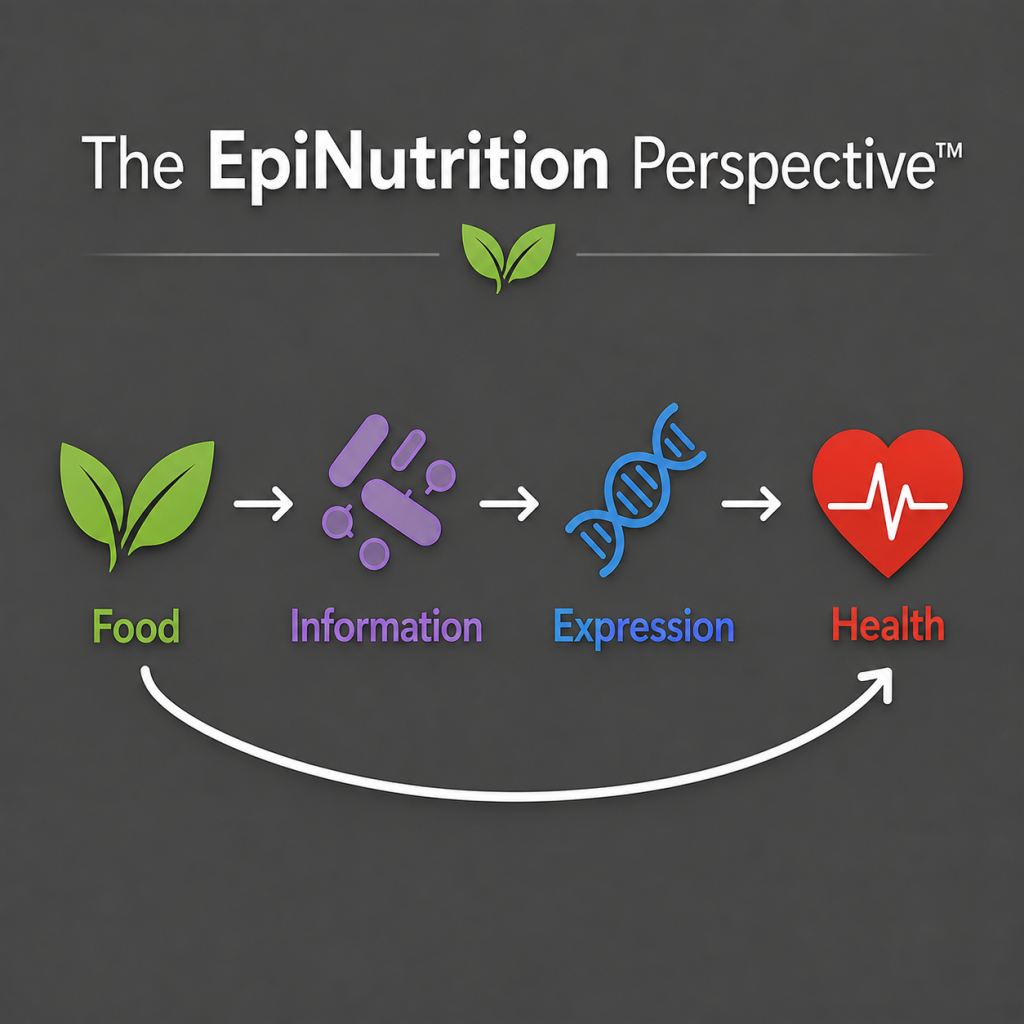
Epigenetics changes the way we think about the relationship between food and genes.
The important idea is not that food controls our genes.
It does not.
The important idea is that our genes operate inside living cells, and those cells exist within a constantly changing biological environment.
Nutrition is one contributor to that environment.
Epigenetic mechanisms help cells regulate access to genetic information as they respond to the conditions around them.
Our DNA provides the information we inherit.
Epigenetics helps regulate how that information is used.
But that raises the next question.
What actually changes when a cell uses its genetic information differently?
Next: Gene Expression — When Genetic Information Becomes Action
A gene becomes biologically meaningful when its information is used.
Cells can increase or decrease the activity of particular genes depending upon their identity, their needs, and the conditions they encounter.
This process is called gene expression.
In Chapter 5, we will explore how information contained within DNA becomes cellular activity—and why changes in gene expression can ultimately influence how cells behave.
Bibliography
- Allis CD, Jenuwein T. The molecular hallmarks of epigenetic control. Nat Rev Genet. 2016;17(8):487–500.
- Cavalli G, Heard E. Advances in epigenetics link genetics to the environment and disease. Nature. 2019;571:489–499.
- Feinberg AP. The key role of epigenetics in human disease prevention and mitigation. N Engl J Med.2018;378(14):1323–1334.
- Klemm SL, Shipony Z, Greenleaf WJ. Chromatin accessibility and the regulatory epigenome. Nat Rev Genet.2019;20:207–220.
- Anderson OS, Sant KE, Dolinoy DC. Nutrition and epigenetics: an interplay of dietary methyl donors, one-carbon metabolism and DNA methylation. J Nutr Biochem. 2012;23(8):853–859.
- Mentch SJ, Locasale JW. One-carbon metabolism and epigenetics: understanding the specificity. Ann N Y Acad Sci.2016;1363(1):91–98.
- Donohoe DR, Collins LB, Wali A, Bigler R, Sun W, Bultman SJ. The Warburg effect dictates the mechanism of butyrate-mediated histone acetylation and cell proliferation. Mol Cell. 2012;48(4):612–626.
- Davie JR. Inhibition of histone deacetylase activity by butyrate. J Nutr. 2003;133(7 Suppl):2485S–2493S.
- Hardy TM, Tollefsbol TO. Epigenetic diet: impact on the epigenome and cancer. Epigenomics. 2011;3(4):503–518.
- Carlos-Reyes Á, López-González JS, Meneses-Flores M, et al. Dietary compounds as epigenetic modulating agents in cancer. Front Genet. 2019;10:79.