Chapter 6
Cellular Metabolism: Where Information Becomes Chemistry
In the previous chapter, we explored gene expression—the process through which cells use genetic information to produce RNA, proteins, enzymes, receptors, and other molecules needed for life.
But producing those molecules is only part of what makes a cell function.
Every cell must also obtain energy. It must acquire raw materials, build new molecules, dismantle old ones, maintain its internal environment, repair damage, and continually adjust its activities to changing conditions.
All of this requires metabolism. Cellular metabolism is the vast network of chemical reactions occurring continuously within living cells. These reactions determine how nutrients are used, how energy is produced, which molecules are built, which are broken down, and how the cell allocates its resources. Metabolism is sometimes described simply as the process of “burning calories.”
It is much more than that.
Metabolism is how a cell manages its resources in order to stay alive and perform its work.
Every Cell Has an Energy Problem
Life requires energy.
A colon cell must maintain its membrane, transport molecules, repair DNA, produce proteins, communicate with neighboring cells, and eventually divide or be replaced. A muscle cell must contract. A liver cell must process and distribute nutrients. An immune cell may suddenly need enormous resources when responding to an infection.
Cells therefore need a continuously available form of usable energy.
Much of that energy is captured in a molecule called adenosine triphosphate, or ATP. ATP can be thought of as a readily usable form of cellular energy. Cells continually produce it and consume it. Rather than maintaining a large reservoir, they constantly replenish the ATP required to perform biological work. [1–3] Producing ATP requires cells to process available fuels.
Glucose can provide energy.
Fatty acids can provide energy.
Amino acids can enter metabolic pathways.
And some cells can use other molecules particularly well.
The important point is that cells are not simply passive recipients of nutrients.
They must decide what to do with them.
Mitochondria: More Than Cellular Power Plants
Much of cellular energy production occurs within specialized structures called mitochondria.
Mitochondria are often described as the power plants of the cell because they use oxygen and energy-rich molecules to generate ATP through oxidative metabolism. The description is useful, but mitochondria do considerably more.
They participate in the processing of carbohydrates, fats, and amino acids. They help regulate cellular redox balance. They contribute to the production of molecules needed for biosynthesis. They participate in cellular stress responses and can help determine whether a severely damaged cell survives or undergoes programmed cell death. [2–4]
Mitochondria therefore occupy a central position in cellular biology.
They help connect what is available to a cell with what that cell is capable of doing.
Different Cells Use Fuel Differently
There is no single metabolic program shared identically by every human cell.
Different tissues have different responsibilities and therefore different metabolic requirements.
A contracting muscle cell may rapidly increase its demand for energy. Liver cells have specialized roles in managing glucose and lipids. Adipose cells store and release energy. Immune cells can substantially reorganize their metabolism when activated.
The cells lining the colon provide an especially interesting example.
Healthy colonocytes can use butyrate, the microbial product we encountered in Chapter 3, as an important energy source. Butyrate produced within the colon can be taken up by colonocytes and oxidized within their mitochondria. [5–7]
This creates a remarkable biological connection.
A component of food reaches the microbiome.
Microorganisms transform it.
A new molecule is produced.
And a human cell can use that molecule as fuel.
We no longer need to think of food and the microbiome as separate from cellular metabolism. They can participate in the same biological system.
Metabolism Is About Choices
When nutrients enter a cell, there is no single predetermined outcome.
A molecule might be used immediately to produce energy. It might become a building block for another molecule. It might be stored. It might participate in maintaining the cell’s chemical balance. Or it might enter a pathway that helps the cell respond to its environment.
Cells continually allocate resources among these competing needs.
When energy is plentiful, a cell may favor growth and synthesis. When energy is limited, it may conserve resources and increase processes involved in maintenance and recycling. During stress or injury, priorities can change again.
Metabolism is therefore dynamic.
The cell continually asks, in biochemical terms:
What is available?
What do I need?
What should I do with it?
Cells Can Sense Their Nutritional Environment
Cells do not make these decisions blindly.
They contain systems capable of sensing the availability of nutrients and energy.
Among the best studied are AMP-activated protein kinase, or AMPK, and mTOR, the mechanistic target of rapamycin.
AMPK becomes particularly important when cellular energy availability is low. It can help shift cellular activity toward generating energy and conserving resources.
mTOR participates in sensing nutrient availability and growth conditions. When conditions are appropriate, it can support protein synthesis, cellular growth, and other resource-intensive activities. [8–10]
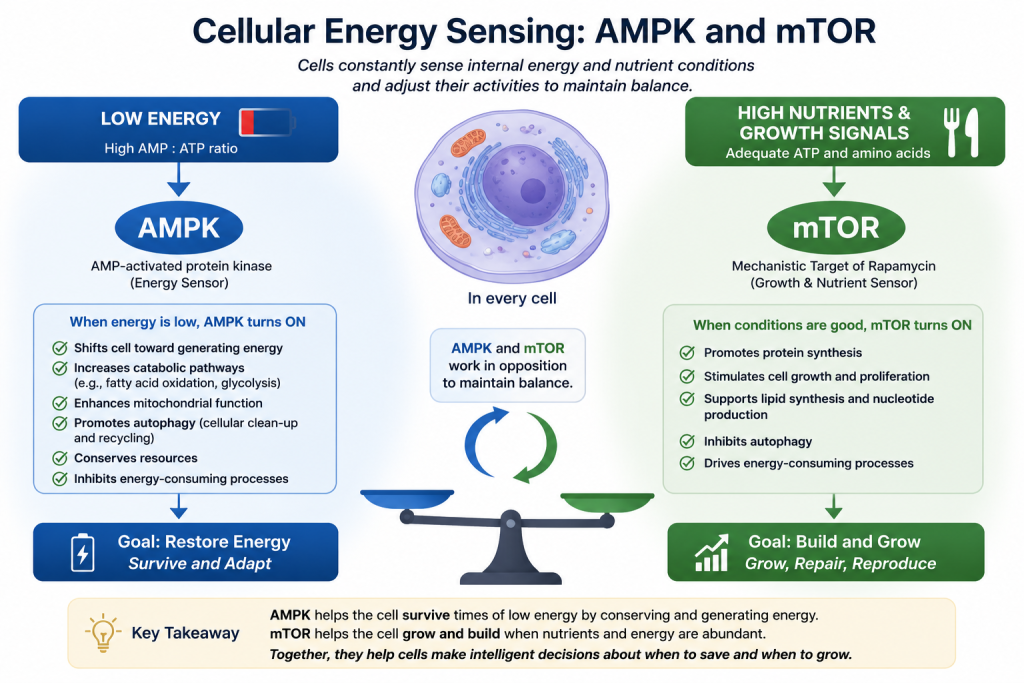
These pathways illustrate an important principle.
Nutrients are not merely materials that cells consume.
Their availability can also become information about the cell’s environment.
A cell can sense whether resources are abundant or limited and adjust its behavior accordingly.
This brings cellular metabolism directly into the Food as Information story.
Metabolism and Gene Expression Communicate
The relationship between metabolism and gene expression also works in both directions.
Genes encode many of the enzymes that carry out metabolism. If expression of those genes changes, the metabolic capabilities of the cell can change. But metabolism can also influence gene regulation.
Metabolic reactions produce molecules required by enzymes involved in DNA and histone modification. The availability of molecules such as acetyl-CoA, S-adenosylmethionine, NAD⁺, and other metabolic intermediates can influence regulatory processes within the cell. [11–13]
This means metabolism and gene regulation are not two separate systems operating independently.
They communicate.
Gene expression helps determine which metabolic machinery the cell possesses.
Metabolism helps determine the chemical environment in which gene regulation occurs.
This creates a biological feedback system rather than a simple one-way pathway.
Metabolic Flexibility
Healthy cells must be able to adapt.
The availability of nutrients changes throughout the day. Energy demands rise and fall. We eat, fast, exercise, sleep, experience stress, and recover.
Cells must function through all of these conditions.
The ability to adjust fuel use and metabolic activity in response to changing circumstances is sometimes described as metabolic flexibility. [14,15]
This flexibility is an important feature of normal physiology.
A cell that can appropriately match its metabolism to its needs is better equipped to maintain energy balance, perform specialized functions, respond to stress, and preserve itself.
Problems can arise when cellular metabolism becomes persistently altered or disconnected from normal regulatory controls.
Cancer provides an important example. Many cancer cells reorganize their metabolism to support rapid growth and proliferation, frequently increasing their dependence on glucose and glycolysis even when oxygen is available. This phenomenon is associated with what is commonly called the Warburg effect. [16,17]
We will explore that biology elsewhere in greater depth.
For now, it illustrates a broader principle:
How a cell uses energy is closely connected to how that cell behaves.
Food Has Reached the Cell
We can now look back at the journey we have followed.
We began with food containing an extraordinary diversity of potential components. Some encountered the microbiome. Microorganisms transformed them. New compounds emerged. Human cells encountered this changing chemical environment.
Epigenetic mechanisms helped regulate access to genetic information. Gene expression allowed cells to use that information.
And now cellular metabolism determines how energy and materials are actually handled inside the cell.
At this point, Food as Information has become something tangible.
It has become cellular activity.
The distinction is important.
Food has not issued a command. The microbiome has not determined an outcome. A metabolite has not dictated cellular behavior.
Instead, each has contributed to a biological environment that the cell must sense, interpret, and respond to.
That is how living systems work.
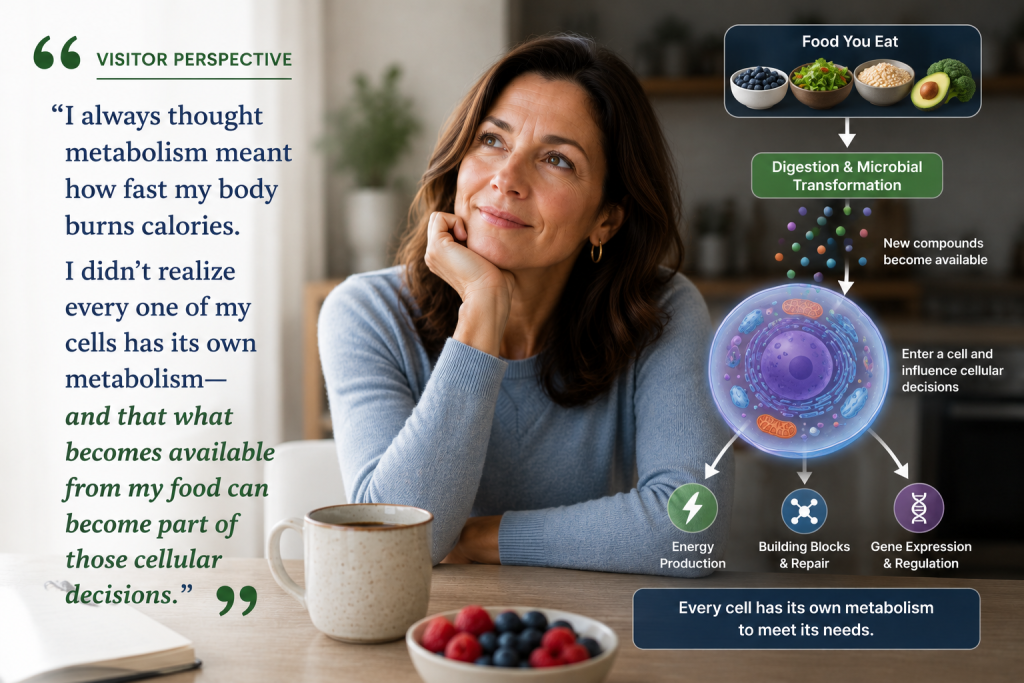
That observation captures the central discovery of this chapter.
Metabolism is not simply something that determines body weight.
It is happening inside every living cell, every moment of our lives.
Cells continually decide how to produce energy, what to build, what to conserve, and how to respond to changing conditions.
Nutrition participates in that dynamic environment.
But it does not act alone.
Our genes, microbiome, hormones, physical activity, oxygen availability, cellular state, and many other factors participate as well.
Cellular metabolism is where many of these influences converge.
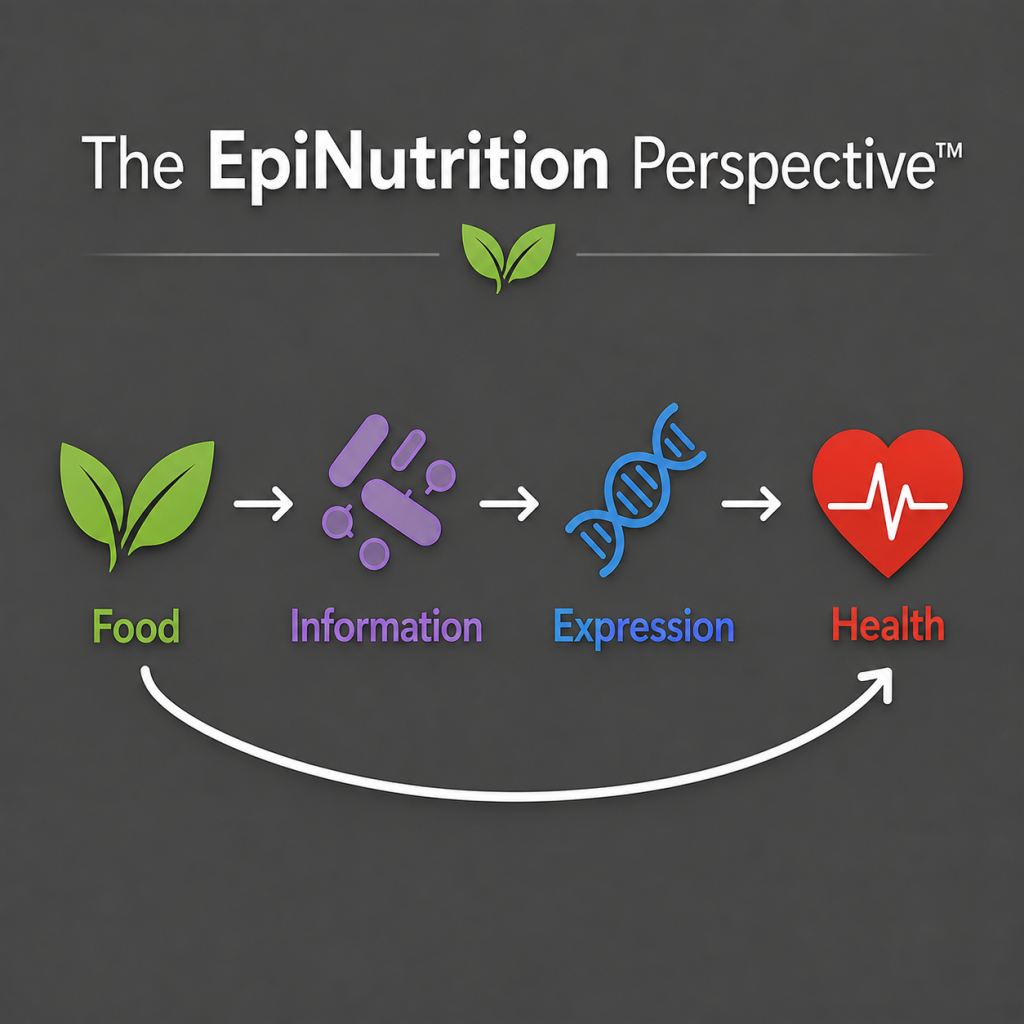
Food begins as potential.
Biology progressively transforms that potential.
By the time food-derived materials reach human cells, they have entered an extraordinarily complex system capable of sensing resources, producing energy, constructing molecules, regulating genes, and adapting to changing conditions.
Cellular metabolism is at the center of that activity.
It is not simply the burning of calories.
It is the chemistry through which a cell stays alive and performs its work.
And when millions of cells perform their work together, something larger emerges.
Cells become tissues.
Tissues form organs.
And cellular function becomes human physiology.
Next: Tissue & Organ Health — When Cellular Biology Becomes Human Biology
A healthy colon cannot exist without healthy colon cells.
A healthy muscle cannot exist without functioning muscle cells.
A healthy liver depends upon the coordinated activity of liver cells and the many other cell types that support them.
The effects of cellular biology therefore do not end at the cell membrane.
In the next chapter, we will explore how the activity of individual cells becomes the function of tissues and organs—and how the Food as Information story begins to become relevant to health.
Bibliography
- DeBerardinis RJ, Thompson CB. Cellular metabolism and disease: what do metabolic outliers teach us? Cell.2012;148(6):1132–1144.
- Spinelli JB, Haigis MC. The multifaceted contributions of mitochondria to cellular metabolism. Nat Cell Biol.2018;20:745–754.
- Martínez-Reyes I, Chandel NS. Mitochondrial TCA cycle metabolites control physiology and disease. Nat Commun. 2020;11:102.
- Nunnari J, Suomalainen A. Mitochondria: in sickness and in health. Cell. 2012;148(6):1145–1159.
- Donohoe DR, Garge N, Zhang X, et al. The microbiome and butyrate regulate energy metabolism and autophagy in the mammalian colon. Cell Metab. 2011;13(5):517–526.
- Roediger WEW. Role of anaerobic bacteria in the metabolic welfare of the colonic mucosa in man. Gut.1980;21(9):793–798.
- Donohoe DR, Collins LB, Wali A, Bigler R, Sun W, Bultman SJ. The Warburg effect dictates the mechanism of butyrate-mediated histone acetylation and cell proliferation. Mol Cell. 2012;48(4):612–626.
- Hardie DG, Ross FA, Hawley SA. AMPK: a nutrient and energy sensor that maintains energy homeostasis. Nat Rev Mol Cell Biol. 2012;13:251–262.
- Saxton RA, Sabatini DM. mTOR signaling in growth, metabolism, and disease. Cell. 2017;168(6):960–976.
- Efeyan A, Comb WC, Sabatini DM. Nutrient-sensing mechanisms and pathways. Nature. 2015;517:302–310.
- Kaelin WG Jr, McKnight SL. Influence of metabolism on epigenetics and disease. Cell. 2013;153(1):56–69.
- Reid MA, Dai Z, Locasale JW. The impact of cellular metabolism on chromatin dynamics and epigenetics. Nat Cell Biol. 2017;19:1298–1306.
- Etchegaray JP, Mostoslavsky R. Interplay between metabolism and epigenetics: a nuclear adaptation to environmental changes. Mol Cell. 2016;62(5):695–711.
- Goodpaster BH, Sparks LM. Metabolic flexibility in health and disease. Cell Metab. 2017;25(5):1027–1036.
- Smith RL, Soeters MR, Wüst RCI, Houtkooper RH. Metabolic flexibility as an adaptation to energy resources and requirements in health and disease. Endocr Rev. 2018;39(4):489–517.
- Vander Heiden MG, Cantley LC, Thompson CB. Understanding the Warburg effect: the metabolic requirements of cell proliferation. Science. 2009;324(5930):1029–1033.
- Liberti MV, Locasale JW. The Warburg effect: how does it benefit cancer cells? Trends Biochem Sci.2016;41(3):211–218.